
Solid all-round for its segment
The NEXUS PS-MNB156(HCBF) series combines half-cut N-type cells with bifacial technology, allowing the module to capture irradiance from both the front and rear sides and boosting energy yield by a meaningful margin without increasing the installation's footprint. The 16 busbar layout improves current collection and reduces losses from partial shading, translating into more stable performance under real-world conditions rather than lab settings alone. The panel is built for installers and investors who expect low LCOE over the long haul, backed by a 30-year linear power warranty with minimal annual degradation and strong resistance to PID effects achieved through carefully selected materials and controlled manufacturing processes. Its reinforced construction withstands high mechanical loads on both the front and rear surfaces, making it suitable for industrial and commercial rooftops as well as large-scale solar power plants and off-grid systems. This is a solution for those seeking high reliability, predictable performance over time, and a genuine energy advantage from bifacial light capture, not just declared nominal power.
Ranking
Signals from the data
Commercial, utility-scale, shaded-installations and off-grid.
Combining N-type half-cut cells with bifacial light capture delivers a declared efficiency of up to 23.26% and additional rear-side energy yield of up to double-digit percentages, without increasing installation footprint.
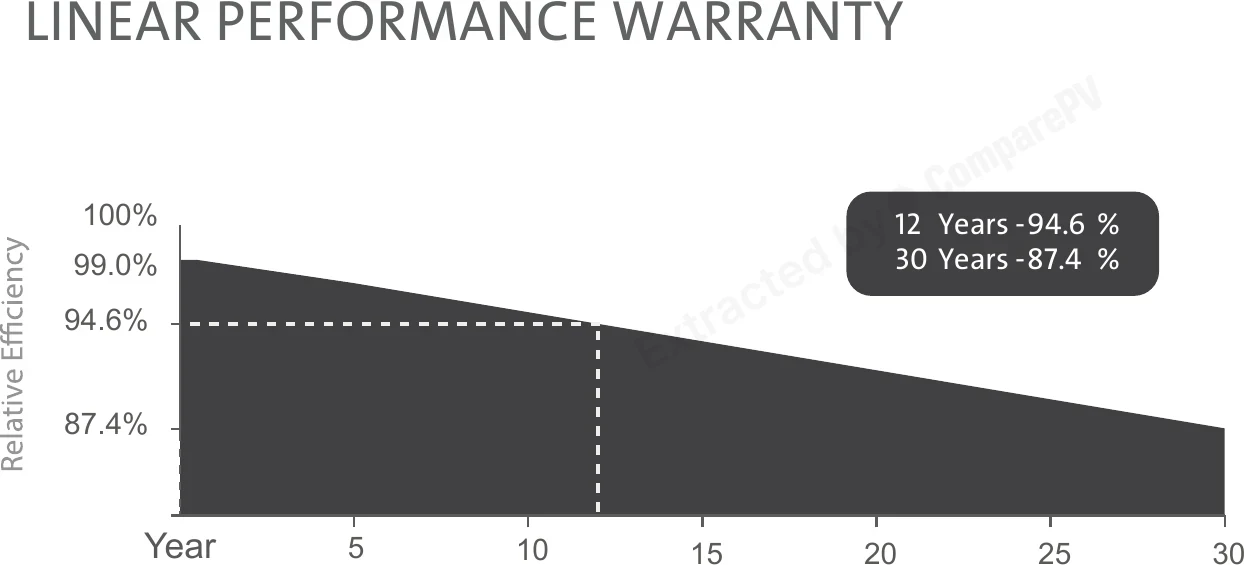
The manufacturer guarantees minimal annual power degradation over a 30-year horizon, a premium-segment standard for N-type modules matching offerings from BYD AURO N and Jinko Tiger Neo.
The increased busbar count (16BB) improves current collection from each cell and reduces losses under partial shading, resulting in more stable real-world performance beyond STC test conditions.
The 650 Wp variant matches top-tier competitor modules (BYD AURO N NLBK-39, Astronergy ASTRO N5), reducing module count and BoS costs in large commercial installations and utility-scale solar farms.
Philadelphia Solar has operated since 2007 and appears on BNEF Tier 1 lists, confirming project bankability and reducing financing risk for installations using this series.
Maximum efficiency of 23.26% is lower than Jinko Solar Tiger Neo (24.06%) and Astronergy ASTRO N5 (23.3%) at the same 650 Wp power class, meaning a slightly larger array footprint is needed for equivalent installed capacity.
The standard product defect warranty is 12 years, while some Tier-1 N-type competitors are moving to 15-year product warranties, which may matter in negotiations for large commercial projects.
- At 22.6% efficiency, this panel is on par with typical N-type 600-650W modules
- Power density of 225.5 W/m² matches the N-type 600-650W median
- At -0.29%/°C, hot weather performance is typical for N-type 600-650W panels
- 80% bifaciality enables rear-side power generation, boosting yield by 4-12% on reflective surfaces
- In the top 28% for efficiency among all N-type panels
Specifications
Datasheet charts
Measured curves published by Philadelphia Solar in this model's datasheet. A chart carrying a wattage was measured on that variant alone - only the ones that describe 630 Wp appear here. The rest cover the whole series.
Simulations
Degradation from this panel's own datasheet figures. No inverter, soiling or shading losses.
Model: bifaciality × albedo × 0.6 view factor. A first-order estimate, not a yield simulation.



Found 616 panels of the same or similar size to this one, within ±10 mm. See them here Found 616 panels of the same or similar size to this one, within ±25 mm. See them here Found 616 panels of the same or similar size to this one, within ±50 mm. See them here Found 1813 panels of the same or similar size to this one, within ±100 mm. See them here