Middle of its segment, needs the roof space
The DAS-DH156NA series are advanced bifacial modules that set efficiency standards through the use of N-type cells in TOPCon technology. This solution effectively eliminates light-induced degradation, guaranteeing investors stable energy production for decades. The bifacial double-glass design allows for the efficient use of reflected radiation, which, combined with high cell efficiency, drastically increases the total energy yield, especially on ground-mounted farms and light-colored roofs. These models are characterized by an exceptionally low temperature coefficient, allowing them to maintain high efficiency even in full sun and at high ambient temperatures. The robust double-glass construction provides enhanced mechanical resistance to harsh weather conditions, protecting the installation from micro-cracks and chemical corrosion. The DAS-DH156NA series is primarily dedicated to large commercial projects and photovoltaic farms, where achieving the lowest LCOE is crucial. It stands out from the competition with its excellent low-light performance and significantly slower power degradation over time, making it one of the most predictable and safe components for modern energy in Poland.
Ranking
Signals from the data
Utility-scale, commercial and hot-climate.
Roofs where every square metre has to count, weight-limited structures and hot climates.
Bottom 18% of the TOPCon 600-650 W segment, against a median of 227.7.
Bottom 18% of the TOPCon 600-650 W segment, against a median of 53.1.
Bottom 19% of the TOPCon 600-650 W segment, against a median of -0.290.
TOPCon technology delivers a temperature coefficient of -0.30%/°C, outperforming standard PERC cells (-0.35 to -0.38%/°C). Under typical Central European summer conditions (Tmod ~65°C), this translates to approximately 1.5–2% higher energy yield compared to a PERC-based system of identical rated power.
The dual-glass 2+2 mm laminate with an 80% bifacial ratio enables an additional 5–30% energy yield from ground-reflected irradiance (albedo), depending on surface type. The glass-glass structure effectively eliminates microcracks and PID corrosion risk compared to conventional backsheet modules, extending the mechanical service life of the installation.
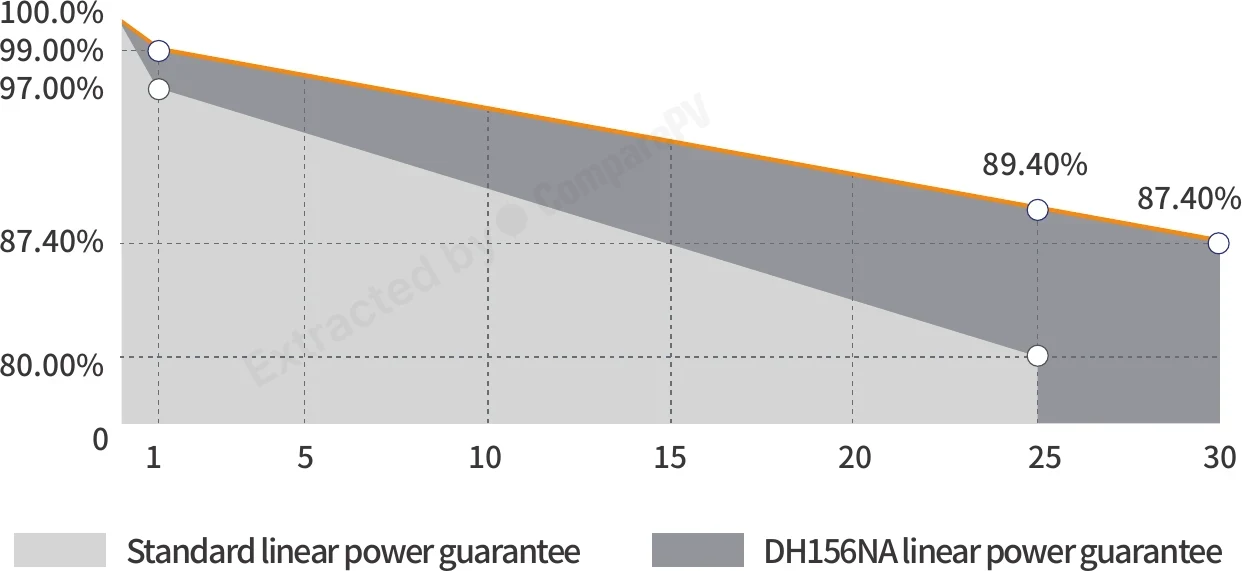
The manufacturer provides a 30-year linear power warranty, which reduces project risk in typical discounted cash flow models for non-recourse financing. While most peer comparables in this power class (610–635 Wp) offer equivalent 30-year warranty terms, DAS Solar backs its commitment with four consecutive quarters of BNEF Tier 1 status (Q1–Q4 2025).
DAS Solar has maintained BNEF Tier 1 standing for four consecutive quarters in 2025, confirming the bankability required for utility-scale PV project financing. Independently, Kiwa PVEL awarded DAS Solar Top Performer status in the 2024 PV Module Reliability Scorecard, providing objective third-party verification of module reliability beyond manufacturer claims.
The 610–635 Wp power range in a 156-cell format (2,465×1,134 mm) reduces the module count required to reach a given system capacity, lowering BoS costs (cabling, racking, and labor) and, in turn, LCOE. The series is directly competitive on output with the Longi Hi-MO X10 Explorer (max. 635 Wp) and the Jinko Tiger Neo 66HL4M (max. 635 Wp).
The series peaks at 22.7% module efficiency, while direct peer comparables — the Longi Hi-MO X10 Explorer LR7-72HVD and the Jinko Tiger Neo 66HL4M — reach 23.5% and 23.51%, respectively. The ~0.8 percentage-point gap means approximately 3.5% more modules or a proportionally larger roof or ground area are required for the same installed capacity, a meaningful constraint on space-limited projects.
DAS Solar was founded in 2018, giving it roughly 7 years of market presence compared to 25 years for Longi (est. 2000) and 19 years for Jinko (est. 2006). The absence of long-term field degradation data predating 2018 makes independent verification of stated annual degradation rates difficult, which may represent a risk factor when modeling 30-year project cash flows.
- Efficiency of 22.4% matches the TOPCon 600-650W median
- At 223.6 W/m², this panel generates 4.1 W/m² less per unit area than TOPCon 600-650W median (227.7 W/m²)
- Temperature coefficient of -0.30%/°C matches the TOPCon 600-650W median
- At 34.3 kg (1.6 kg above TOPCon 600-650W median of 32.7 kg), requires checking roof load capacity
- 80% bifaciality enables rear-side power generation, boosting yield by 4-12% on reflective surfaces
Specifications
Datasheet charts
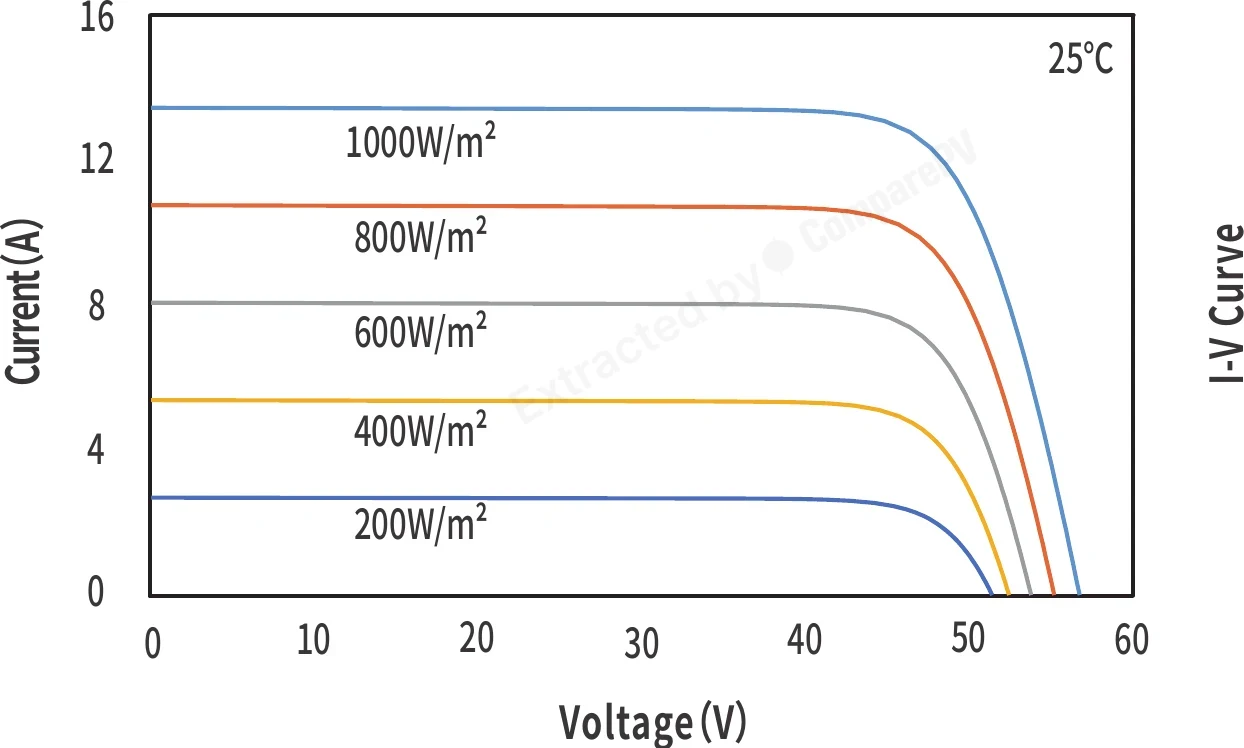
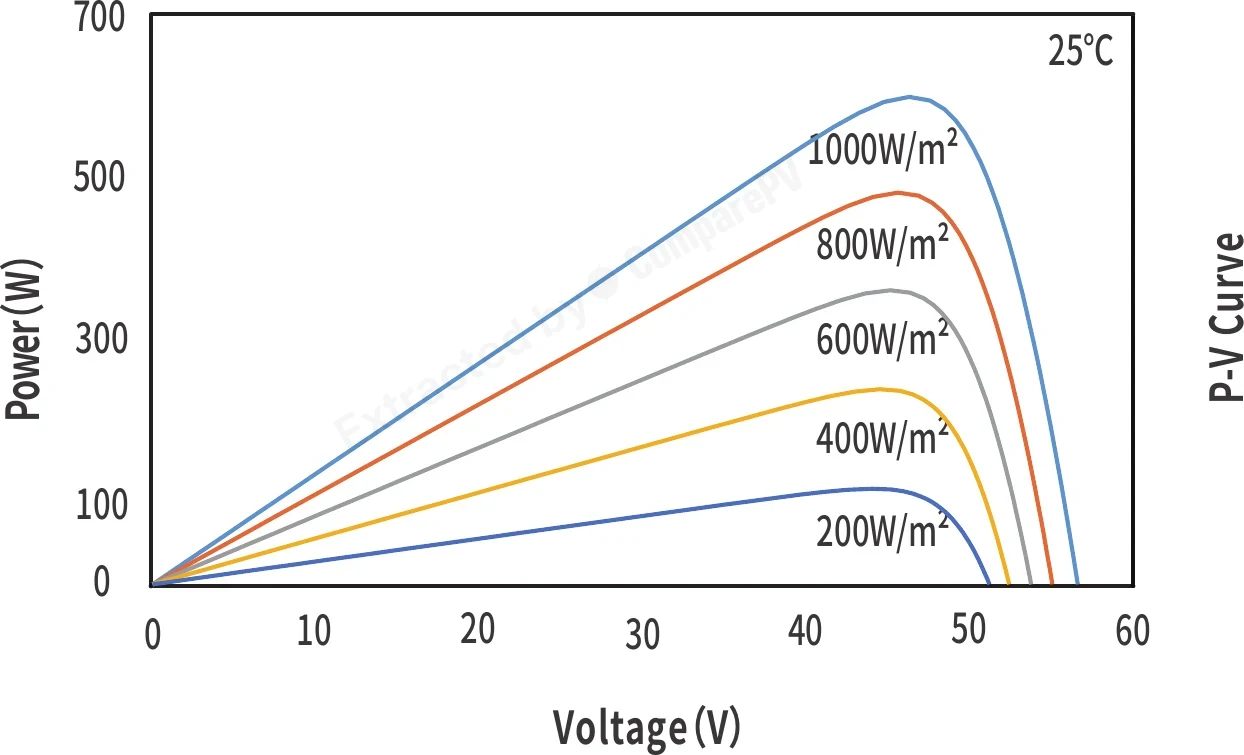
Measured curves published by DAS Solar in this model's datasheet. A chart carrying a wattage was measured on that variant alone - only the ones that describe 625 Wp appear here. The rest cover the whole series.
Simulations
Degradation from this panel's own datasheet figures. No inverter, soiling or shading losses.
Model: bifaciality × albedo × 0.6 view factor. A first-order estimate, not a yield simulation.




Found 616 panels of the same or similar size to this one, within ±10 mm. See them here Found 616 panels of the same or similar size to this one, within ±25 mm. See them here Found 616 panels of the same or similar size to this one, within ±50 mm. See them here Found 1813 panels of the same or similar size to this one, within ±100 mm. See them here