DAS Solar DAS-DH156NA-630W

DAS-DH156NA-630W

630 Wp TOPCon Bifacial 80%
ComparePV verdict

Middle of its segment, weak in heat

Rank 2,208 of 14,005
Compare panels Datasheet PDF
Power (Wp)
630
Typical for its class
Efficiency (%)
22.50
Typical · median 22.80%
Density (Wp/m²)
225.4
Typical · median 227.7
Temp (%/°C)
-0.300
Weak · bottom 19%
Weight (kg)
34.3
Weak · 1.6 kg above median
Warranty (yrs)
30
Typical · median 30 yrs

The DAS Solar DAS-DH156NA series are bifacial glass-glass modules designed for maximum yield in locations where every square meter counts and stable performance in variable conditions. Thanks to double-sided generation, the panels effectively utilize reflected light from the ground, helping to genuinely increase energy production in ground-mounted installations, on light-coloured roofs, and in systems with appropriately designed support structures. The use of N-type cells supports high efficiency and better predictability in the long term, while the glass-glass construction improves resistance to environmental factors. A key feature of this series is its symmetrical structure, which minimizes the risk of micro-cracks and所谓的 hidden damage occurring during transport and installation. The modules also offer better performance under low-light conditions, which is significant given Polish weather conditions - overcast skies, fog, and transitional periods. This is a proposition for investors and contractors who prioritize reliability, predictable yields, and long-term project profitability.

Ranking

1,086 panels in the segment TOPCon 600-650 W
Metric This panel Median Position in segment Overall rank
Module efficiency 22.50% 22.80% Typical 4,222
Power density 225.4 227.7 Typical 3,907
Temperature coefficient -0.300 -0.290 Weak · bottom 19% 6,093
Weight per kWp 54.4 53.1 Weak · bottom 24% 8,755
Performance warranty 30 yrs 30 yrs Typical 21
Colour key Strong - top 25% Typical - middle 50% Weak - bottom 25%

Signals from the data

5 positive · 4 caution
Best for

Commercial and utility-scale.

Not ideal for

Hot climates and weight-limited structures.

Watch-outs
-0.300 %/°C temperature coefficient

Bottom 19% of the TOPCon 600-650 W segment, against a median of -0.290.

54.4 kg per kWp

Bottom 24% of the TOPCon 600-650 W segment, against a median of 53.1.

What owners get
Up to 23.3% efficiency – on par with top-tier competitors

The series' peak efficiency of 23.3% matches the Astronergy ASTRO N5 and marginally exceeds the BYD AURO N NLBK-39 (23.25%). This places the series firmly among the leaders in the bifacial TOPCon 650 W segment, although the lower bound of 22.4% indicates a notable spread across module variants.

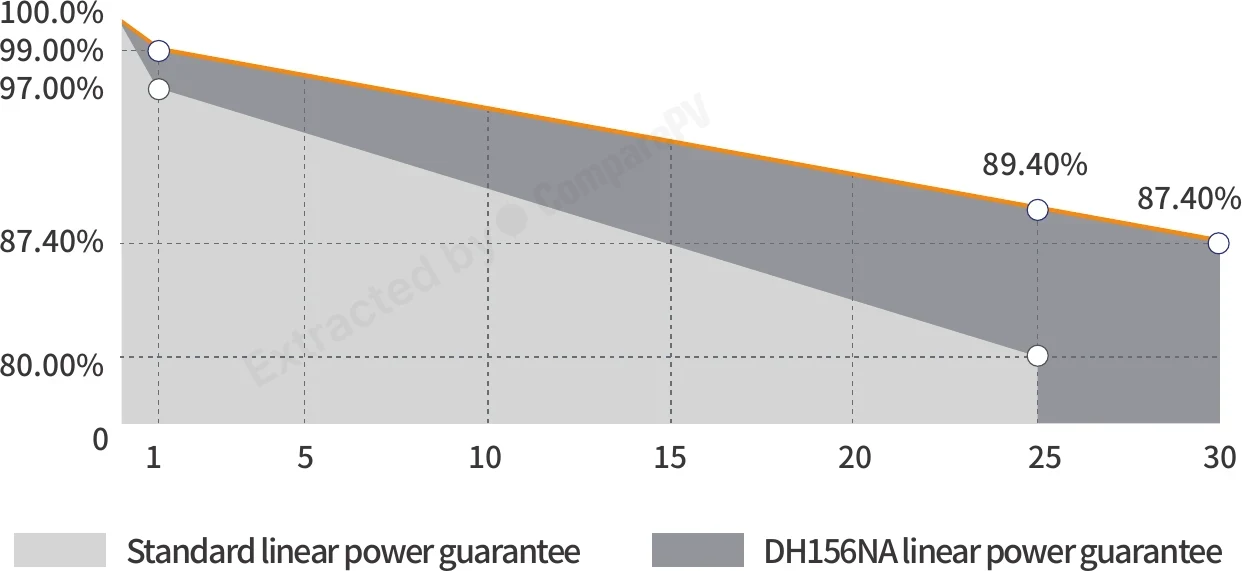
Low linear degradation – 0.40%/year

Following the first-year step (-1.00%), the module loses only 0.40% of rated power annually. Under a 30-year linear power warranty, this guarantees retention of at least ~87% of nominal output over the full service life — a result comparable to the best N-type models in the segment and better than a typical PERC warranty (25 years, 0.55%/year degradation).

~80% bifaciality and durable glass-glass construction

According to manufacturer documentation, the bifaciality factor reaches 80%, which — with adequate ground albedo (light-colored roofing, gravel, or snow) — can translate into an additional 10–25% energy yield over a monofacial module. The 2+2 mm dual-glass structure eliminates the backsheet as a long-term risk factor for UV degradation and moisture ingress.

BNEF Tier 1 status and #2 TOPCon manufacturer globally

DAS Solar appears on the BNEF Tier 1 bankable manufacturer list and reports over 28 GW of cumulative shipments and 30 GW of annual production capacity. Its #2 global ranking in the TOPCon segment (per PV Tech, 2023) reflects a manufacturing scale that materially reduces operational risk for project financiers.

Favorable temperature coefficient of -0.30%/°C

The Pmax temperature coefficient of -0.30%/°C outperforms typical PERC modules (-0.37 to -0.40%/°C) by approximately 0.08–0.10 percentage points. In the Polish climate — where module temperatures frequently exceed 60°C during summer — this meaningfully reduces thermal losses and improves the annual energy balance.

Trade-offs
Lower efficiency than the Jinko Tiger Neo 66HL4M-BDX

The top peer in this comparison, the Jinko Solar Tiger Neo 66HL4M-BDX, achieves an efficiency of 24.06% — 0.76 percentage points above the DAS-DH156NA's maximum of 23.3%. For area-constrained installations such as industrial rooftops, this translates into a meaningfully higher power yield per m² for an equivalent roof footprint.

Short market track record (founded 2018)

DAS Solar has been operating for only 8 years, compared to Jinko Solar (~2006) or BYD (~2008). Its bankability rating of BB (PV ModuleTech Q4 2023) — as opposed to the AA/AAA ratings of leading brands — may present an obstacle when securing project financing from conservative lending institutions.

Notes from the database
  • Efficiency of 22.5% matches the TOPCon 600-650W median
  • Power density of 225.4 W/m² matches the TOPCon 600-650W median
  • Temperature coefficient of -0.30%/°C matches the TOPCon 600-650W median
  • At 34.3 kg (1.6 kg above TOPCon 600-650W median of 32.7 kg), requires checking roof load capacity
  • 80% bifaciality enables rear-side power generation, boosting yield by 4-12% on reflective surfaces

Specifications

Open datasheet PDF
Nominal power (Pmax) 630 Wp Nameplate at 1000 W/m², 25 °C
Module efficiency 22.50 % Typical Segment median 22.80%
Vmpp · Impp 46.26 V · 13.62 A Operating point at max power
Voc · Isc 55.88 V · 14.35 A Sizes the string length
Max system voltage 1500 V Longer strings than 1000 V modules
Dimensions 2465×1134×30 mm · 2.80 m² of roof
Weight 34.3 kg Weak Weak · 1.6 kg above median
Bifaciality 80 % Rear output as a share of front
Coefficient Pmax -0.300 %/°C Weak bottom 19% of its segment
Coefficient Voc · Isc -0.250 · 0.045 %/°C
NOCT 42 °C At 800 W/m², 20 °C ambient
Product warranty 15 years Hardware defects only
Performance warranty 30 years Typical median 30 yrs · median 30 yrs
End-of-warranty output 87.4 % Equals 551 W guaranteed
Degradation 1.00 → 0.40 % First year, then annual

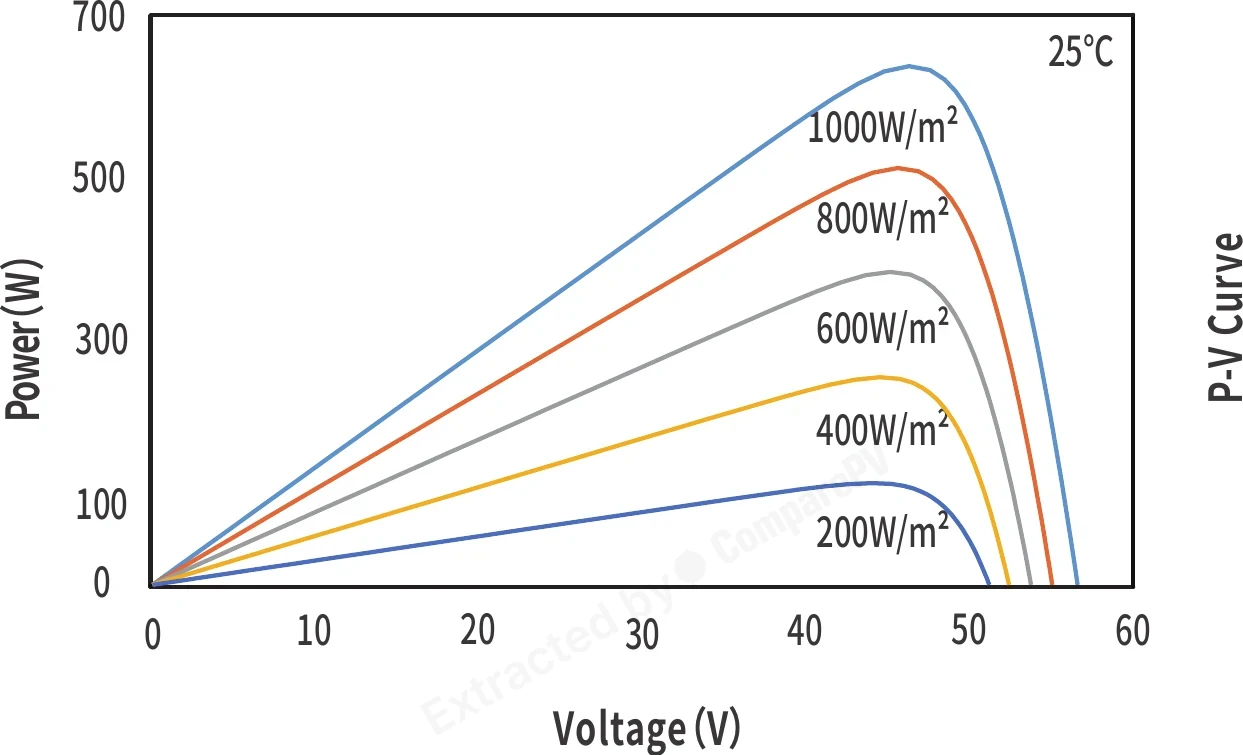
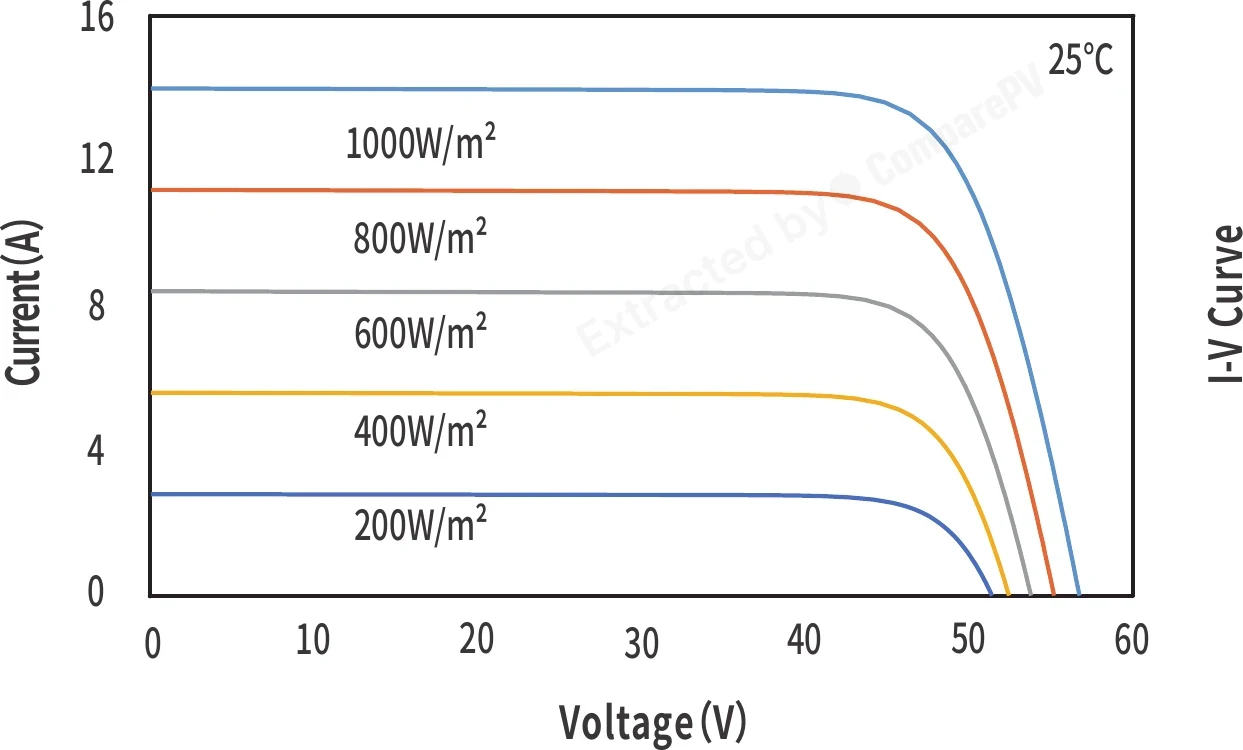
Datasheet charts

Open datasheet PDF

Measured curves published by DAS Solar in this model's datasheet. A chart carrying a wattage was measured on that variant alone - only the ones that describe 630 Wp appear here. The rest cover the whole series.
Simulations

Live - change any input
Lifetime output & value
30 years at 1200 kWh/kWp/year and €0.50 per kWh
Power in year 30
-
Lifetime energy
-
Energy value
-
With bifacial gain
-

Degradation from this panel's own datasheet figures. No inverter, soiling or shading losses.

Heat losses
-0.300 %/°C against a segment median of -0.290
-
Bifacial gain
Rear gain over light concrete: -
-

Model: bifaciality × albedo × 0.6 view factor. A first-order estimate, not a yield simulation.

Filter these
Size
Panel Power Eff. Temp. Weight Difference
DAS Solar DAS-DH156NA-630W 630 W 22.50% -0.300 34.3 kg You are here
AIKO-A650-MAE72Mw 650 W 25.20% -0.260 27.0 kg Cooler, lighter, +2.7 pp
AIKO-A680-MDE72Mw 680 W 25.20% -0.260 29.0 kg +50 W, lighter, +2.7 pp
AIKO-A675-MDE72Mw 675 W 25.00% -0.260 29.0 kg +45 W, lighter, +2.5 pp
AIKO-A645-MAE72Mw 645 W 25.00% -0.260 27.0 kg Cooler, lighter, +2.5 pp
AIKO-G670-MCH72Mw 670 W 24.80% -0.260 28.2 kg +40 W, lighter, +2.3 pp
LR7-72HVHF-670M 670 W 24.80% -0.260 28.5 kg +40 W, lighter, +2.3 pp
AIKO-A640-MAE72Mw 640 W 24.80% -0.260 27.0 kg Cooler, lighter, +2.3 pp
DAS-DH156NA-610 610 W 21.80% -0.300 34.3 kg -20 W, -0.7 pp
DAS-DH156NA-615 615 W 22.00% -0.300 34.3 kg -15 W, -0.5 pp
DAS-DH156NA-620 620 W 22.20% -0.300 34.3 kg -10 W, -0.3 pp
DAS-DH156NA-625W 625 W 22.40% -0.300 34.3 kg Very close match
DAS-DH156NA-635W 635 W 22.70% -0.300 34.3 kg Very close match
DAS-DH156NA-640W 640 W 22.90% -0.300 34.3 kg +10 W, +0.4 pp
AIKO-A700-MAE78Dw 700 W 25.00% -0.260 34.5 kg +70 W, cooler, +2.5 pp
AIKO-A695-MAE78Dw 695 W 24.90% -0.260 34.5 kg +65 W, cooler, +2.4 pp
JKM650-670N-66QL6-BDV (670W class) 670 W 24.80% -0.260 32.5 kg +40 W, cooler, +2.3 pp

Found 616 panels of the same or similar size to this one, within ±10 mm. See them here Found 616 panels of the same or similar size to this one, within ±25 mm. See them here Found 616 panels of the same or similar size to this one, within ±50 mm. See them here Found 1813 panels of the same or similar size to this one, within ±100 mm. See them here

Common questions

6 answered
What warranty coverage applies to DAS Solar DAS-DH156NA panels?
The DAS-DH156NA series comes with a 15-year product warranty covering materials and workmanship, along with a 30-year linear power output warranty. Degradation is capped at 1% in the first year and 0.4% per year thereafter. After 30 years, the module is warranted to retain more than 87.4% of its nominal power output. This is one of the longest power warranties available on the market, backed by the manufacturer's Tier 1 status as rated by Bloomberg NEF.
What are the benefits of bifaciality in the DAS-DH156NA series, and when does it pay off?
The bifacial TOPCon cells harvest light from both the front side and light reflected from the ground surface, boosting energy yield without increasing the footprint of the installation. The bifaciality factor of the DAS-DH156NA series reaches approximately 80%. The gain is most pronounced on high-albedo surfaces such as gravel, concrete, or snow, and in ground-mounted systems with sufficient clearance beneath the modules. On dark rooftops with little to no reflectivity the benefit is reduced, though diffuse rear-side irradiance still contributes to additional yield.
Will the DAS-DH156NA panels perform well in the Polish climate — under overcast skies and in winter?
Yes. N-type TOPCon technology delivers superior low-irradiance performance compared to older PERC cells, which is particularly relevant in Poland where a significant portion of annual operating hours involve cloud cover or fog. The modules are rated for an operating temperature range of -40°C to +85°C, and the power temperature coefficient is -0.30%/°C — lower than that of typical P-type modules, which translates to smaller output losses on hot summer days.
How much does the DAS-DH156NA module weigh, and is it difficult to install?
The module weighs approximately 35 kg and measures 2465 × 1134 × 35 mm. This form factor is typical for large-format modules used in utility-scale ground-mounted systems, and at least a two-person installation crew should be planned for. The glass-glass construction with a symmetric frame reduces the risk of microcracks during transport and installation. A mounting system compatible with the 35 mm module thickness is required.
How does TOPCon technology in the DAS-DH156NA differ from older PERC cells?
TOPCon (Tunnel Oxide Passivated Contact) is an N-type cell architecture featuring an additional passivation layer on the rear surface that suppresses charge carrier recombination. In practice, this results in higher module efficiency (up to 23.3% for the DAS-DH156NA series), a lower temperature coefficient, slower long-term degradation, and better performance under diffuse and low-light conditions. Older PERC cells are based on P-type technology and trail TOPCon across all of these key performance parameters.
Is DAS Solar a reliable manufacturer, and is the DAS-DH156NA series still available?
DAS Solar appears on the Bloomberg New Energy Finance Tier 1 list, which confirms the company's financial stability and manufacturing scale. The DAS-DH156NA series is currently active and available for purchase. The manufacturer has passed triple testing in accordance with the latest IEC standards. The company operates its own production facilities in China with certified quality-control processes in place.
Add to compare