
Middle of its segment, weak in heat
The DAS Solar DAS-DH156NA series are bifacial glass-glass modules designed for maximum yield in locations where every square meter counts and stable performance in variable conditions. Thanks to double-sided generation, the panels effectively utilize reflected light from the ground, helping to genuinely increase energy production in ground-mounted installations, on light-coloured roofs, and in systems with appropriately designed support structures. The use of N-type cells supports high efficiency and better predictability in the long term, while the glass-glass construction improves resistance to environmental factors. A key feature of this series is its symmetrical structure, which minimizes the risk of micro-cracks and所谓的 hidden damage occurring during transport and installation. The modules also offer better performance under low-light conditions, which is significant given Polish weather conditions - overcast skies, fog, and transitional periods. This is a proposition for investors and contractors who prioritize reliability, predictable yields, and long-term project profitability.
Ranking
Signals from the data
Commercial and utility-scale.
Hot climates.
Bottom 19% of the TOPCon 600-650 W segment, against a median of -0.290.
The series' peak efficiency of 23.3% matches the Astronergy ASTRO N5 and marginally exceeds the BYD AURO N NLBK-39 (23.25%). This places the series firmly among the leaders in the bifacial TOPCon 650 W segment, although the lower bound of 22.4% indicates a notable spread across module variants.
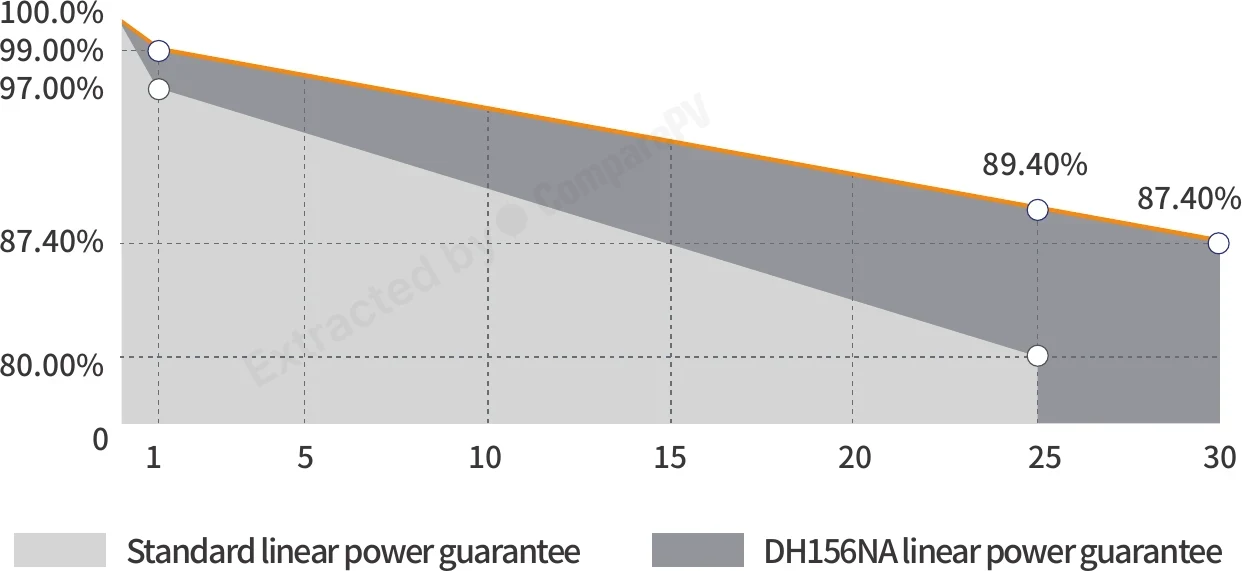
Following the first-year step (-1.00%), the module loses only 0.40% of rated power annually. Under a 30-year linear power warranty, this guarantees retention of at least ~87% of nominal output over the full service life — a result comparable to the best N-type models in the segment and better than a typical PERC warranty (25 years, 0.55%/year degradation).
According to manufacturer documentation, the bifaciality factor reaches 80%, which — with adequate ground albedo (light-colored roofing, gravel, or snow) — can translate into an additional 10–25% energy yield over a monofacial module. The 2+2 mm dual-glass structure eliminates the backsheet as a long-term risk factor for UV degradation and moisture ingress.
DAS Solar appears on the BNEF Tier 1 bankable manufacturer list and reports over 28 GW of cumulative shipments and 30 GW of annual production capacity. Its #2 global ranking in the TOPCon segment (per PV Tech, 2023) reflects a manufacturing scale that materially reduces operational risk for project financiers.
The Pmax temperature coefficient of -0.30%/°C outperforms typical PERC modules (-0.37 to -0.40%/°C) by approximately 0.08–0.10 percentage points. In the Polish climate — where module temperatures frequently exceed 60°C during summer — this meaningfully reduces thermal losses and improves the annual energy balance.
The top peer in this comparison, the Jinko Solar Tiger Neo 66HL4M-BDX, achieves an efficiency of 24.06% — 0.76 percentage points above the DAS-DH156NA's maximum of 23.3%. For area-constrained installations such as industrial rooftops, this translates into a meaningfully higher power yield per m² for an equivalent roof footprint.
DAS Solar has been operating for only 8 years, compared to Jinko Solar (~2006) or BYD (~2008). Its bankability rating of BB (PV ModuleTech Q4 2023) — as opposed to the AA/AAA ratings of leading brands — may present an obstacle when securing project financing from conservative lending institutions.
- At 22.9% efficiency, this panel is on par with typical TOPCon 600-650W modules
- At 228.9 W/m² power density, roof space requirements are typical for TOPCon 600-650W panels
- At -0.30%/°C, hot weather performance is typical for TOPCon 600-650W panels
- Weight of 34.3 kg is 1.6 kg above TOPCon 600-650W median (32.7 kg) - verify structural support
- 80% bifaciality enables rear-side power generation, boosting yield by 4-12% on reflective surfaces
Specifications
Datasheet charts
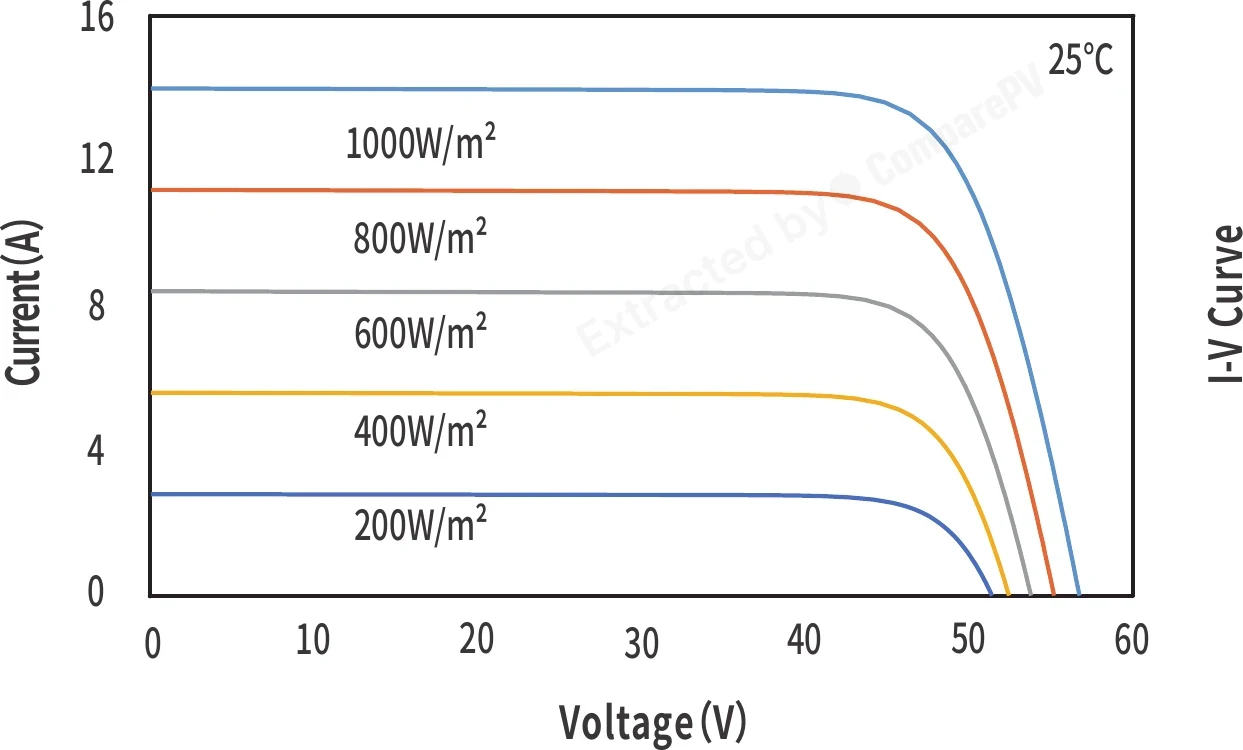
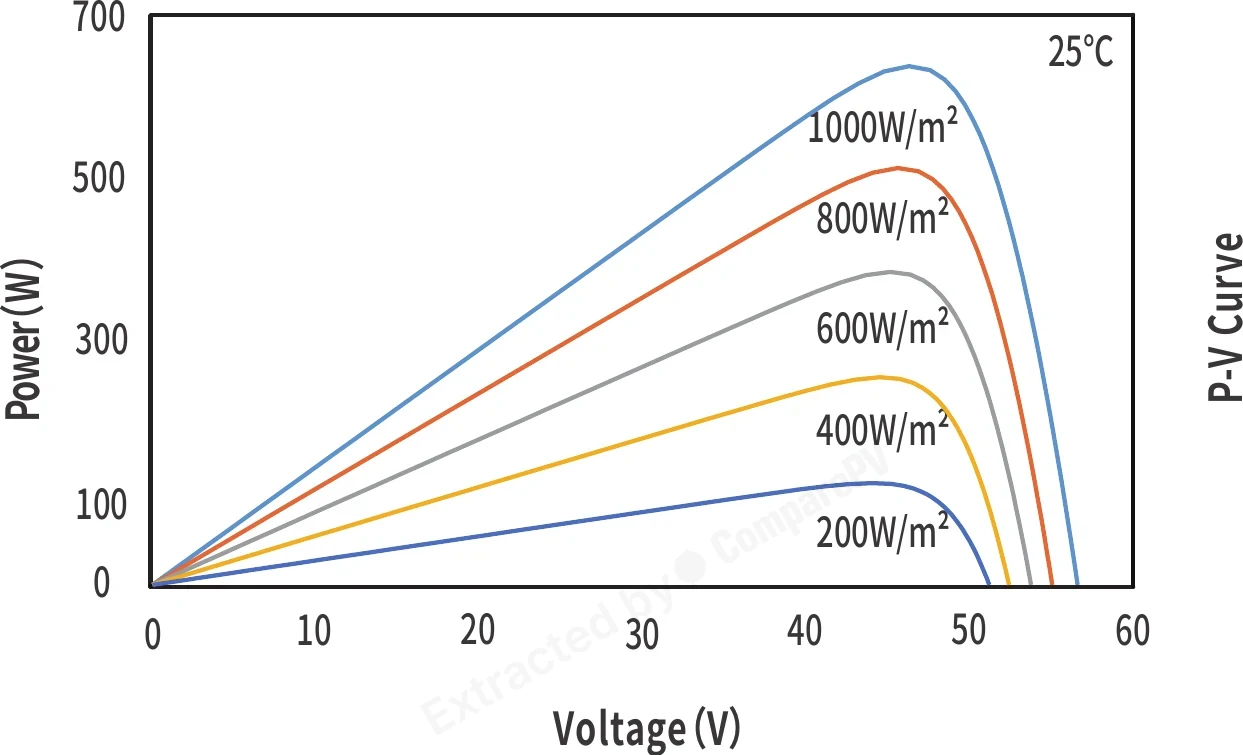
Measured curves published by DAS Solar in this model's datasheet. A chart carrying a wattage was measured on that variant alone - only the ones that describe 640 Wp appear here. The rest cover the whole series.
Simulations
Degradation from this panel's own datasheet figures. No inverter, soiling or shading losses.
Model: bifaciality × albedo × 0.6 view factor. A first-order estimate, not a yield simulation.




Found 616 panels of the same or similar size to this one, within ±10 mm. See them here Found 616 panels of the same or similar size to this one, within ±25 mm. See them here Found 616 panels of the same or similar size to this one, within ±50 mm. See them here Found 1813 panels of the same or similar size to this one, within ±100 mm. See them here