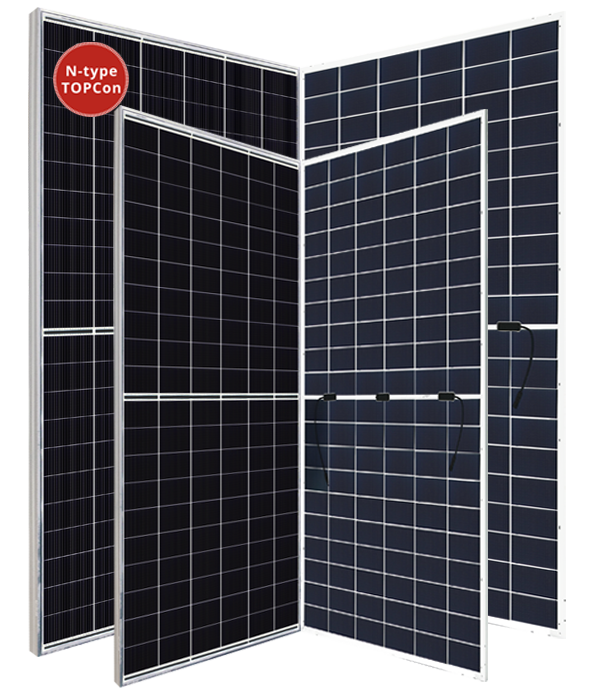
Canadian Solar CS7N-725TB-AG

CS7N-725TB-AG

725 Wp TOPCon Bifacial 80%
ComparePV verdict

Space saver, no clear weak spot

Rank 424 of 14,005
Compare panels Datasheet PDF
Power (Wp)
725
Strong · top 17%
Efficiency (%)
23.30
Strong · top 19%
Density (Wp/m²)
233.4
Strong · top 18%
Temp (%/°C)
-0.290
Typical · median -0.290
Weight (kg)
37.8
Typical · median 38.0 kg
Warranty (yrs)
30
Typical · median 30 yrs

The Canadian Solar TOPBiHiKu7 series was designed with installations in mind where maximizing yield from the same surface area and better overall system economics are key. These modules are based on TOPCon N-type cells, which maintain efficiency better over time and are less prone to typical degradation-accelerating phenomena. The key advantage is the bifacial design - the panel actively generates electricity not only from the front side but also the rear, significantly boosting energy production when mounted on suitable surfaces and frame structures.

The TOPBiHiKu7 also boasts a low temperature coefficient, helping stabilize energy output during warmer periods and narrowing the gap between theoretical performance and real-world operation. In practice, this translates to a lower energy and BOS cost - fewer modules and auxiliary components for the same project capacity, plus faster installation on farms.

This series is primarily aimed at utility-scale PV farms, C&I projects, large rooftops, carports, and any application where durability and predictable energy production are crucial. Compared to many PERC modules, TOPBiHiKu7 focuses on higher yields and greater resilience against performance degradation over the long term.

Ranking

420 panels in the segment TOPCon 700-750 W
Metric This panel Median Position in segment Overall rank
Module efficiency 23.30% 23.00% Strong · top 19% 1,017
Power density 233.4 230.2 Strong · top 18% 936
Temperature coefficient -0.290 -0.290 Typical 2,165
Weight per kWp 52.1 52.9 Typical 5,609
Performance warranty 30 yrs 30 yrs Typical 21
Colour key Strong - top 25% Typical - middle 50% Weak - bottom 25%

Signals from the data

7 positive · 1 caution
Best for

Utility-scale, commercial and hot-climate.

Strengths
233.4 watts per square metre

Top 18% of the TOPCon 700-750 W segment, against a median of 230.2.

23.30% module efficiency

Top 19% of the TOPCon 700-750 W segment, against a median of 23.00%.

What owners get
Low Temperature Coefficient of −0.29%/°C

According to the manufacturer's datasheet, Pmax decreases by only −0.29%/°C, compared to a typical −0.34 to −0.37%/°C for PERC modules. On a summer day with a module temperature of 65°C, this translates into measurably higher hourly energy yield relative to the previous generation of technology.

Maximum Degradation of 0.4%/Year Over 30 Years

The 30-year linear power warranty with an annual degradation cap of 0.4% (after Year 1) outperforms the typical 25-year/0.55% warranty standard for PERC modules. DNV's factory audit report for Canadian Solar recommends an assumed useful service life of 35–45 years for TOPBiHiKu7 modules — a notable bankability signal.

Bifaciality Up to 85% — Tangible Energy Yield Gain

The rated bifaciality factor reaches up to 85%. With a ground albedo of 0.35 (light gravel, concrete) and adequate row clearance, this delivers a real energy gain of 8–15% over an equivalent monofacial module, directly reducing LCOE in ground-mount utility projects and carport installations.

LID/LeTID Resistance Confirmed by Testing

N-type TOPCon cells exhibit approximately 1.0% degradation in H1 damp-heat testing (2,000 h), versus ~1.9% for P-type PERC. The elimination of boron-induced LID is inherent to N-type cell technology, reducing the risk of early power loss following system commissioning.

BNEF Tier-1, DNV Audit, Bankability Q1 2026

Canadian Solar maintains BNEF Tier-1 status in Q1 2026 and holds an independent DNV technology report. For non-recourse debt-financed projects, this is a key prerequisite — modules are accepted by major project finance banks without additional product-level due diligence.

Trade-offs
Weight ~37.8 kg — Constraint for Rooftop Installations

G12R-format modules in this series weigh approximately 37.8 kg, requiring a two-person installation crew and a structural assessment of the roof's load-bearing capacity. For prosumer installations on older buildings, this may rule out the series in favor of lighter alternatives (e.g., 400–450 W modules at ~21–23 kg).

Notes from the database
  • Efficiency of 23.3% matches the TOPCon 700-750W median
  • At 233.4 W/m² power density, this panel generates 3.2 W/m² more per unit area than TOPCon 700-750W median (230.2 W/m²)
  • Temperature coefficient of -0.29%/°C matches the TOPCon 700-750W median
  • 80% bifaciality enables rear-side power generation, boosting yield by 4-12% on reflective surfaces
  • #1017 for efficiency, #2165 for temperature performance out of 14005 panels

Specifications

Open datasheet PDF
Nominal power (Pmax) 725 Wp Nameplate at 1000 W/m², 25 °C
Module efficiency 23.30 % Strong Segment median 23.00%
Vmpp · Impp 41.00 V · 17.71 A Operating point at max power
Voc · Isc 48.90 V · 18.74 A Sizes the string length
Max system voltage 1500 V Longer strings than 1000 V modules
Dimensions 2384×1303×33 mm · 3.11 m² of roof
Weight 37.8 kg Typical Typical · median 38.0 kg
Cells 132 · TOPCon Monocrystalline
Bifaciality 80 % Rear output as a share of front
Coefficient Pmax -0.290 %/°C Typical median -0.290 of its segment
Coefficient Voc · Isc -0.250 · 0.050 %/°C
NOCT 41 °C At 800 W/m², 20 °C ambient
Product warranty 12 years Hardware defects only
Performance warranty 30 years Typical median 30 yrs · median 30 yrs
End-of-warranty output 87.4 % Equals 634 W guaranteed
Degradation 1.00 → 0.40 % First year, then annual

Simulations

Live - change any input
Lifetime output & value
30 years at 1200 kWh/kWp/year and €0.50 per kWh
Power in year 30
-
Lifetime energy
-
Energy value
-
With bifacial gain
-

Degradation from this panel's own datasheet figures. No inverter, soiling or shading losses.

Heat losses
-0.290 %/°C against a segment median of -0.290
-
Bifacial gain
Rear gain over light concrete: -
-

Model: bifaciality × albedo × 0.6 view factor. A first-order estimate, not a yield simulation.

Filter these
Size
Panel Power Eff. Temp. Weight Difference
Canadian Solar CS7N-725TB-AG 725 W 23.30% -0.290 37.8 kg You are here
AIKO-A680-MDE72Mw 680 W 25.20% -0.260 29.0 kg -45 W, lighter, +1.9 pp
AIKO-A675-MDE72Mw 675 W 25.00% -0.260 29.0 kg -50 W, lighter, +1.7 pp
AIKO-A700-MAE78Dw 700 W 25.00% -0.260 34.5 kg Cooler, lighter, +1.7 pp
AIKO-A695-MAE78Dw 695 W 24.90% -0.260 34.5 kg -30 W, lighter, +1.6 pp
AIKO-A690-MAE78Dw 690 W 24.70% -0.260 34.5 kg -35 W, lighter, +1.4 pp
AIKO-A685-MAE78Dw 685 W 24.50% -0.260 34.5 kg -40 W, lighter, +1.2 pp
TSM-NEG21C.20Q-760 760 W 24.50% -0.260 38.3 kg +35 W, cooler, +1.2 pp
AIKO-A680-MAH78Dw 680 W 24.30% -0.260 34.7 kg -45 W, lighter, +1.0 pp
CS7N-640MB-AG 640 W 20.60% -0.340 37.9 kg -85 W, hotter, -2.7 pp
CS7N-645MS 645 W 20.80% -0.340 33.9 kg -80 W, hotter, -2.5 pp
CS7N-650MS 650 W 20.90% -0.340 33.9 kg -75 W, hotter, -2.4 pp
CS7N-655MB-AG 655 W 21.10% -0.340 37.9 kg -70 W, hotter, -2.2 pp
CS7N-660MS 660 W 21.20% -0.340 33.9 kg -65 W, hotter, -2.1 pp
CS7N-665MS 665 W 21.40% -0.340 33.9 kg -60 W, hotter, -1.9 pp
AIKO-A805-GRH78Dw 805 W 25.10% -0.260 39.8 kg +80 W, cooler, +1.8 pp
AIKO-A800-GRH78Dw 800 W 24.90% -0.260 39.8 kg +75 W, cooler, +1.6 pp

Found 1390 panels of the same or similar size to this one, within ±10 mm. See them here Found 1400 panels of the same or similar size to this one, within ±25 mm. See them here Found 1400 panels of the same or similar size to this one, within ±50 mm. See them here Found 1432 panels of the same or similar size to this one, within ±100 mm. See them here

Common questions

6 answered
What warranty does the Canadian Solar TOPBiHiKu7 series carry?
The TOPBiHiKu7 series comes with a 12-year product warranty covering material and manufacturing defects, along with a 30-year linear power output warranty. Under the power warranty, the manufacturer guarantees that degradation will not exceed 1% in the first year and no more than 0.4% per year in subsequent years. As a Tier 1 manufacturer with a global service network, Canadian Solar provides genuine assurance that these commitments can be enforced.
What does the bifacial design of the TOPBiHiKu7 offer, and when does it pay off?
Thanks to its dual-sided operation, the TOPBiHiKu7 module captures light from both the front side and light reflected off the ground or surroundings through the rear glass, achieving a bifaciality factor of up to 85%. The greatest energy yield gains are realized in utility-scale PV plants with high-albedo ground surfaces (light-colored gravel, concrete, or snow) or in elevated mounting configurations such as canopies and carports. In typical ground-mount farm installations, the yield increase ranges from several to over ten percent compared to monofacial modules.
Are the Canadian Solar TOPBiHiKu7 730W panels suitable for installation on a warehouse or industrial hall roof?
Yes, but this requires a structural assessment of the roof. The TOPBiHiKu7 730W module measures 2384×1303×33 mm and weighs 37.8 kg, which generates significant roof loading in large commercial and industrial (C&I) installations. The module is rated to withstand snow loads of up to 5400 Pa and wind loads of up to 2400 Pa, so its mechanical parameters are robust. Prior to installation on an industrial facility, a structural engineering assessment of the roof and proper selection of racking and mounting systems are required.
How does TOPCon cell technology in the TOPBiHiKu7 series differ from older PERC cells?
The N-type TOPCon cells in the TOPBiHiKu7 achieve a module efficiency of up to 23.5%, significantly higher than typical PERC modules, which generally fall in the 20–22% range. A key differentiator is the lower temperature coefficient of −0.29%/°C compared to approximately −0.35%/°C for PERC, resulting in reduced power losses on hot days. TOPCon technology is also substantially more resistant to LID (Light-Induced Degradation) and LeTID (Light and elevated Temperature-Induced Degradation) phenomena, which accelerate degradation in PERC modules during the first years of operation.
How many TOPBiHiKu7 modules do I need for a 1 MW solar farm?
With the 730W variant, approximately 1,370 modules are sufficient for 1 MW of installed capacity. This is roughly ten to fifteen percent fewer units than a typical 600 W PERC-class module would require, which directly reduces balance-of-system (BoS) costs: fewer mounting structures, less cabling, and faster installation. In large-scale PV farm projects, this difference can significantly improve the overall investment economics and shorten the project completion timeline.
How well do the TOPBiHiKu7 panels perform at high temperatures during summer?
The TOPBiHiKu7 series features a Pmax temperature coefficient of −0.29%/°C, which ranks among the lowest in its class. In practice, this means that at a typical module operating temperature of 65°C, the panel loses approximately 10% of its rated power output, whereas an older PERC module would lose approximately 13–14%. Over the course of a full year and across an entire farm, this difference translates into measurable additional kilowatt-hours of generation and better alignment with production forecasts during summer months.
Add to compare