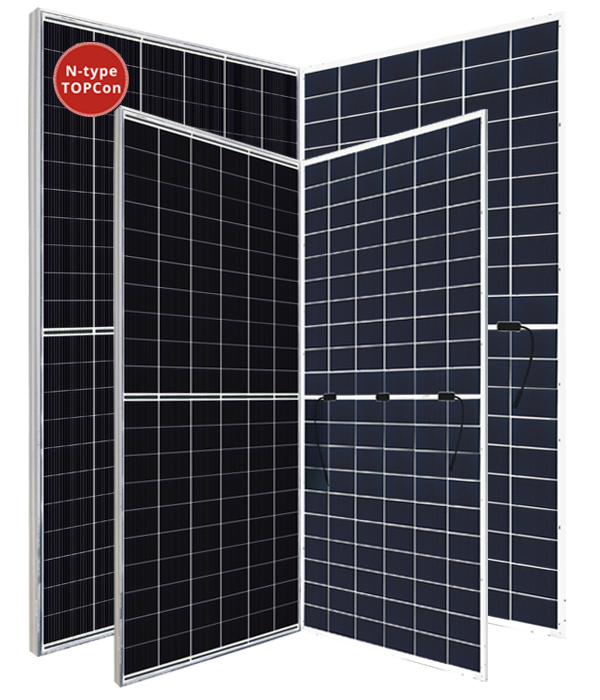
Middle of its segment, modest efficiency
Canadian Solar's BiHiKu7 series are bifacial modules based on the dual cell architecture, designed for maximum energy yield not only from the front but also from the reflected light off the ground. In practice, this means a real gain where competitive panels "stop at just the front surface" - especially on flat roofs, ground-mounted structures, carports, and PV farms with light-colored ground or gravel.
The BiHiKu7 features bifacial PERC technology combined with the format of large wafers, facilitating the construction of high-power installations using fewer modules and simpler installation logistics. The series is also optimized for compatibility with trackers and inverters, helping to reduce equipment and labor costs, thereby lowering the energy cost throughout the entire lifecycle.
For investors, increased reliability, good shading tolerance, and hot-spot resistance are also crucial, translating into more stable performance under demanding operating conditions.
Ranking
Signals from the data
Utility-scale, commercial and shaded-installations.
Tight roof space, roofs where every square metre has to count and weight-limited structures.
Bottom 3% of the PERC 600-650 W segment, against a median of 21.38%. Ranked 11,093rd in the whole database.
Bottom 3% of the PERC 600-650 W segment, against a median of 213.8. Ranked 11,100th in the whole database.
Bottom 14% of the PERC 600-650 W segment, against a median of 55.7.
Modules incorporate Canadian Solar Advanced Regeneration (CSAR), which reduces LID/LeTID degradation by 50% compared to standard PERC cells. The guaranteed annual power loss after the first year is no more than 0.45%, translating into higher energy yield over the full 30-year operational lifetime.
The dual-cell architecture with 210 mm cells delivers a bifacial factor of ~70% and a real-world rear-side energy gain of up to 30% — particularly valuable in ground-mounted installations, farms with light-colored gravel, and carports. According to Canadian Solar, the series generates 25.7% more energy over its lifetime than conventional monofacial modules.
The manufacturer guarantees a linear degradation schedule for 30 years (≤2% in year one, ≤0.45% for each subsequent year), while many competitors in this segment offer only a 25-year warranty with a stepped rather than linear degradation profile. This is complemented by a 12-year product warranty covering materials and workmanship.
Canadian Solar (founded 2001) has maintained continuous BNEF Tier-1 status for years, with a manufacturing capacity of approximately 61 GW (Q2 2025). Bankable status ensures access to project financing, service availability, and supply chain continuity — critical for large-scale PV farms with a 20–30-year investment horizon.
The highest-performing BiHiKu7 variant achieves 21.6% module efficiency, matching direct competitors such as Hiwatt Solar HW-M12/132H (21.6%) and Techwise Solar Summit Series and ZNShine ZXM8-TP132 (21.57%). The series holds its own against leading peer comparables within the same power class (up to 670 Wp).
P-type PERC cells offer a bifacial factor of ~70% versus ~85% for N-type TOPCon modules (e.g., Canadian Solar's own TOPBiHiKu7 series, which spans 620–725 Wp). TOPCon also exhibits lower LeTID susceptibility and cell efficiency >26% vs. ~24.5% for PERC. In long-term installations (farms >5 MW), the difference in energy yield and degradation rate may justify selecting the newer technology despite the higher CAPEX.
- At 20.6% efficiency, this panel is 0.8pp below the PERC 600-650W median of 21.4%
- At 206.0 W/m², this panel generates 7.8 W/m² less per unit area than PERC 600-650W median (213.8 W/m²)
- At -0.34%/°C, hot weather performance is typical for PERC 600-650W panels
- At 37.9 kg, this panel is 3.9 kg heavier than the PERC 600-650W median (34.0 kg) - more demanding for installation crews
- Bifacial design (70% factor) captures reflected light - adds 4-10% yield on ground-mount or white roof
Specifications
Simulations
Degradation from this panel's own datasheet figures. No inverter, soiling or shading losses.
Model: bifaciality × albedo × 0.6 view factor. A first-order estimate, not a yield simulation.



Found 1390 panels of the same or similar size to this one, within ±10 mm. See them here Found 1400 panels of the same or similar size to this one, within ±25 mm. See them here Found 1400 panels of the same or similar size to this one, within ±50 mm. See them here Found 1432 panels of the same or similar size to this one, within ±100 mm. See them here