Tongwei TWMNF-66HD700

700 Wp N-type Bifacial 80%
ComparePV verdict

Strong in heat, modest efficiency

Rank 1,228 of 14,129
Compare panels Datasheet PDF
Power (Wp)
700
Weak · bottom 10%
Efficiency (%)
22.50
Weak · bottom 3%
Density (Wp/m²)
225.3
Weak · bottom 10%
Temp (%/°C)
-0.280
Strong · top 22%
Weight (kg)
37.9
Typical · median 37.9 kg
Warranty (yrs)
30
Typical · median 30 yrs

The TWMNF N-type Half-cell Bifacial Module (66) series represents an advanced solution for investors seeking maximum efficiency per unit area. The innovative N-type cell technology used in them effectively eliminates the problem of light-induced degradation (LID), which translates into stable energy production for decades. A key differentiator is the high bifaciality, which allows for generating additional yield from reflected radiation, being particularly effective on high-albedo surfaces such as light gravel or bright roof membranes. The use of a Half-cell structure in combination with 66 cells optimizes current flow and significantly reduces resistance losses, while also improving the module's resistance to the negative effects of partial shading. These panels solve the problem of limited installation space by offering higher power density than standard market solutions. This series is primarily dedicated to large-scale photovoltaic farms and modern commercial installations, where the lowest levelized cost of energy (LCOE) is key. What sets them apart from the competition is exceptional efficiency in low-light conditions and a low temperature coefficient, guaranteeing operational stability and smaller power drops even on hot days. This is a solid foundation for profitable PV systems.

Ranking

93 panels in the segment N-type 700-750 W
Metric This panel Median Position in segment Overall rank
Module efficiency 22.50% 22.90% Weak · bottom 3% 4,281
Power density 225.3 228.6 Weak · bottom 10% 4,048
Temperature coefficient -0.280 -0.290 Strong · top 22% 1,347
Weight per kWp 54.1 53.4 Typical 8,436
Performance warranty 30 yrs 30 yrs Typical 21
Colour key Strong - top 25% Typical - middle 50% Weak - bottom 25%

Signals from the data

1 positive · 2 caution
Best for

Utility-scale, commercial, shaded-installations and hot-climate.

Not ideal for

Tight roof space and roofs where every square metre has to count.

Strengths
-0.280 %/°C temperature coefficient

Top 22% of the N-type 700-750 W segment, against a median of -0.290.

Watch-outs
22.50% module efficiency

Bottom 3% of the N-type 700-750 W segment, against a median of 22.90%. Ranked 4,281st in the whole database.

225.3 watts per square metre

Bottom 10% of the N-type 700-750 W segment, against a median of 228.6. Ranked 4,048th in the whole database.

Notes from the database
  • Efficiency of 22.5% matches the N-type 700-750W median
  • At 225.3 W/m², this panel generates 3.3 W/m² less per unit area than N-type 700-750W median (228.6 W/m²)
  • Temperature coefficient of -0.28%/°C matches the N-type 700-750W median
  • Bifaciality factor of 80% can add 4-12% extra yield with reflective mounting surface
  • Ranked #4281 out of 14129 panels for efficiency in the database

Specifications

Open datasheet PDF
Nominal power (Pmax) 700 Wp Nameplate at 1000 W/m², 25 °C
Module efficiency 22.50 % Weak Segment median 22.90%
Vmpp · Impp 40.35 V · 17.35 A Operating point at max power
Voc · Isc 48.60 V · 18.35 A Sizes the string length
Max system voltage 1500 V Longer strings than 1000 V modules
Dimensions 2384×1303×33 mm · 3.11 m² of roof
Weight 37.9 kg Typical Typical · median 37.9 kg
Cells 132 · N-type Monocrystalline
Bifaciality 80 % Rear output as a share of front
Coefficient Pmax -0.280 %/°C Strong top 22% of its segment
Coefficient Voc · Isc -0.240 · 0.046 %/°C
NOCT 45 °C At 800 W/m², 20 °C ambient
Product warranty 12 years Hardware defects only
Performance warranty 30 years Typical median 30 yrs · median 30 yrs
End-of-warranty output 87.4 % Equals 612 W guaranteed
Degradation 1.00 → 0.40 % First year, then annual

Datasheet charts

Open datasheet PDF

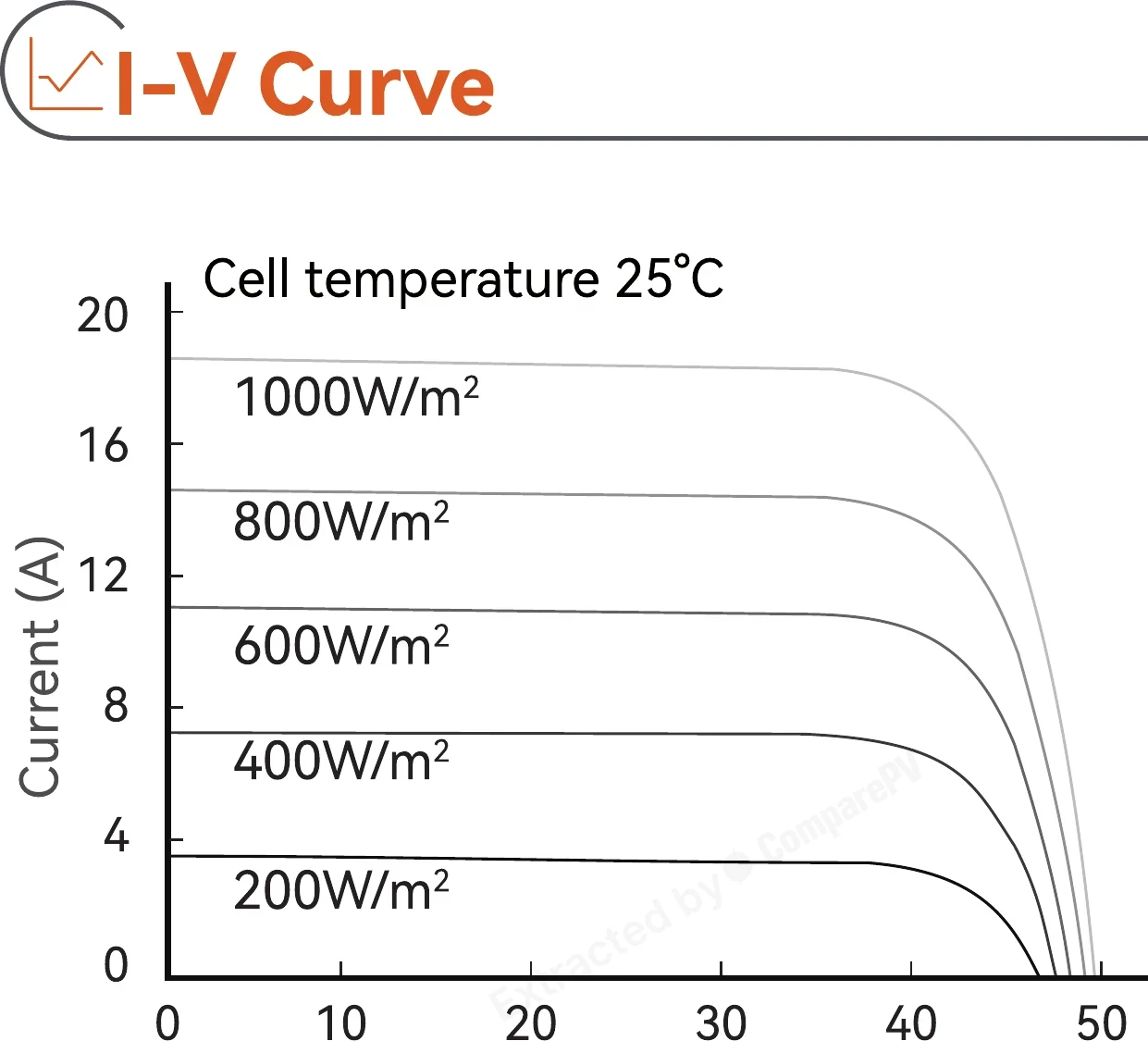
Measured curves published by Tongwei in this model's datasheet. A chart carrying a wattage was measured on that variant alone - only the ones that describe 700 Wp appear here. The rest cover the whole series.
Simulations

Live - change any input
Lifetime output & value
30 years at 1200 kWh/kWp/year and €0.50 per kWh
Power in year 30
-
Lifetime energy
-
Energy value
-
With bifacial gain
-

Degradation from this panel's own datasheet figures. No inverter, soiling or shading losses.

Heat losses
-0.280 %/°C against a segment median of -0.290
-
Bifacial gain
Rear gain over light concrete: -
-

Model: bifaciality × albedo × 0.6 view factor. A first-order estimate, not a yield simulation.

Filter these
Size
Panel Power Eff. Temp. Weight Difference
Tongwei TWMNF-66HD700 700 W 22.50% -0.280 37.9 kg You are here
AIKO-A650-MAE72Mw 650 W 25.20% -0.260 27.0 kg -50 W, lighter, +2.7 pp
AIKO-A680-MDE72Mw 680 W 25.20% -0.260 29.0 kg Cooler, lighter, +2.7 pp
AIKO-A675-MDE72Mw 675 W 25.00% -0.260 29.0 kg -25 W, lighter, +2.5 pp
AIKO-A700-MAE78Dw 700 W 25.00% -0.260 34.5 kg Cooler, lighter, +2.5 pp
WST-675BKX72-A2 675 W 25.00% -0.260 32.1 kg -25 W, lighter, +2.5 pp
AIKO-A695-MAE78Dw 695 W 24.90% -0.260 34.5 kg Cooler, lighter, +2.4 pp
AIKO-G670-MCH72Mw 670 W 24.80% -0.260 28.2 kg -30 W, lighter, +2.3 pp
LR7-72HVHF-670M 670 W 24.80% -0.260 28.5 kg -30 W, lighter, +2.3 pp
TWMPF-66HD655 655 W 21.10% -0.330 37.9 kg -45 W, hotter, -1.4 pp
TWMPF-66HD660 660 W 21.20% -0.330 37.9 kg -40 W, hotter, -1.3 pp
TWMPF-66HD665 665 W 21.40% -0.330 37.9 kg -35 W, hotter, -1.1 pp
TWMPF-66HD670 670 W 21.60% -0.330 37.9 kg -30 W, hotter, -0.9 pp
TWMPF-66HD675 675 W 21.70% -0.330 37.9 kg -25 W, hotter, -0.8 pp
TWMNF-66HD705 705 W 22.70% -0.280 37.9 kg Very close match
AIKO-A805-GRH78Dw 805 W 25.10% -0.260 39.8 kg +105 W, cooler, +2.6 pp
AIKO-A800-GRH78Dw 800 W 24.90% -0.260 39.8 kg +100 W, cooler, +2.4 pp

Found 1393 panels of the same or similar size to this one, within ±10 mm. See them here Found 1403 panels of the same or similar size to this one, within ±25 mm. See them here Found 1403 panels of the same or similar size to this one, within ±50 mm. See them here Found 1435 panels of the same or similar size to this one, within ±100 mm. See them here

About the TWMNF N-type Half-cell Bifacial Module (66) series

6 answered

These answers cover the whole series. Where a figure differs, the specification above is this module's own.

What is N-type cell technology used in Tongwei TWMNF panels, and why does it eliminate LID degradation?
N-type cells use phosphorus-doped silicon instead of boron, so they do not form the boron-oxygen complexes responsible for light-induced degradation (LID). In practice, this means the TWMNF module does not lose significant power in the first months of operation, and energy output stays stable throughout the entire 30-year power warranty period. N-type technology also delivers higher initial efficiency, reaching up to 23.5%.
How much extra energy can the bifacial TWMNF-66 panels generate from reflected sunlight?
With a bifaciality factor of 80±5%, TWMNF-66 modules also generate current from the rear side using light reflected off the ground surface. Depending on the albedo of the mounting surface - such as light gravel, a white roofing membrane, or snow - the additional energy yield can range from a few to over ten percent compared to an equivalent monofacial panel of the same rated power.
What warranty does Tongwei offer on the TWMNF N-type Half-cell Bifacial (66) module series?
Tongwei backs the TWMNF series with a standard 12-year product warranty as a Tier 1 PV manufacturer headquartered in China. The panels also come with a 30-year linear power warranty, guaranteeing a minimum energy output level throughout the system's operating life. This is a typical standard for premium-class N-type modules designed for long-term use in commercial installations and utility-scale PV farms.
Are Tongwei TWMNF-66 panels suitable for residential installations, or are they mainly for solar farms?
The TWMNF-66 series, with its half-cell design and power up to 700 Wp, is optimized primarily for large-scale PV farms and commercial installations, where low LCOE and high power density per unit area are key priorities. In residential settings, it works best where a sufficiently large and sturdy mounting surface is available, such as large commercial roofs or agricultural land.
How do TWMNF-66 panels perform in summer under high roof temperatures?
TWMNF-66 modules have a low power temperature coefficient of around -0.28%/°C, an improvement over classic P-type PERC panels. This means a smaller power drop on hot days when panel temperature can exceed 60°C. The module's operating range spans from -40°C to +85°C, confirming its stability even under extreme climate conditions.
What does the half-cell structure with 66 cells mean, and how does it improve shading tolerance?
The half-cell design cuts standard cells in half, giving the TWMNF-66 module effectively 132 smaller cells connected across two independent circuits. This layout reduces resistive current losses and limits the impact of shading a single cell on the entire string - so if part of the panel is shaded, for example by a chimney or antenna, only that section loses power rather than the whole module.
Add to compare