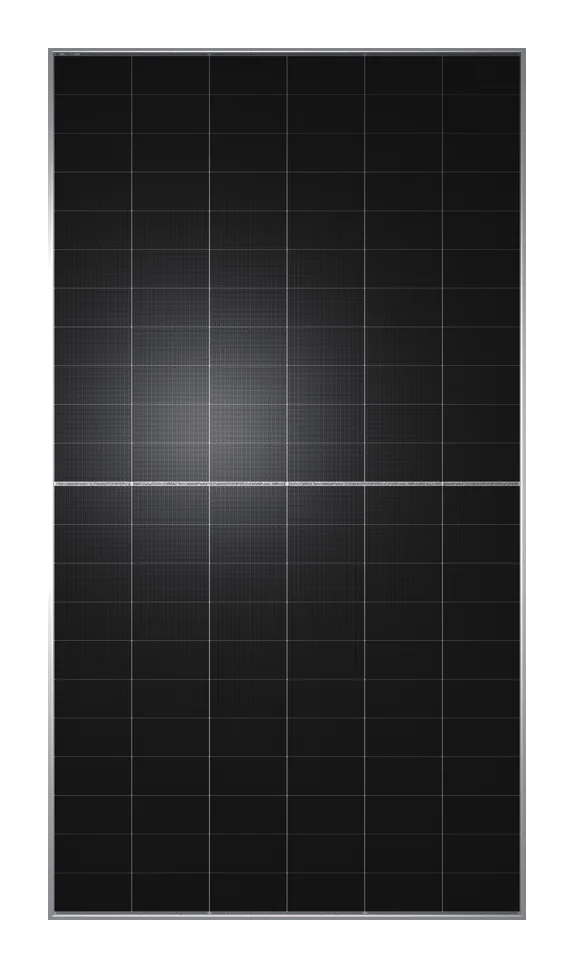
Tongwei TWMNF-66HD705

TWMNF-66HD705

705 Wp TOPCon Bifacial 80%
ComparePV verdict

Strong in heat, needs the roof space

Rank 1,007 of 14,005
Compare panels Datasheet PDF
Power (Wp)
705
Weak · bottom 22%
Efficiency (%)
22.70
Weak · bottom 23%
Density (Wp/m²)
227.0
Weak · bottom 21%
Temp (%/°C)
-0.280
Strong · top 11%
Weight (kg)
37.9
Typical · median 38.0 kg
Warranty (yrs)
30
Typical · median 30 yrs

The Tongwei TNC series is a line of photovoltaic modules built around proprietary n-type TOPCon cells, developed by one of the world's largest solar cell manufacturers. What sets it apart is the combination of half-cut cell technology with a dense multi-busbar layout, which significantly reduces power losses from microcracks and shading while making current flow across the module more even. TNC panels rely on advanced 3D passivation that limits carrier recombination and helps maintain high efficiency even under weak, diffuse light - during early mornings, fog, or low sun angles. A major strength of the series is its high bifaciality, which lets the module capture extra energy from light reflected onto its rear side, meaningfully lowering the cost of energy per installed watt. The TNC series performs well both in rooftop installations and large-scale solar farms, where long-term output stability matters most. Its rugged construction and extended manufacturer warranty make it an attractive choice for investors seeking predictable returns with limited risk of power degradation over time.

Ranking

420 panels in the segment TOPCon 700-750 W
Metric This panel Median Position in segment Overall rank
Module efficiency 22.70% 23.00% Weak · bottom 23% 3,307
Power density 227.0 230.2 Weak · bottom 21% 3,361
Temperature coefficient -0.280 -0.290 Strong · top 11% 1,309
Weight per kWp 53.8 52.9 Typical 7,811
Performance warranty 30 yrs 30 yrs Typical 21
Colour key Strong - top 25% Typical - middle 50% Weak - bottom 25%

Signals from the data

1 positive · 2 caution
Best for

Utility-scale, commercial and shaded-installations.

Not ideal for

Roofs where every square metre has to count and tight roof space.

Strengths
-0.280 %/°C temperature coefficient

Top 11% of the TOPCon 700-750 W segment, against a median of -0.290.

Watch-outs
227.0 watts per square metre

Bottom 21% of the TOPCon 700-750 W segment, against a median of 230.2.

22.70% module efficiency

Bottom 23% of the TOPCon 700-750 W segment, against a median of 23.00%.

Notes from the database
  • Efficiency of 22.7% matches the TOPCon 700-750W median
  • 226.9 W/m² power density is 3.2 W/m² below TOPCon 700-750W median (230.2 W/m²) - requires larger installation area
  • Temperature coefficient of -0.28%/°C matches the TOPCon 700-750W median
  • Bifacial design (80% factor) captures reflected light - adds 4-12% yield on ground-mount or white roof
  • #3307 for efficiency, #1309 for temperature performance out of 14005 panels

Specifications

Open datasheet PDF
Nominal power (Pmax) 705 Wp Nameplate at 1000 W/m², 25 °C
Module efficiency 22.70 % Weak Segment median 23.00%
Vmpp · Impp 40.52 V · 17.40 A Operating point at max power
Voc · Isc 48.77 V · 18.40 A Sizes the string length
Max system voltage 1500 V Longer strings than 1000 V modules
Dimensions 2384×1303×33 mm · 3.11 m² of roof
Weight 37.9 kg Typical Typical · median 38.0 kg
Cells 132 · TOPCon Monocrystalline
Bifaciality 80 % Rear output as a share of front
Coefficient Pmax -0.280 %/°C Strong top 11% of its segment
Coefficient Voc · Isc -0.240 · 0.046 %/°C
NOCT 45 °C At 800 W/m², 20 °C ambient
Product warranty 12 years Hardware defects only
Performance warranty 30 years Typical median 30 yrs · median 30 yrs
End-of-warranty output 87.4 % Equals 616 W guaranteed
Degradation 1.00 → 0.40 % First year, then annual

Datasheet charts

Open datasheet PDF

Measured curves published by Tongwei in this model's datasheet. A chart carrying a wattage was measured on that variant alone - only the ones that describe 705 Wp appear here. The rest cover the whole series.

Simulations

Live - change any input
Lifetime output & value
30 years at 1200 kWh/kWp/year and €0.50 per kWh
Power in year 30
-
Lifetime energy
-
Energy value
-
With bifacial gain
-

Degradation from this panel's own datasheet figures. No inverter, soiling or shading losses.

Heat losses
-0.280 %/°C against a segment median of -0.290
-
Bifacial gain
Rear gain over light concrete: -
-

Model: bifaciality × albedo × 0.6 view factor. A first-order estimate, not a yield simulation.

Filter these
Size
Panel Power Eff. Temp. Weight Difference
Tongwei TWMNF-66HD705 705 W 22.70% -0.280 37.9 kg You are here
AIKO-A680-MDE72Mw 680 W 25.20% -0.260 29.0 kg -25 W, lighter, +2.5 pp
AIKO-A675-MDE72Mw 675 W 25.00% -0.260 29.0 kg -30 W, lighter, +2.3 pp
AIKO-A700-MAE78Dw 700 W 25.00% -0.260 34.5 kg Cooler, lighter, +2.3 pp
AIKO-A695-MAE78Dw 695 W 24.90% -0.260 34.5 kg Cooler, lighter, +2.2 pp
AIKO-G670-MCH72Mw 670 W 24.80% -0.260 28.2 kg -35 W, lighter, +2.1 pp
LR7-72HVHF-670M 670 W 24.80% -0.260 28.5 kg -35 W, lighter, +2.1 pp
JKM650-670N-66QL6-BDV (670W class) 670 W 24.80% -0.260 32.5 kg -35 W, lighter, +2.1 pp
TWMPF-66HD655 655 W 21.10% -0.330 37.9 kg -50 W, hotter, -1.6 pp
TWMPF-66HD660 660 W 21.20% -0.330 37.9 kg -45 W, hotter, -1.5 pp
TWMPF-66HD665 665 W 21.40% -0.330 37.9 kg -40 W, hotter, -1.3 pp
TWMPF-66HD670 670 W 21.60% -0.330 37.9 kg -35 W, hotter, -1.1 pp
TWMPF-66HD675 675 W 21.70% -0.330 37.9 kg -30 W, hotter, -1.0 pp
TWMNF-66HD700XX 700 W 22.50% -0.280 37.9 kg Very close match
AIKO-A805-GRH78Dw 805 W 25.10% -0.260 39.8 kg +100 W, cooler, +2.4 pp
AIKO-A800-GRH78Dw 800 W 24.90% -0.260 39.8 kg +95 W, cooler, +2.2 pp
AIKO-A795-GRH78Dw 795 W 24.80% -0.260 39.8 kg +90 W, cooler, +2.1 pp

Found 1390 panels of the same or similar size to this one, within ±10 mm. See them here Found 1400 panels of the same or similar size to this one, within ±25 mm. See them here Found 1400 panels of the same or similar size to this one, within ±50 mm. See them here Found 1432 panels of the same or similar size to this one, within ±100 mm. See them here

Common questions

6 answered
How does TOPCon cell technology in Tongwei TNC panels differ from standard PERC cells?
The n-type TOPCon cells used in the TNC series feature an additional rear-side passivation layer that reduces carrier recombination and lowers current losses compared to conventional PERC cells. As a result, TNC modules reach efficiencies up to 23.3% and a lower annual degradation rate. In practice this means higher energy yield from the same roof area throughout the entire lifetime of the installation.
Will a 725 Wp Tongwei TNC panel fit on a typical residential pitched roof?
The 725 Wp TNC panel measures 2384x1303x33 mm and weighs 37.9 kg, sizing similar to large industrial-format modules also used on large residential roof areas. Lower-power variants within the same series are also available and better suited to smaller prosumer installations. Because of the panel weight, a sturdy mounting structure is required, but the module itself is fully compatible with standard racking systems.
What warranty do Tongwei TNC panels carry, and how much power do they retain after 30 years?
The TNC series comes with a 12-year product warranty and a 30-year linear power warranty guaranteeing at least 87.4% of the original rated power after three decades of operation. This matches the level typical of top-tier n-type TOPCon modules and means slower annual degradation than older PERC technology, translating into a higher and more predictable return on investment.
How much extra energy does bifaciality add to Tongwei TNC panels?
Thanks to their bifacial design, TNC panels capture light reflected from the ground onto the rear side of the module, which, depending on surface albedo, mounting height, and tilt angle, can add roughly a few to over ten percent of annual energy compared to a monofacial panel of the same rated power. The effect is strongest over bright surfaces such as gravel or white roofing membrane, and in ground-mount or east-west installations.
Do Tongwei TNC panels perform well in winter and under low, diffuse light?
Yes, TNC modules have a power temperature coefficient of -0.28%/°C, meaning lower output loss at high temperatures than older technologies, while cold winter temperatures actually favor silicon cell performance. In addition, advanced 3D passivation reduces losses under weak, diffuse light typical of cloudy days, fog, or early morning hours, resulting in more stable energy production throughout the year.
Is the Tongwei TNC series better suited to large solar farms or does it also work on commercial and residential roofs?
The TNC series is designed for universal use, deployed both in utility-scale solar farms, where long-term production stability over 25-30 years matters most, and on commercial and residential roof installations. A robust construction, high per-module power up to 725 Wp, and bifaciality allow it to reduce the cost of energy per watt installed in both applications.
Add to compare