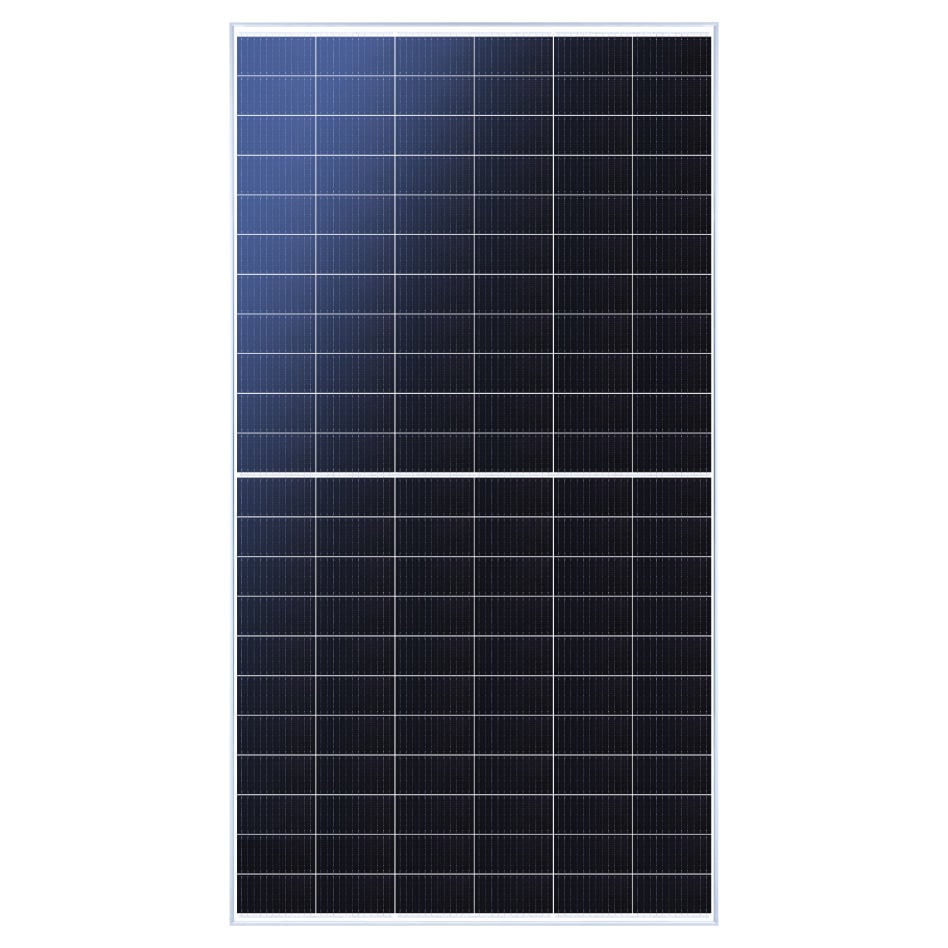
Phono Solar PS730M13GFH-22/WSHW

PS730M13GFH-22/WSHW

730 Wp HJT Bifacial 90%
ComparePV verdict

Light for its output, no clear weak spot

Rank 199 of 14,005
Compare panels Datasheet PDF
Power (Wp)
730
Strong · top 16%
Efficiency (%)
23.50
Strong · top 16%
Density (Wp/m²)
235.0
Strong · top 16%
Temp (%/°C)
-0.240
Typical · median -0.240
Weight (kg)
37.9
Strong · top 13%
Warranty (yrs)
30
Typical · median 30 yrs

The Phono Solar Helios Module (N-HJT HIGH EFFICIENCY MONO 132-20BB-W-WG) was designed to maximize energy gain under real-world operating conditions - even when the roof has limited space, and the investor expects stable production for years. Its unique combination of N-type HJT cells and glass-glass dual-string construction ensures superior mechanical strength and better laminate sealing compared to many standard modules. The application of 20BB multi-string architecture minimizes connection losses and improves performance under partial shading, which is crucial in single-family home installations and commercial rooftops with obstacles. HJT technology also provides excellent performance at high temperatures and a better response to low light conditions, enabling the system to generate more energy in the morning, evening, and on cloudy days. This is the ideal choice for prosumers, agriculture, and businesses seeking reliability, longevity, and real-world growth in self-consumption.

Ranking

222 panels in the segment HJT 700-750 W
Metric This panel Median Position in segment Overall rank
Module efficiency 23.50% 23.02% Strong · top 16% 716
Power density 235.0 230.2 Strong · top 16% 800
Temperature coefficient -0.240 -0.240 Typical 13
Weight per kWp 51.9 53.6 Strong · top 13% 5,338
Performance warranty 30 yrs 30 yrs Typical 21
Colour key Strong - top 25% Typical - middle 50% Weak - bottom 25%

Signals from the data

8 positive · 2 caution
Best for

Commercial, utility-scale, hot-climate and shaded-installations.

Strengths
51.9 kg per kWp

Top 13% of the HJT 700-750 W segment, against a median of 53.6.

235.0 watts per square metre

Top 16% of the HJT 700-750 W segment, against a median of 230.2.

23.50% module efficiency

Top 16% of the HJT 700-750 W segment, against a median of 23.02%.

What owners get
N-type HJT cell technology

Heterojunction (HJT) cells offer a lower power temperature coefficient and minimal LID/LeTID degradation compared to older PERC cells, and combined with 22.86-23.5% module efficiency this yields higher energy harvest on hot days and under low-light conditions (morning, evening, overcast days).

30-year linear power warranty

The manufacturer offers a 30-year power warranty alongside a 15-year product warranty - notably longer than the standard 25 years offered by most PERC/TOPCon modules in this segment, a direct result of HJT's lower degradation rate.

Glass-glass bifacial construction

Dual-glass lamination instead of a traditional backsheet improves laminate sealing and mechanical durability, directly supporting the stated 30-year lifespan while enabling effective bifacial energy gain.

20BB architecture cuts resistive losses

The multi-busbar 20BB structure reduces resistive losses at cell interconnections and improves partial-shading tolerance - relevant for residential rooftops and commercial roofs with obstructions such as chimneys or antennas.

Tier-1 bankability since 2014

Phono Solar (affiliated with the Sinomach group, Fortune 500) has been continuously listed on BloombergNEF's Tier-1 list since 2014, lowering project financing risk and easing access to investment loans or leasing for the installation.

Trade-offs
Heavier glass-glass construction

The dual-glass lamination increases module weight versus standard glass-backsheet panels (typically by low double-digit percentages in this power class), raising roof structural load requirements and transport/installation costs on large rooftop deployments with limited load capacity.

Short market track record

The series launched in 2023, so at most roughly 3 years of independent field performance data exist - compared to longer-established PERC/TOPCon series, long-term behavior under Polish climate conditions is harder to verify.

Notes from the database
  • Efficiency of 23.5% matches the HJT 700-750W median
  • At 235.0 W/m² power density, this panel generates 4.8 W/m² more per unit area than HJT 700-750W median (230.2 W/m²)
  • At -0.24%/°C, hot weather performance is typical for HJT 700-750W panels
  • 90% bifaciality enables rear-side power generation, boosting yield by 4-14% on reflective surfaces
  • In the top 5% for efficiency among all HJT panels

Specifications

Open datasheet PDF
Nominal power (Pmax) 730 Wp Nameplate at 1000 W/m², 25 °C
Module efficiency 23.50 % Strong Segment median 23.02%
Vmpp · Impp 42.35 V · 17.24 A Operating point at max power
Voc · Isc 50.42 V · 18.33 A Sizes the string length
Max system voltage 1500 V Longer strings than 1000 V modules
Dimensions 2384×1303×33 mm · 3.11 m² of roof
Weight 37.9 kg Strong Strong · top 13%
Cells 132 · HJT Monocrystalline
Bifaciality 90 % Rear output as a share of front
Coefficient Pmax -0.240 %/°C Typical median -0.240 of its segment
Coefficient Voc · Isc -0.220 · 0.040 %/°C
NOCT 44 °C At 800 W/m², 20 °C ambient
Product warranty 15 years Hardware defects only
Performance warranty 30 years Typical median 30 yrs · median 30 yrs
End-of-warranty output 88.0 % Equals 643 W guaranteed
Degradation 1.00 → 0.38 % First year, then annual

Datasheet charts

Open datasheet PDF

Measured curves published by Phono Solar in this model's datasheet. A chart carrying a wattage was measured on that variant alone - only the ones that describe 730 Wp appear here. The rest cover the whole series.

Simulations

Live - change any input
Lifetime output & value
30 years at 1200 kWh/kWp/year and €0.50 per kWh
Power in year 30
-
Lifetime energy
-
Energy value
-
With bifacial gain
-

Degradation from this panel's own datasheet figures. No inverter, soiling or shading losses.

Heat losses
-0.240 %/°C against a segment median of -0.240
-
Bifacial gain
Rear gain over light concrete: -
-

Model: bifaciality × albedo × 0.6 view factor. A first-order estimate, not a yield simulation.

Filter these
Size
Panel Power Eff. Temp. Weight Difference
Phono Solar PS730M13GFH-22/WSHW 730 W 23.50% -0.240 37.9 kg You are here
AIKO-A680-MDE72Mw 680 W 25.20% -0.260 29.0 kg -50 W, lighter, +1.7 pp
AIKO-A700-MAE78Dw 700 W 25.00% -0.260 34.5 kg -30 W, lighter, +1.5 pp
AIKO-A695-MAE78Dw 695 W 24.90% -0.260 34.5 kg -35 W, lighter, +1.4 pp
AIKO-A690-MAE78Dw 690 W 24.70% -0.260 34.5 kg -40 W, lighter, +1.2 pp
AIKO-A685-MAE78Dw 685 W 24.50% -0.260 34.5 kg -45 W, lighter, +1.0 pp
TSM-NEG21C.20Q-760 760 W 24.50% -0.260 38.3 kg +30 W, hotter, +1.0 pp
AIKO-A680-MAH78Dw 680 W 24.30% -0.260 34.7 kg -50 W, lighter, +0.8 pp
GK-4-78HGBD-780M 780 W 24.30% -0.260 38.7 kg +50 W, hotter, +0.8 pp
AIKO-A780-GRH78Dw 780 W 24.30% -0.260 39.8 kg +50 W, hotter, +0.8 pp
NS-650MH-132 650 W 20.92% -0.290 38.7 kg -80 W, hotter, -2.6 pp
NS-655MH-132 655 W 21.08% -0.290 38.7 kg -75 W, hotter, -2.4 pp
NS-660MH-132 660 W 21.24% -0.290 38.7 kg -70 W, hotter, -2.3 pp
NS-665MH-132 665 W 21.40% -0.290 38.7 kg -65 W, hotter, -2.1 pp
NS-670MH-132 670 W 21.56% -0.290 38.7 kg -60 W, hotter, -1.9 pp
PS690M13GFH-22/WNH 690 W 22.21% -0.290 37.7 kg -40 W, hotter, -1.3 pp
PS695M13GFH-22/WNH 695 W 22.37% -0.290 37.7 kg -35 W, hotter, -1.1 pp
AIKO-A805-GRH78Dw 805 W 25.10% -0.260 39.8 kg +75 W, hotter, +1.6 pp

Found 1390 panels of the same or similar size to this one, within ±10 mm. See them here Found 1400 panels of the same or similar size to this one, within ±25 mm. See them here Found 1400 panels of the same or similar size to this one, within ±50 mm. See them here Found 1432 panels of the same or similar size to this one, within ±100 mm. See them here

Common questions

6 answered
What warranty does the Phono Solar Helios Module N-HJT 132-20BB come with?
The Phono Solar Helios Module N-HJT 132-20BB series includes a 15-year product warranty covering manufacturing defects, and a 30-year linear power warranty guaranteeing at least 87.4% of rated output after 30 years. This is among the stronger degradation schedules offered by Tier 1 manufacturers and supports a reliable long-term LCOE calculation for both residential and commercial installations.
Does the Phono Solar Helios HJT series really perform better in high temperatures compared to PERC panels?
Yes. HJT cells deliver a temperature coefficient of Pmax around -0.26%/°C, compared to -0.35%/°C or worse for standard PERC modules. At a cell temperature of 70°C, a typical summer scenario in Central Europe, the Helios N-HJT loses roughly 10% of rated power versus 14-15% for PERC. Over a full summer season this difference is reflected in measurable additional kilowatt-hours generated.
What does the 20-busbar (20BB) architecture in the Phono Solar Helios mean for partial shading?
The 20BB design splits current collection across 20 parallel busbars per cell, reducing resistive losses and limiting the impact of localized shading or micro-cracks on overall module output. Compared to older 9BB or 12BB layouts, this architecture improves performance when part of the array is shaded by chimneys, dormers, or roof edges — a common constraint in residential rooftop installations.
Is the Phono Solar Helios 730 Wp truly bifacial and how much additional energy can the rear glass generate?
Yes, the Helios N-HJT 132-20BB is a bifacial module in a glass-glass construction with a bifaciality factor of approximately 85%. Depending on ground albedo and installation geometry, the rear side can contribute 5-25% additional energy yield. Ground-mounted systems with light-colored gravel or white roofing surfaces benefit most. On standard clay roofing tiles the rear-side gain is lower, but still measurable over a 30-year lifetime.
How heavy and large is the Phono Solar Helios N-HJT 132-20BB 730 Wp module — can a standard residential roof handle it?
The 730 Wp module in a 132-cell M10/M12 format measures approximately 2384 × 1303 mm and weighs around 33-35 kg. This is significantly heavier than a typical 400-430 Wp residential panel, so a structural assessment by a certified engineer is mandatory before installation. The series is best suited for flat commercial rooftops, ground-mount systems, and large industrial buildings where the high unit power reduces module count and overall BoS costs.
Is Phono Solar a reliable manufacturer and is the Helios N-HJT series still available for purchase?
Phono Solar (SUMEC Group) is a Bloomberg NEF Tier 1 manufacturer with verified financial and production capacity, in business since 2004. The Helios N-HJT 132-20BB series is currently active and available. The modules carry IEC, TÜV, and MCS certifications, making them eligible for government incentive programs and tax relief schemes in most European markets including Poland.
Add to compare