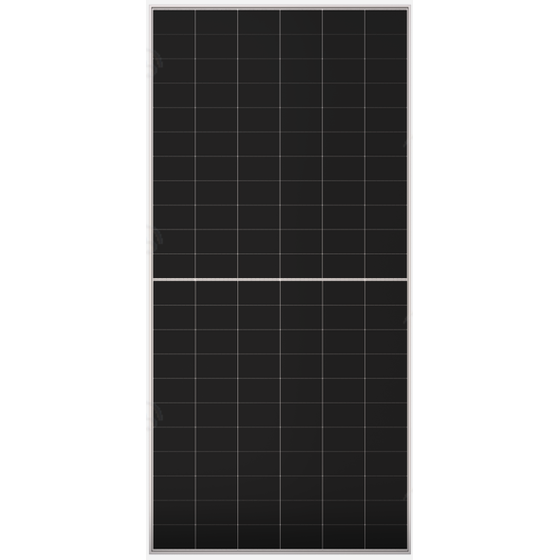
Longi Solar LR8-66HVD-640M

LR8-66HVD-640M

640 Wp Back Contact Bifacial 75%
ComparePV verdict

Middle of its segment, heavy for its output

Rank 1,271 of 14,005
Compare panels Datasheet PDF
Power (Wp)
640
Typical for its class
Efficiency (%)
23.69
Typical · median 23.70%
Density (Wp/m²)
236.9
Typical · median 236.9
Temp (%/°C)
-0.260
Typical · median -0.260
Weight (kg)
33.5
Weak · 1.2 kg above median
Warranty (yrs)
30
Typical · median 30 yrs

This Longi Solar Hi-MO X10 Scientist LR8-66HVD 640-665M series is designed for investors seeking maximum energy production from limited roof space and reliable performance in real-world conditions. The application of N-TaiRay cells and HPBC 2.0 architecture enables better light utilization and minimizes typical losses associated with conventional modules featuring visible front grids. The result is not only high efficiency but also more predictable energy generation under variable sunlight conditions.

A practical advantage of this series is A+ Anti-Shading - a solution that supports energy gains when the module is partially shaded by a chimney, tree, or structural elements. Furthermore, the construction is engineered for safety by reducing the risk of hotspots and offering lower susceptibility to micro-cracks.

This is an excellent choice for modern residential installations and premium projects where yield, aesthetics (lack of visible front gridlines), and durability are prioritized over the compromises typical of less expensive solutions.

Ranking

72 panels in the segment Back Contact 600-650 W
Metric This panel Median Position in segment Overall rank
Module efficiency 23.69% 23.70% Typical 580
Power density 236.9 236.9 Typical 521
Temperature coefficient -0.260 -0.260 Typical 511
Weight per kWp 52.3 50.4 Weak · bottom 21% 5,829
Performance warranty 30 yrs 30 yrs Typical 21
Colour key Strong - top 25% Typical - middle 50% Weak - bottom 25%

Signals from the data

5 positive · 3 caution
Best for

Residential, commercial, utility-scale, shaded-installations and hot-climate.

Not ideal for

Weight-limited structures.

Watch-outs
52.3 kg per kWp

Bottom 21% of the Back Contact 600-650 W segment, against a median of 50.4.

What owners get
24.62% efficiency, top of segment

Maximum module efficiency of 24.62% matches Sunpro Power SPDG-BC132R12 (24.62%) and Talesun CIPRO-TM9C72M (24.6%), and clearly outperforms Waaree ARKA (21.29%). This is enabled by N-TaiRay cell technology and HPBC 2.0 architecture.

No front busbars (HPBC 2.0)

The back-contact architecture eliminates visible front-side gridlines, reducing busbar shading losses and improving module aesthetics - a key advantage for premium projects where visual appearance matters.

Low temperature coefficient of -0.26%/°C

This coefficient is roughly 0.03 pp better than typical TOPCon modules, translating into smaller power losses at high panel temperatures and higher real-world summer yield.

Two-sided generation despite BC design

A bifaciality factor of around 75% is a notable achievement, since back-contact modules traditionally struggle with efficient rear-side generation - the series won the pv magazine Award 2025 for bifacial back-contact innovation.

Enhanced mechanical durability via N-TaiRay

The N-TaiRay wafer offers a 16% higher fracture resistance and fewer impurities, which combined with the A+ Anti-Shading feature reduces the risk of microcracks and local hotspots under partial shading.

Trade-offs
Shorter 15-year product warranty

The product warranty is 15 years, below the 25-year standard now offered by many tier-1 manufacturers for premium n-type modules. The 30-year linear power warranty remains competitive with peers.

Limited field track record for BC technology

The Hi-MO X10 series with HPBC 2.0 architecture launched in 2024, so it lacks the long-term field track record that mature TOPCon and PERC technologies have accumulated over more than a decade.

Notes from the database
  • Efficiency of 23.7% matches the Back Contact 600-650W median
  • At 236.9 W/m² power density, roof space requirements are typical for Back Contact 600-650W panels
  • At -0.26%/°C, hot weather performance is typical for Back Contact 600-650W panels
  • At 33.5 kg (1.2 kg above Back Contact 600-650W median of 32.3 kg), requires checking roof load capacity
  • 75% bifaciality enables rear-side power generation, boosting yield by 4-11% on reflective surfaces

Specifications

Open datasheet PDF
Nominal power (Pmax) 640 Wp Nameplate at 1000 W/m², 25 °C
Module efficiency 23.69 % Typical Segment median 23.70%
Vmpp · Impp 40.78 V · 15.69 A Operating point at max power
Voc · Isc 49.52 V · 16.38 A Sizes the string length
Max system voltage 1500 V Longer strings than 1000 V modules
Dimensions 2382×1134×30 mm · 2.70 m² of roof
Weight 33.5 kg Weak Weak · 1.2 kg above median
Cells 132 · Back Contact Monocrystalline
Bifaciality 75 % Rear output as a share of front
Coefficient Pmax -0.260 %/°C Typical median -0.260 of its segment
Coefficient Voc · Isc -0.200 · 0.050 %/°C
NOCT 45 °C At 800 W/m², 20 °C ambient
Product warranty 15 years Hardware defects only
Performance warranty 30 years Typical median 30 yrs · median 30 yrs
End-of-warranty output 88.8 % Equals 569 W guaranteed
Degradation 1.00 → 0.35 % First year, then annual

Datasheet charts

Open datasheet PDF

Measured curves published by Longi Solar in this model's datasheet. A chart carrying a wattage was measured on that variant alone - only the ones that describe 640 Wp appear here. The rest cover the whole series.

Simulations

Live - change any input
Lifetime output & value
30 years at 1200 kWh/kWp/year and €0.50 per kWh
Power in year 30
-
Lifetime energy
-
Energy value
-
With bifacial gain
-

Degradation from this panel's own datasheet figures. No inverter, soiling or shading losses.

Heat losses
-0.260 %/°C against a segment median of -0.260
-
Bifacial gain
Rear gain over light concrete: -
-

Model: bifaciality × albedo × 0.6 view factor. A first-order estimate, not a yield simulation.

Filter these
Size
Panel Power Eff. Temp. Weight Difference
Longi Solar LR8-66HVD-640M 640 W 23.69% -0.260 33.5 kg You are here
AIKO-A650-MAE72Mw 650 W 25.20% -0.260 27.0 kg +10 W, lighter, +1.5 pp
AIKO-A680-MDE72Mw 680 W 25.20% -0.260 29.0 kg +40 W, lighter, +1.5 pp
AIKO-A675-MDE72Mw 675 W 25.00% -0.260 29.0 kg +35 W, lighter, +1.3 pp
AIKO-A645-MAE72Mw 645 W 25.00% -0.260 27.0 kg Lighter, +1.3 pp
AIKO-G670-MCH72Mw 670 W 24.80% -0.260 28.2 kg +30 W, lighter, +1.1 pp
LR7-72HVHF-670M 670 W 24.80% -0.260 28.5 kg +30 W, lighter, +1.1 pp
AIKO-A640-MAE72Mw 640 W 24.80% -0.260 27.0 kg Lighter, +1.1 pp
LR8-66HGD-595M 595 W 22.00% -0.280 32.5 kg -45 W, hotter, -1.7 pp
LR7-72HGD-600M 600 W 22.20% -0.280 33.5 kg -40 W, hotter, -1.5 pp
600M 600 W 22.40% -0.280 31.0 kg -40 W, -1.3 pp, -5 yr warranty
LR7-72HTH-605M 605 W 22.40% -0.280 28.5 kg Lighter, -1.3 pp, -5 yr warranty
AIKO-A700-MAE78Dw 700 W 25.00% -0.260 34.5 kg +60 W, heavier, +1.3 pp
AIKO-A695-MAE78Dw 695 W 24.90% -0.260 34.5 kg +55 W, heavier, +1.2 pp
JKM650-670N-66QL6-BDV (670W class) 670 W 24.80% -0.260 32.5 kg +30 W, lighter, +1.1 pp

Found 1119 panels of the same or similar size to this one, within ±10 mm. See them here Found 1125 panels of the same or similar size to this one, within ±25 mm. See them here Found 1236 panels of the same or similar size to this one, within ±50 mm. See them here Found 1917 panels of the same or similar size to this one, within ±100 mm. See them here

Common questions

6 answered
What is HPBC 2.0 technology in the LONGi Hi-MO X10 Scientist and how does it compare to standard TOPCon?
HPBC 2.0 (Hybrid Passivated Back Contact) is a back-contact cell architecture built on LONGi's proprietary n-type N-TaiRay wafer. All electrical contacts sit on the rear of the cell, eliminating front-side busbar shading and pushing module efficiency up to 24.62% on the 665M variant. Typical TOPCon modules top out at 22–23%, making HPBC 2.0 a meaningful advantage on rooftops where usable area is limited.
What warranties come with the LONGi Hi-MO X10 Scientist LR8-66HVD solar panels?
LONGi provides a 15-year product warranty covering manufacturing and material defects, plus a 30-year linear power output warranty. After 30 years, modules are guaranteed to retain at least 88.85% of rated power. This is among the longest power warranty terms on the market today and significantly reduces investment risk over the system's lifetime.
How does the LONGi Hi-MO X10 Scientist handle partial shading from a chimney or nearby trees?
The Hi-MO X10 series includes LONGi's A+ Anti-Shading technology, which the manufacturer claims reduces power losses from partial shading by approximately 70% compared to TOPCon modules. This is a practical advantage for urban rooftops surrounded by vegetation or architectural elements. The 132-cell layout further limits the impact of localized shading on the full string output.
How do the LONGi Hi-MO X10 Scientist LR8-66HVD panels perform in high summer temperatures?
The power temperature coefficient is -0.26%/°C, one of the lowest among silicon-based modules. When a panel heats up to 70°C on a dark roof in summer, it loses less output than a standard TOPCon module rated at -0.29 to -0.35%/°C. For a 10 kWp system, this translates into a measurable gain in annual energy yield.
Is the LONGi Hi-MO X10 Scientist LR8-66HVD bifacial, and does that matter for a pitched roof installation?
Yes, the LR8-66HVD series is bifacial — it captures light from both sides of the module. On a pitched roof where the panel sits close to the roof surface, the bifacial gain is limited because very little reflected irradiance reaches the rear glass. The benefit is marginal on sloped rooftops but real on ground-mount or flat-roof systems with a reflective surface such as a white membrane or gravel.
How much does the LONGi Hi-MO X10 Scientist panel weigh, and can a standard roof structure support it?
The module weighs approximately 33.5 kg and measures 2382×1134×30 mm. The higher weight results from its dual-glass construction. Before installation — particularly on older roof structures — a structural assessment is recommended to verify load capacity for combined snow, wind, and panel weight. The mounting system including rails and clamps must be rated for this module class.
Add to compare