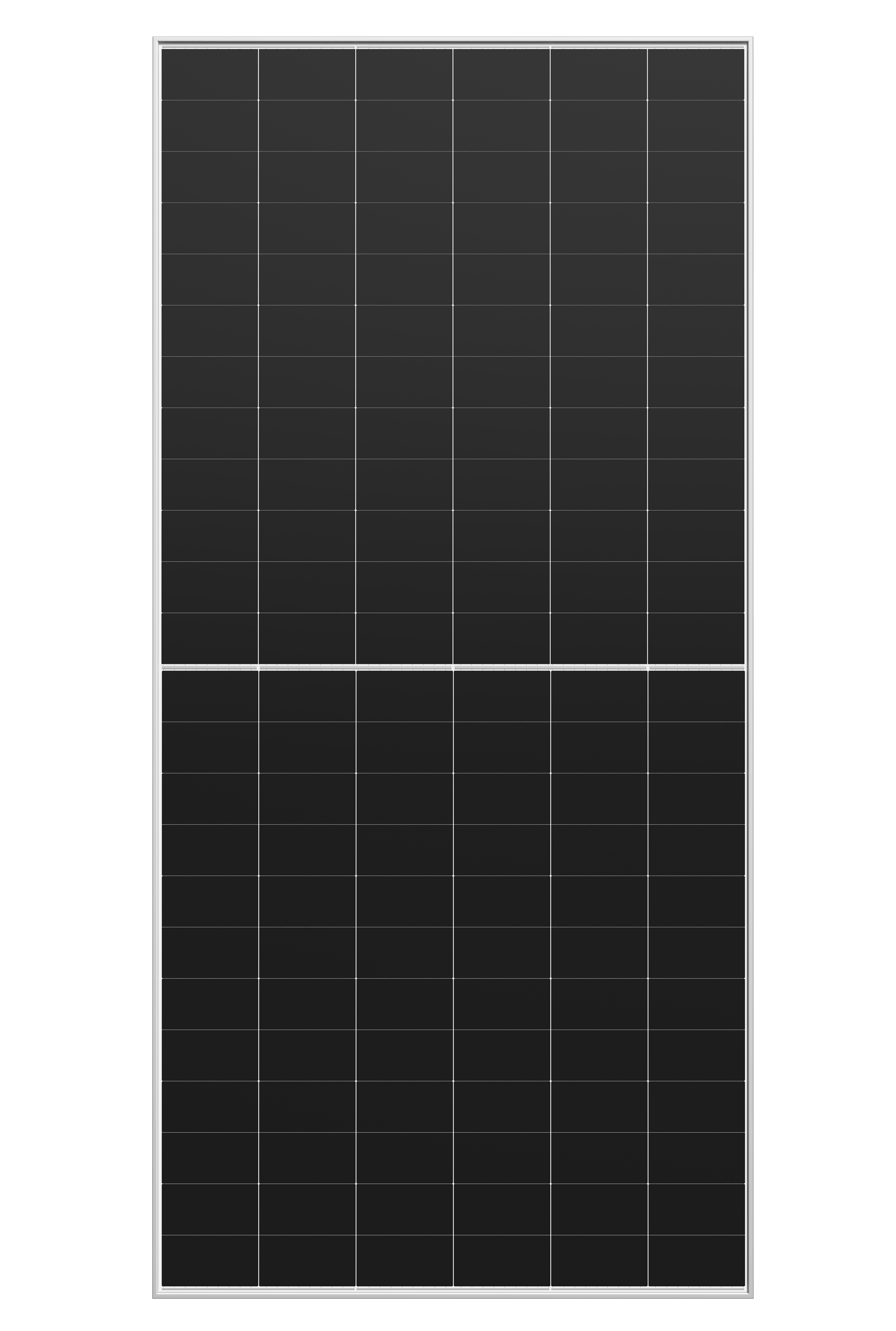
Longi Solar LR7-72HYD-645M

LR7-72HYD-645M

645 Wp N-type Bifacial 70%
ComparePV verdict

Efficiency leader, no clear weak spot

Rank 1,358 of 14,005
Compare panels Datasheet PDF
Power (Wp)
645
Strong · top 3%
Efficiency (%)
23.90
Strong · top 2%
Density (Wp/m²)
238.8
Strong · top 2%
Temp (%/°C)
-0.260
Strong · top 4%
Weight (kg)
33.5
Typical · median 32.5 kg
Warranty (yrs)
30
Typical · median 30 yrs

The Longi Solar Hi-MO 9 LR7-72HYD 625-660M series was designed to maximize yield in PV farms, where power density per hectare and stable performance under real-world conditions are key. Its core feature is the HPBC 2.0 back-contact cells - without front busbars for collecting current, more light reaches the silicon directly, and the module looks aesthetically pleasing while delivering higher performance even under weaker sunlight.

In practice, the biggest advantage of the Hi-MO 9 is higher tolerance to partial shading losses. The current flow architecture in BC, combined with an integrated shading management approach, helps minimize production drops and the risk of localized overheating, which is crucial for installations with uneven irradiance, dirt accumulation, or periodic shading.

Additionally, the use of 0BB and advanced passivation solutions supports reliability and long-term parameter stability. This is the series for investors and EPCs who want to extract more energy from the same surface area and stand out with higher yields, rather than just the module price.

Ranking

359 panels in the segment N-type 600-650 W
Metric This panel Median Position in segment Overall rank
Module efficiency 23.90% 22.77% Strong · top 2% 351
Power density 238.8 227.7 Strong · top 2% 356
Temperature coefficient -0.260 -0.290 Strong · top 4% 511
Weight per kWp 51.9 52.7 Typical 5,361
Performance warranty 30 yrs 30 yrs Typical 21
Colour key Strong - top 25% Typical - middle 50% Weak - bottom 25%

Signals from the data

8 positive · 1 caution
Best for

Utility-scale and shaded-installations.

Strengths
23.90% module efficiency

Top 2% of the N-type 600-650 W segment, against a median of 22.77%. Ranked 351st in the whole database.

238.8 watts per square metre

Top 2% of the N-type 600-650 W segment, against a median of 227.7. Ranked 356th in the whole database.

-0.260 %/°C temperature coefficient

Top 4% of the N-type 600-650 W segment, against a median of -0.290. Ranked 511th in the whole database.

What owners get
Record 24.4% efficiency via HPBC 2.0

Back contact cells without front busbars enable a maximum efficiency of 24.4%, matching Canadian Solar TOPBiHiKu6 (24.4%) and clearly outperforming AE Solar AURORA ME-132 (21.27%) and PolyCrown Monocrystalline120 (23.32%).

Strong partial-shading tolerance (STAC)

STAC interconnection technology reduces power loss under single-cell shading by more than 70% compared to conventional non-BC modules, meaningfully cutting production losses in installations with uneven irradiance.

Low temperature coefficient of -0.260%/°C

The Pmax temperature coefficient of -0.260%/°C beats typical PERC modules (around -0.35%/°C) and many TOPCon designs (around -0.29 to -0.30%/°C), translating into higher yield during high module operating temperatures.

30-year linear power warranty

The manufacturer guarantees less than 1% degradation in year one and a maximum of 0.35% per year thereafter, resulting in over 87.4% of nominal power after 30 years - a longer term and better end-point guarantee than the typical 25-year warranties offered by some tier-1 competitors.

Bankable Tier-1 manufacturer with 25-year track record

LONGi Solar has operated since 2000 and holds Tier-1 bankable status, easing project financing for utility-scale PV and lowering risk for investors and EPCs compared to less-established brands in the peer set.

Trade-offs
Lower bifaciality than TOPCon competitors

Bifaciality is rated at 75%±5% (up to roughly 80%), while the power- and efficiency-matched Canadian Solar TOPBiHiKu6 (bifacial TOPCon) reaches up to 85%. This is a typical trade-off of back-contact architecture - rear-side metallization limits the potential rear-side energy gain in installations on high-albedo surfaces.

Notes from the database
  • At 23.9% efficiency, this panel is 1.1pp above typical N-type 600-650W modules (median: 22.8%)
  • At 238.8 W/m² power density, this panel generates 11.1 W/m² more per unit area than N-type 600-650W median (227.7 W/m²)
  • At -0.26%/°C (vs median -0.29%/°C), loses ~1% less power in hot conditions
  • Weight of 33.5 kg is typical for N-type 600-650W panels
  • Bifaciality factor of 70% can add 4-10% extra yield with reflective mounting surface

Specifications

Open datasheet PDF
Nominal power (Pmax) 645 Wp Nameplate at 1000 W/m², 25 °C
Module efficiency 23.90 % Strong Segment median 22.77%
Vmpp · Impp 44.77 V · 14.41 A Operating point at max power
Voc · Isc 54.12 V · 15.06 A Sizes the string length
Max system voltage 1500 V Longer strings than 1000 V modules
Dimensions 2382×1134×30 mm · 2.70 m² of roof
Weight 33.5 kg Typical Typical · median 32.5 kg
Cells 144 · N-type Monocrystalline
Bifaciality 70 % Rear output as a share of front
Coefficient Pmax -0.260 %/°C Strong top 4% of its segment
Coefficient Voc · Isc -0.200 · 0.050 %/°C
NOCT 45 °C At 800 W/m², 20 °C ambient
Product warranty 12 years Hardware defects only
Performance warranty 30 years Typical median 30 yrs · median 30 yrs
End-of-warranty output 88.8 % Equals 573 W guaranteed
Degradation 1.00 → 0.35 % First year, then annual

Datasheet charts

Open datasheet PDF

Measured curves published by Longi Solar in this model's datasheet. A chart carrying a wattage was measured on that variant alone - only the ones that describe 645 Wp appear here. The rest cover the whole series.

Simulations

Live - change any input
Lifetime output & value
30 years at 1200 kWh/kWp/year and €0.50 per kWh
Power in year 30
-
Lifetime energy
-
Energy value
-
With bifacial gain
-

Degradation from this panel's own datasheet figures. No inverter, soiling or shading losses.

Heat losses
-0.260 %/°C against a segment median of -0.290
-
Bifacial gain
Rear gain over light concrete: -
-

Model: bifaciality × albedo × 0.6 view factor. A first-order estimate, not a yield simulation.

Filter these
Size
Panel Power Eff. Temp. Weight Difference
Longi Solar LR7-72HYD-645M 645 W 23.90% -0.260 33.5 kg You are here
AIKO-A650-MAE72Mw 650 W 25.20% -0.260 27.0 kg Lighter, +1.3 pp
AIKO-A680-MDE72Mw 680 W 25.20% -0.260 29.0 kg +35 W, lighter, +1.3 pp
AIKO-A675-MDE72Mw 675 W 25.00% -0.260 29.0 kg +30 W, lighter, +1.1 pp
AIKO-A645-MAE72Mw 645 W 25.00% -0.260 27.0 kg Lighter, +1.1 pp
AIKO-A695-MAE78Dw 695 W 24.90% -0.260 34.5 kg +50 W, heavier, +1.0 pp
AIKO-G670-MCH72Mw 670 W 24.80% -0.260 28.2 kg +25 W, lighter, +0.9 pp
LR7-72HVHF-670M 670 W 24.80% -0.260 28.5 kg +25 W, lighter, +0.9 pp
LR8-66HGD-595M 595 W 22.00% -0.280 32.5 kg -50 W, hotter, -1.9 pp
LR7-72HGD-600M 600 W 22.20% -0.280 33.5 kg -45 W, hotter, -1.7 pp
600M 600 W 22.40% -0.280 31.0 kg -45 W, -1.5 pp, -5 yr warranty
LR7-72HTH-605M 605 W 22.40% -0.280 28.5 kg Lighter, -1.5 pp, -5 yr warranty
AIKO-A700-MAE78Dw 700 W 25.00% -0.260 34.5 kg +55 W, heavier, +1.1 pp
JKM650-670N-66QL6-BDV (670W class) 670 W 24.80% -0.260 32.5 kg +25 W, lighter, +0.9 pp

Found 1119 panels of the same or similar size to this one, within ±10 mm. See them here Found 1125 panels of the same or similar size to this one, within ±25 mm. See them here Found 1236 panels of the same or similar size to this one, within ±50 mm. See them here Found 1917 panels of the same or similar size to this one, within ±100 mm. See them here

Common questions

6 answered
What warranty does LONGi Solar offer on the Hi-MO 9 LR7-72HYD 625–660M series?
LONGi Solar provides a 12-year product warranty (materials and workmanship) and a 30-year linear power warranty for the Hi-MO 9 LR7-72HYD series. Degradation is capped at less than 1% in year one and no more than 0.35% per year from years 2 through 30, guaranteeing over 87.4% of nominal power at the end of the warranty period.
What is HPBC 2.0 technology in the LONGi Hi-MO 9 modules and how does it differ from conventional cells?
HPBC 2.0 (Hybrid Passivated Back Contact) is an N-type cell design where all current-collecting contacts are moved to the rear — eliminating front-side busbars entirely. This allows more light to reach the silicon directly, pushing module efficiency up to 24.4%. The temperature coefficient of –0.26%/°C is a measurable improvement over first-generation HPBC 1.0 (–0.29%/°C) and most competing technologies.
Do LONGi Hi-MO 9 LR7-72HYD 660M panels perform well in high summer temperatures?
Yes. With a temperature coefficient of –0.26%/°C, the Hi-MO 9 series loses less power as module temperature rises compared to PERC or HPBC 1.0. At a typical operating temperature of 65°C, power loss is roughly 10.4%, versus 14–15% for standard PERC modules. This translates into a measurably higher annual energy yield in warm climates or installations with limited airflow behind the modules.
Is the Hi-MO 9 LR7-72HYD series bifacial, and how much extra energy can be harvested from rear-side irradiance?
Yes, the Hi-MO 9 LR7-72HYD is a bifacial, dual-glass module. The rear side captures irradiance reflected from the ground or rooftop surface. With a typical albedo of 20–30% (light gravel or concrete), bifacial gain can range from 5–15% additional annual production compared to a monofacial module of the same rated power. The gain is most pronounced in ground-mount farms with a bright substrate and an optimized tilt angle.
What are the dimensions and weight of the LONGi Hi-MO 9 LR7-72HYD 660M — will it fit standard utility-scale mounting systems?
The panel measures 2382 × 1134 × 30 mm and weighs 33.5 kg. The footprint matches the Hi-MO 7 form factor, so Hi-MO 9 is compatible with racking systems designed for previous-generation 72-cell modules. The module uses 144 half-cut cells in the 210 mm format. When sizing strings, note the open-circuit voltage (Voc) of 53.30 V for the 660 M variant and verify MPPT input range with your inverter.
Are LONGi Hi-MO 9 LR7-72HYD panels suitable for installations with partial shading from trees or nearby structures?
The busbar-free HPBC 2.0 back contact architecture reduces hot-spot risk and limits the cascade shading losses that affect conventional PERC strings. Compared to standard modules, the Hi-MO 9 is less susceptible to string-level power drops from localized shade. For sites with predictable partial shading, pairing the modules with power optimizers or microinverters will further maximize yield and protect long-term reliability.
Add to compare