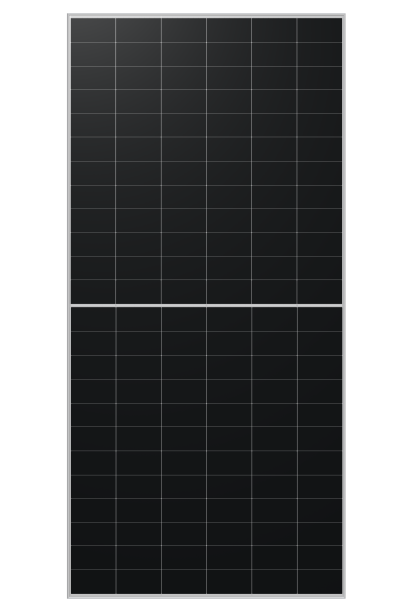
Space saver, no clear weak spot
Longi Solar Hi-MO X10 Scientist (LR7-72HVD 640-665M) is designed to maximize energy yield where every square meter counts and production predictability is key. Its foundation is HPBC 2.0 back-contact technology, an architecture with contacts moved to the rear side-eliminating front-side metal pathways that hinder light absorption. In practice, this translates to better real-world performance, not just in the lab.
A key advantage is the built-in shading optimizer, which minimizes losses when shade from a chimney, branch, or rooftop installation falls on the panel. Additionally, the 0BB (zero busbar) structure efficiently collects current and enhances aesthetics, often a crucial factor in visible rooftop installations. The applied multilayer structure helps utilize light more effectively and stabilize long-term performance.
This is an excellent choice for demanding rooftop systems, commercial installations, and C&I projects where resilience to partial shading and high module efficiency are significant advantages.
Ranking
Signals from the data
Commercial, utility-scale and shaded-installations.
Top 16% of the N-type 650-700 W segment, against a median of 233.2.
Top 17% of the N-type 650-700 W segment, against a median of 23.31%.
Top 24% of the N-type 650-700 W segment, against a median of -0.290.
Cells with contacts moved to the rear eliminate front-side busbars, enabling up to 24.6% efficiency - on par with the best back-contact modules on the market (Sunpro 24.62%, Talesun 24.6%) and clearly ahead of legacy PERC and standard TOPCon.
The dedicated HPBC 2.0 architecture reduces power loss under partial shading by about 70% compared to conventional TOPCon modules (manufacturer data), which matters for roofs with chimneys, dormers, or nearby structures.
A -0.26%/°C coefficient is roughly 0.03 pp better than typical TOPCon modules (~-0.29%/°C), translating into smaller output losses on hot days and higher yield in warmer climates.
Degradation of ≤1% in the first year and ≤0.35%/year thereafter results in about 88.85% retained power after 30 years - better than the standard 25-year warranties with ~84-85% retention typical of many competing series.
Longi Solar has operated since 2000 and holds bankable Tier-1 status, easing project financing for C&I installations and providing added confidence in long-term warranty support versus less established brands.
Back-contact HPBC modules, including Hi-MO X10, are positioned by Longi as a premium tier - priced above its own TOPCon Hi-MO 6 series and mainstream TOPCon offerings from competitors. The higher cost per Wp may not be justified in projects where LCOE, rather than maximum power density, is the primary driver.
- 24.4% module efficiency - 1.1pp better than the N-type 650-700W median of 23.3%
- At 244.3 W/m² power density, this panel generates 11.1 W/m² more per unit area than N-type 650-700W median (233.2 W/m²)
- Temperature coefficient of -0.26%/°C vs median -0.29%/°C means ~1% less power loss at 65°C
- 70% bifaciality enables rear-side power generation, boosting yield by 4-10% on reflective surfaces
- #113 for efficiency, #515 for temperature performance out of 14129 panels
Specifications
Datasheet charts
Measured curves published by Longi Solar in this model's datasheet. A chart carrying a wattage was measured on that variant alone - only the ones that describe 660 Wp appear here. The rest cover the whole series.

Simulations
Degradation from this panel's own datasheet figures. No inverter, soiling or shading losses.
Model: bifaciality × albedo × 0.6 view factor. A first-order estimate, not a yield simulation.




Found 1144 panels of the same or similar size to this one, within ±10 mm. See them here Found 1150 panels of the same or similar size to this one, within ±25 mm. See them here Found 1261 panels of the same or similar size to this one, within ±50 mm. See them here Found 1942 panels of the same or similar size to this one, within ±100 mm. See them here
About the Hi-MO X10 Scientist (LR7-72HVD 640~665M) series
These answers cover the whole series. Where a figure differs, the specification above is this module's own.