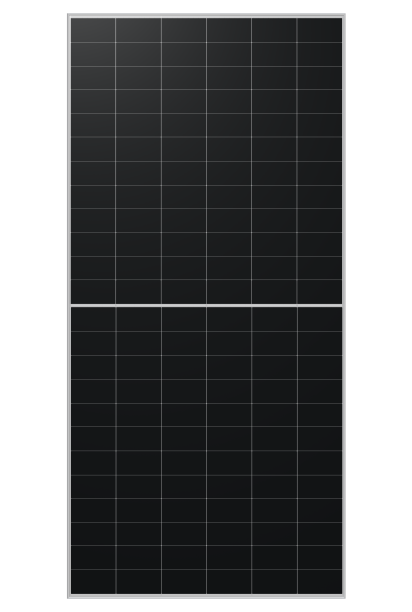
Longi Solar LR7-72HVD-655M

LR7-72HVD-655M

655 Wp N-type Bifacial 70%
ComparePV verdict

Strong in heat, no clear weak spot

Rank 747 of 14,005
Compare panels Datasheet PDF
Power (Wp)
655
Typical for its class
Efficiency (%)
24.20
Typical · median 23.30%
Density (Wp/m²)
242.5
Typical · median 233.2
Temp (%/°C)
-0.260
Strong · top 24%
Weight (kg)
33.5
Typical · median 33.5 kg
Warranty (yrs)
30
Typical · median 30 yrs

Longi Solar Hi-MO X10 Scientist (LR7-72HVD 640-665M) is designed to maximize energy yield where every square meter counts and production predictability is key. Its foundation is HPBC 2.0 back-contact technology, an architecture with contacts moved to the rear side-eliminating front-side metal pathways that hinder light absorption. In practice, this translates to better real-world performance, not just in the lab.

A key advantage is the built-in shading optimizer, which minimizes losses when shade from a chimney, branch, or rooftop installation falls on the panel. Additionally, the 0BB (zero busbar) structure efficiently collects current and enhances aesthetics, often a crucial factor in visible rooftop installations. The applied multilayer structure helps utilize light more effectively and stabilize long-term performance.

This is an excellent choice for demanding rooftop systems, commercial installations, and C&I projects where resilience to partial shading and high module efficiency are significant advantages.

Ranking

109 panels in the segment N-type 650-700 W
Metric This panel Median Position in segment Overall rank
Module efficiency 24.20% 23.30% Typical 184
Power density 242.5 233.2 Typical 172
Temperature coefficient -0.260 -0.290 Strong · top 24% 511
Weight per kWp 51.1 50.9 Typical 4,503
Performance warranty 30 yrs 30 yrs Typical 21
Colour key Strong - top 25% Typical - middle 50% Weak - bottom 25%

Signals from the data

6 positive · 1 caution
Best for

Commercial, utility-scale and shaded-installations.

Strengths
-0.260 %/°C temperature coefficient

Top 24% of the N-type 650-700 W segment, against a median of -0.290.

What owners get
HPBC 2.0 back-contact technology

Cells with contacts moved to the rear eliminate front-side busbars, enabling up to 24.6% efficiency - on par with the best back-contact modules on the market (Sunpro 24.62%, Talesun 24.6%) and clearly ahead of legacy PERC and standard TOPCon.

Built-in shading optimizer

The dedicated HPBC 2.0 architecture reduces power loss under partial shading by about 70% compared to conventional TOPCon modules (manufacturer data), which matters for roofs with chimneys, dormers, or nearby structures.

Low power temperature coefficient

A -0.26%/°C coefficient is roughly 0.03 pp better than typical TOPCon modules (~-0.29%/°C), translating into smaller output losses on hot days and higher yield in warmer climates.

30-year power warranty with low degradation

Degradation of ≤1% in the first year and ≤0.35%/year thereafter results in about 88.85% retained power after 30 years - better than the standard 25-year warranties with ~84-85% retention typical of many competing series.

Established Tier-1 manufacturer

Longi Solar has operated since 2000 and holds bankable Tier-1 status, easing project financing for C&I installations and providing added confidence in long-term warranty support versus less established brands.

Trade-offs
Price premium over TOPCon modules

Back-contact HPBC modules, including Hi-MO X10, are positioned by Longi as a premium tier - priced above its own TOPCon Hi-MO 6 series and mainstream TOPCon offerings from competitors. The higher cost per Wp may not be justified in projects where LCOE, rather than maximum power density, is the primary driver.

Notes from the database
  • At 24.2% efficiency, this panel is 0.9pp above typical N-type 650-700W modules (median: 23.3%)
  • Power density of 242.5 W/m² packs 9.3 W/m² more into the same footprint vs N-type 650-700W median (233.2 W/m²)
  • -0.26%/°C temperature coefficient (median: -0.29%/°C) - retains ~1% more power at high temperatures
  • 70% bifaciality enables rear-side power generation, boosting yield by 4-10% on reflective surfaces
  • Ranked #184 out of 14005 panels for efficiency in the database

Specifications

Open datasheet PDF
Nominal power (Pmax) 655 Wp Nameplate at 1000 W/m², 25 °C
Module efficiency 24.20 % Typical Segment median 23.30%
Vmpp · Impp 44.97 V · 14.57 A Operating point at max power
Voc · Isc 54.32 V · 15.22 A Sizes the string length
Max system voltage 1500 V Longer strings than 1000 V modules
Dimensions 2382×1134×30 mm · 2.70 m² of roof
Weight 33.5 kg Typical Typical · median 33.5 kg
Cells 144 · N-type Monocrystalline
Bifaciality 70 % Rear output as a share of front
Coefficient Pmax -0.260 %/°C Strong top 24% of its segment
Coefficient Voc · Isc -0.200 · 0.050 %/°C
NOCT 45 °C At 800 W/m², 20 °C ambient
Product warranty 15 years Hardware defects only
Performance warranty 30 years Typical median 30 yrs · median 30 yrs
End-of-warranty output 88.8 % Equals 582 W guaranteed
Degradation 1.00 → 0.35 % First year, then annual

Datasheet charts

Open datasheet PDF

Measured curves published by Longi Solar in this model's datasheet. A chart carrying a wattage was measured on that variant alone - only the ones that describe 655 Wp appear here. The rest cover the whole series.

Simulations

Live - change any input
Lifetime output & value
30 years at 1200 kWh/kWp/year and €0.50 per kWh
Power in year 30
-
Lifetime energy
-
Energy value
-
With bifacial gain
-

Degradation from this panel's own datasheet figures. No inverter, soiling or shading losses.

Heat losses
-0.260 %/°C against a segment median of -0.290
-
Bifacial gain
Rear gain over light concrete: -
-

Model: bifaciality × albedo × 0.6 view factor. A first-order estimate, not a yield simulation.

Filter these
Size
Panel Power Eff. Temp. Weight Difference
Longi Solar LR7-72HVD-655M 655 W 24.20% -0.260 33.5 kg You are here
AIKO-A650-MAE72Mw 650 W 25.20% -0.260 27.0 kg Lighter, +1.0 pp
AIKO-A680-MDE72Mw 680 W 25.20% -0.260 29.0 kg +25 W, lighter, +1.0 pp
AIKO-A675-MDE72Mw 675 W 25.00% -0.260 29.0 kg +20 W, lighter, +0.8 pp
AIKO-A645-MAE72Mw 645 W 25.00% -0.260 27.0 kg -10 W, lighter, +0.8 pp
AIKO-A700-MAE78Dw 700 W 25.00% -0.260 34.5 kg +45 W, heavier, +0.8 pp
AIKO-A695-MAE78Dw 695 W 24.90% -0.260 34.5 kg +40 W, heavier, +0.7 pp
AIKO-G670-MCH72Mw 670 W 24.80% -0.260 28.2 kg +15 W, lighter, +0.6 pp
LR8-66HGD-595M 595 W 22.00% -0.280 32.5 kg -60 W, hotter, -2.2 pp
LR7-72HGD-600M 600 W 22.20% -0.280 33.5 kg -55 W, hotter, -2.0 pp
600M 600 W 22.40% -0.280 31.0 kg -55 W, -1.8 pp, -5 yr warranty
LR7-72HTH-605M 605 W 22.40% -0.280 28.5 kg -50 W, lighter, -1.8 pp
LR7-72HVHF-670M 670 W 24.80% -0.260 28.5 kg +15 W, lighter, +0.6 pp
JKM650-670N-66QL6-BDV (670W class) 670 W 24.80% -0.260 32.5 kg +15 W, lighter, +0.6 pp

Found 1119 panels of the same or similar size to this one, within ±10 mm. See them here Found 1125 panels of the same or similar size to this one, within ±25 mm. See them here Found 1236 panels of the same or similar size to this one, within ±50 mm. See them here Found 1917 panels of the same or similar size to this one, within ±100 mm. See them here

Common questions

6 answered
What is HPBC 2.0 technology in the LONGi Hi-MO X10 Scientist and how does it differ from standard modules?
HPBC 2.0 is a back contact cell architecture where all electrical contacts are relocated to the rear of the cell, leaving the front surface completely free of busbars and ribbons to maximize light absorption. The LR7-72HVD reaches module efficiency up to 24.6%. The 0BB (zero busbar) design further shortens current transmission distance by 6.5%, adding approximately 5W per module — delivering real-world energy gains that go beyond lab-rated figures.
How does the built-in shading optimizer work in the LONGi Hi-MO X10 Scientist LR7-72HVD, and when does it actually matter?
Unlike conventional modules that bypass entire cell strings under shading, the HPBC 2.0 shading optimizer isolates only the shaded cells, keeping the rest of the module at full output. TÜV Rheinland-certified testing confirms power losses from point-like shading are reduced by over 70% compared to standard TOPCon modules. This translates into measurable daily energy gains on rooftops where chimneys, antennas, or branches cast partial shadows on the panel.
Is the LONGi Hi-MO X10 Scientist LR7-72HVD bifacial, and how much additional energy can it generate?
Yes, the LR7-72HVD is a bifacial dual-glass module with 80% bifaciality. The rear side captures reflected irradiance from rooftop membranes, gravel ballast, or bright ground surfaces and converts it into additional electricity. On flat commercial rooftops with a white TPO or PVC membrane, real-world bifacial gain typically ranges from a few to over ten percent compared to a monofacial module of the same rated power.
What warranty does the LONGi Hi-MO X10 Scientist LR7-72HVD 640–665M come with?
LONGi provides a 15-year product warranty covering materials and workmanship, plus a 30-year linear power output warranty. Degradation is kept to a minimum throughout the 30-year performance horizon. LONGi Solar holds Tier 1 manufacturer status, which carries weight when securing project financing and confirms the company's bankability according to independent market assessments.
Are the LONGi Hi-MO X10 Scientist 640–665M panels a good fit for commercial C&I flat-roof installations?
This series is specifically designed with C&I applications in mind. The large format (approx. 2,382 × 1,134 mm, ~33.5 kg, up to 665 Wp) reduces the number of modules, wiring runs, and mounting points needed per megawatt. Bifaciality pairs well with white flat-roof membranes to boost yield, while the built-in shading optimizer limits losses from HVAC units, skylights, and pipes — directly lowering the installation's LCOE.
How does the LONGi Hi-MO X10 Scientist LR7-72HVD perform in high temperatures during summer?
With a temperature coefficient of -0.26%/°C, the Hi-MO X10 Scientist loses significantly less power on hot days than standard PERC or TOPCon modules. Testing also showed that HPBC 2.0 cells reach a peak temperature of approximately 100°C under point-like shading, while TOPCon modules can exceed 160°C under the same conditions — improving both long-term durability and installation safety.
Add to compare