Leapton LP182*182-M-78-NH-620W

LP182*182-M-78-NH-620W

620 Wp TOPCon
ComparePV verdict

Light for its output, needs the roof space

Rank 1,414 of 14,005
Compare panels Datasheet PDF
Power (Wp)
620
Typical for its class
Efficiency (%)
22.18
Weak · bottom 9%
Density (Wp/m²)
221.8
Weak · bottom 9%
Temp (%/°C)
-0.300
Weak · bottom 19%
Weight (kg)
29.0
Strong · 3.7 kg below median
Warranty (yrs)
30
Typical · median 30 yrs

The Leapton LP182*182-M-78-NH series was designed to maximize energy yield from the same installation area - particularly in situations where every square meter of the structure is valuable. These are monofacial modules based on N-type TOPCon technology cells, which perform more stably over time and better handle less ideal conditions, such as morning and afternoon shading or diffuse light during the autumn and winter seasons. The use of a half-cut design helps to minimize losses and improves the module's performance when partially shaded, which is important on roofs with obstructions (chimneys, skylights, HVAC systems).

In practice, this series solves a common problem for investors - how to increase production without expanding the installation area. Furthermore, the robust construction with an IP68 enclosure ensures reliability in harsh weather conditions. The LP182*182-M-78-NH will be a good choice for large commercial roofs, PV farms, and projects where high efficiency and predictable performance over many years are crucial.

Ranking

1,086 panels in the segment TOPCon 600-650 W
Metric This panel Median Position in segment Overall rank
Module efficiency 22.18% 22.80% Weak · bottom 9% 5,930
Power density 221.8 227.7 Weak · bottom 9% 5,869
Temperature coefficient -0.300 -0.290 Weak · bottom 19% 6,093
Weight per kWp 46.8 53.1 Strong · top 11% 1,343
Performance warranty 30 yrs 30 yrs Typical 21
Colour key Strong - top 25% Typical - middle 50% Weak - bottom 25%

Signals from the data

6 positive · 5 caution
Best for

Commercial, utility-scale and shaded-installations.

Not ideal for

Roofs where every square metre has to count, tight roof space and hot climates.

Strengths
46.8 kg per kWp

Top 11% of the TOPCon 600-650 W segment, against a median of 53.1.

Watch-outs
221.8 watts per square metre

Bottom 9% of the TOPCon 600-650 W segment, against a median of 227.7. Ranked 5,869th in the whole database.

22.18% module efficiency

Bottom 9% of the TOPCon 600-650 W segment, against a median of 22.80%. Ranked 5,930th in the whole database.

-0.300 %/°C temperature coefficient

Bottom 19% of the TOPCon 600-650 W segment, against a median of -0.290.

What owners get
N-type TOPCon cell technology

TOPCon cells deliver lower LID/LeTID degradation and better high-temperature performance than legacy PERC cells, translating into higher and more predictable annual energy yield, especially under diffuse light in fall/winter conditions.

Tier-1 rated manufacturer per BNEF

Leapton holds Tier-1 status from BloombergNEF, confirming module supply to at least six projects above 10 MW financed by independent commercial banks - important for bankability and project financing of PV installations.

Rare Japan-based Tier-1 manufacturer

Founded in 2012 and headquartered in Japan, Leapton is one of the few Japanese manufacturers with Tier-1 status, easing access to bank financing both locally and in export markets.

Half-cut layout and IP68 junction box

The 78 half-cut cell layout reduces losses under partial shading (chimneys, dormers, HVAC units), while the IP68-rated junction box improves resistance to moisture and harsh weather conditions.

High unit power up to 625 Wp

Module power in the 610-625 Wp range reduces the number of modules, cabling, and mounting structure needed on large commercial roofs and PV farms, lowering BoS cost per Wp.

Trade-offs
Efficiency below segment leaders

Module efficiency of 21.82-22.36% is noticeably lower than direct competitors at the same 625 Wp peak power - Longi Hi-MO 7 (23.1%) and DAH Solar DHN-66Z16/DG and DHN-72R20/DG (23.14%) - meaning less power from the same roof area at a comparable module footprint.

No bifacial option in this series

The LP182*182-M-78-NH series is monofacial, while some comparable designs from competitors (e.g., DAH Solar's DG variants) offer dual-glass/bifacial modules that add rear-side yield on reflective mounting surfaces - Leapton does not offer this option within this series.

Notes from the database
  • Efficiency of 22.2% is 0.6pp below the TOPCon 600-650W median (22.8%)
  • Power density of 221.8 W/m² is 5.9 W/m² below TOPCon 600-650W median (227.7 W/m²) - needs more roof space
  • Temperature coefficient of -0.30%/°C matches the TOPCon 600-650W median
  • 29.0 kg weight - 3.7 kg lighter than TOPCon 600-650W median (32.7 kg), reducing installation effort
  • Ranked #5930 out of 14005 panels for efficiency in the database

Specifications

Open datasheet PDF
Nominal power (Pmax) 620 Wp Nameplate at 1000 W/m², 25 °C
Module efficiency 22.18 % Weak Segment median 22.80%
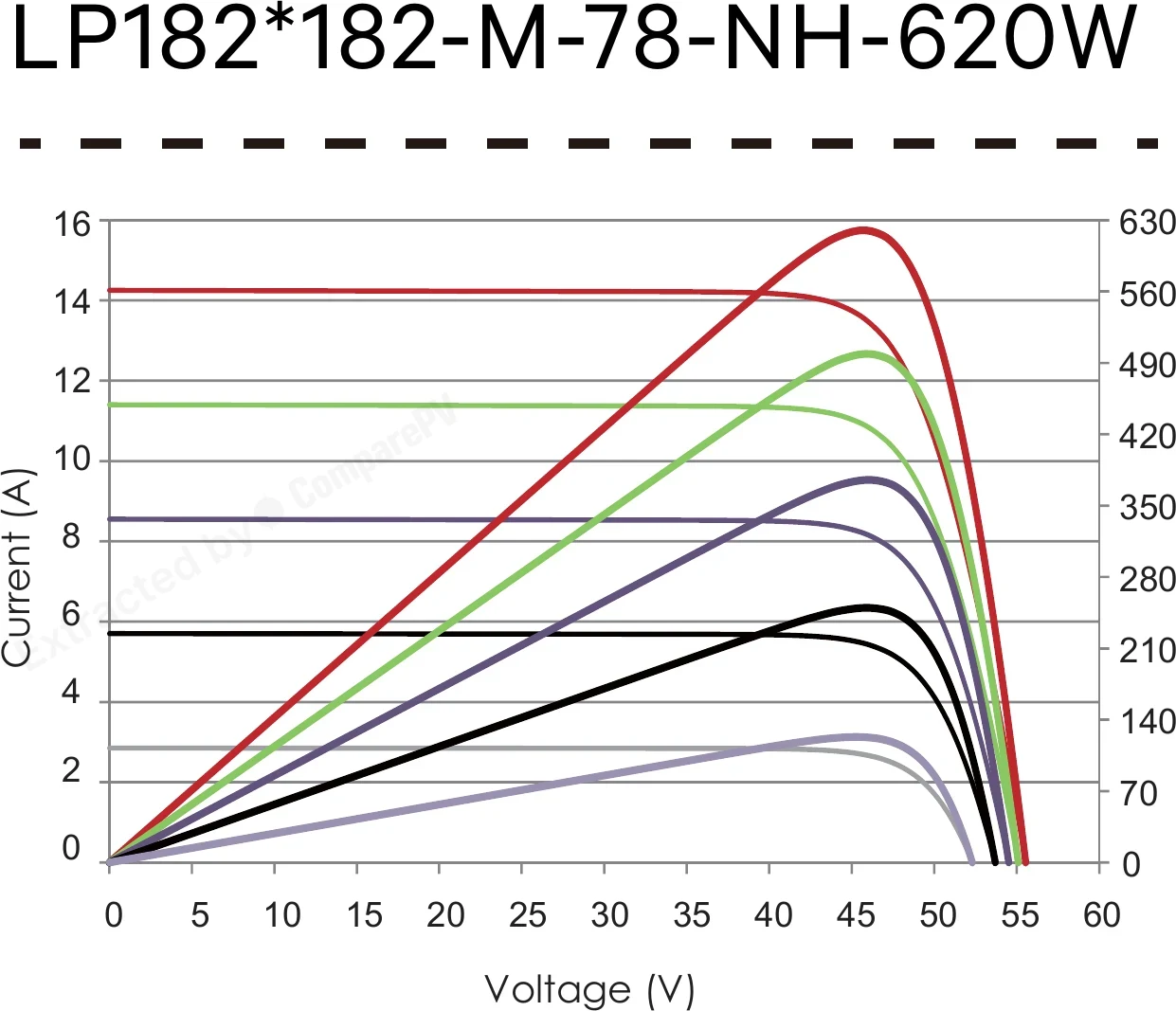
Vmpp · Impp 45.76 V · 13.55 A Operating point at max power
Voc · Isc 55.61 V · 14.09 A Sizes the string length
Max system voltage 1500 V Longer strings than 1000 V modules
Dimensions 2465×1134×30 mm · 2.80 m² of roof
Weight 29.0 kg Strong Strong · 3.7 kg below median
Cells 156 · TOPCon Monocrystalline
Coefficient Pmax -0.300 %/°C Weak bottom 19% of its segment
Coefficient Voc · Isc -0.250 · 0.046 %/°C
NOCT 41 °C At 800 W/m², 20 °C ambient
Product warranty 25 years Hardware defects only
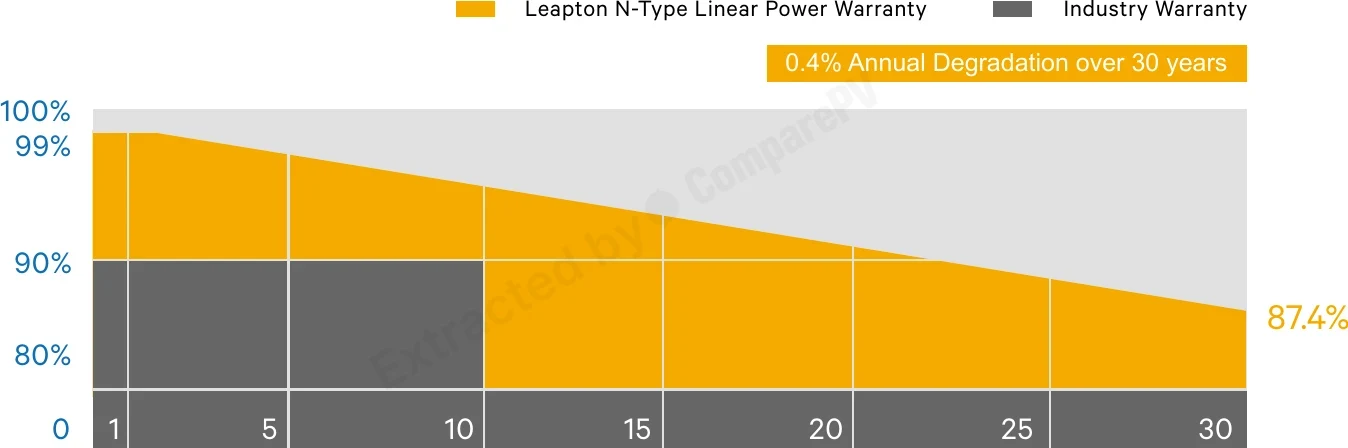
Performance warranty 30 years Typical median 30 yrs · median 30 yrs
End-of-warranty output 87.4 % Equals 542 W guaranteed
Degradation 1.00 → 0.40 % First year, then annual

Datasheet charts

Open datasheet PDF

Measured curves published by Leapton in this model's datasheet. A chart carrying a wattage was measured on that variant alone - only the ones that describe 620 Wp appear here. The rest cover the whole series.
Simulations

Live - change any input
Lifetime output & value
30 years at 1200 kWh/kWp/year and €0.50 per kWh
Power in year 30
-
Lifetime energy
-
Energy value
-

Degradation from this panel's own datasheet figures. No inverter, soiling or shading losses.

Heat losses
-0.300 %/°C against a segment median of -0.290
-
Filter these
Size
Panel Power Eff. Temp. Weight Difference
Leapton LP182*182-M-78-NH-620W 620 W 22.18% -0.300 29.0 kg You are here
AIKO-A650-MAE72Mw 650 W 25.20% -0.260 27.0 kg +30 W, cooler, +3.0 pp
AIKO-A645-MAE72Mw 645 W 25.00% -0.260 27.0 kg +25 W, cooler, +2.8 pp
AIKO-G670-MCH72Mw 670 W 24.80% -0.260 28.2 kg +50 W, cooler, +2.6 pp
LR7-72HVHF-670M 670 W 24.80% -0.260 28.5 kg +50 W, cooler, +2.6 pp
AIKO-A640-MAE72Mw 640 W 24.80% -0.260 27.0 kg +20 W, cooler, +2.6 pp
JKM650-670N-66QL6-BDV (670W class) 670 W 24.80% -0.260 32.5 kg +50 W, cooler, +2.6 pp
LP182*182-M-78-NH-610W 610 W 21.82% -0.300 29.0 kg -10 W, -0.4 pp
LP182*182-M-78-NH-615W 615 W 22.00% -0.300 29.0 kg Very close match
LP182*199-M-72-NB-625W 625 W 22.36% -0.300 34.3 kg Heavier
AIKO-A680-MDE72Mw 680 W 25.20% -0.260 29.0 kg +60 W, cooler, +3.0 pp
AIKO-A675-MDE72Mw 675 W 25.00% -0.260 29.0 kg +55 W, cooler, +2.8 pp
AIKO-A700-MAE78Dw 700 W 25.00% -0.260 34.5 kg +80 W, heavier, +2.8 pp
AIKO-A695-MAE78Dw 695 W 24.90% -0.260 34.5 kg +75 W, heavier, +2.7 pp

Found 616 panels of the same or similar size to this one, within ±10 mm. See them here Found 616 panels of the same or similar size to this one, within ±25 mm. See them here Found 616 panels of the same or similar size to this one, within ±50 mm. See them here Found 1813 panels of the same or similar size to this one, within ±100 mm. See them here

Common questions

6 answered
What warranty does the Leapton LP182*182-M-78-NH series come with?
The LP182*182-M-78-NH series carries a 25-year product warranty and a 30-year linear power warranty. After 30 years, the manufacturer guarantees at least 87.4% of nominal power output. This is among the longest power warranties currently available on the market, significantly reducing investment risk for projects with long payback horizons.
How does the TOPCon technology in the LP182*182-M-78-NH series compare to standard PERC panels?
N-type TOPCon cells feature a lower temperature coefficient (around -0.30%/°C vs. -0.35% to -0.38%/°C for PERC), meaning less power loss on hot days. Annual degradation rates are also lower, and N-type cells are inherently immune to LID (Light Induced Degradation), which typically reduces output in the first months of operation for older PERC modules.
What is the peak power output and efficiency of the LP182*182-M-78-NH panels?
The top variant of the series delivers 625 Wp with a module efficiency of up to 22.36%. Dimensions are 2465 x 1134 x 30 mm with a weight of approximately 29 kg. This high power density means fewer modules are needed to achieve the same energy output compared to older PERC technology, which is especially relevant when roof space or ground area is limited.
How does the LP182*182-M-78-NH series perform under partial shading from a chimney or dormer?
The half-cut cell layout splits each cell in two, reducing the impact of shade on overall module output. Shading one section does not suppress the full panel as severely as with conventional full-cell designs. For rooftops with chimneys, dormers, or HVAC units, it is still advisable to consider power optimizers or microinverters as an additional safeguard for energy yield.
Is Leapton a reliable manufacturer and are the LP182*182-M-78-NH panels certified?
Leapton Energy is a Japanese company classified as Tier 1 by Bloomberg NEF, confirming financial and manufacturing stability. The LP182*182-M-78-NH modules carry TUV, IEC 61215, and IEC 61730 certifications, with testing covering salt mist, ammonia, sand abrasion, and hail resistance. The IP68-rated junction box ensures weatherproof performance in harsh outdoor conditions.
What types of installations is the Leapton LP182*182-M-78-NH series best suited for?
This series is best suited for large commercial rooftop installations, utility-scale PV farms, and industrial projects where maximizing power density per square meter is critical. The 625 Wp peak power and efficiency exceeding 22% reduce installation time and lower Balance of System (BoS) costs by minimizing the number of modules, cables, and mounting components required.
Add to compare