Jinko Solar JKM625-650N-78HL4-BDV (650W)

JKM625-650N-78HL4-BDV (650W)

650 Wp TOPCon Bifacial
ComparePV verdict

Solid all-round for its segment

Rank 1,648 of 14,005
Compare panels Datasheet PDF
Power (Wp)
650
Weak · bottom 13%
Efficiency (%)
23.25
Typical · median 22.40%
Density (Wp/m²)
232.5
Typical · median 223.7
Temp (%/°C)
-0.290
Typical · median -0.290
Weight (kg)
34.0
Typical · median 34.6 kg
Warranty (yrs)
30
Typical · median 30 yrs

Jinko Solar's Tiger Neo 78HL4-BDV series is designed with the goal of achieving maximum yield from every square meter of installation and stable performance year after year. The use of N-type cells in TOPCon technology helps minimize common power losses found in older-generation modules and enhances performance in poorer lighting conditions. The key advantage of this series is the bifacial design combined with dual glass - the module can utilize reflected light from the ground, resulting in a real increase in energy production in PV farms, flat-roof installations, and systems with light membranes or ballast. Additionally, high mechanical strength and a robust module structure facilitate design in challenging wind and snowy regions. The Tiger Neo 78HL4-BDV is the choice for investors, EPC contractors, and companies seeking to reduce LCOE, limit degradation risks, and extract more energy from the same installation footprint.

Ranking

249 panels in the segment TOPCon 650-700 W
Metric This panel Median Position in segment Overall rank
Module efficiency 23.25% 22.40% Typical 1,239
Power density 232.5 223.7 Typical 1,222
Temperature coefficient -0.290 -0.290 Typical 2,165
Weight per kWp 52.3 53.2 Typical 5,769
Performance warranty 30 yrs 30 yrs Typical 21
Colour key Strong - top 25% Typical - middle 50% Weak - bottom 25%

Signals from the data

5 positive · 2 caution
Best for

Commercial, utility-scale and cold-climate.

What owners get
Low degradation – N-type TOPCon

N-type TOPCon cells degrade at approximately 0.4%/year versus ~0.7%/year for P-type PERC modules, with no LID (Light-Induced Degradation) effect. Over a 30-year project lifetime, this translates to several additional percentage points of cumulative energy yield compared to legacy technology.

Up to 23.25% efficiency – top-tier segment

Top variants of the series reach 23.25% module efficiency, matching direct competitors BYD AURO N NLBK-39 (23.25%) and Einnova Solarline TOPCon (23.25%) and trailing Astronergy ASTRO N5 (23.3%) by only 0.05 pp. The series ranks in the top decile of the 625–650 Wp module segment.

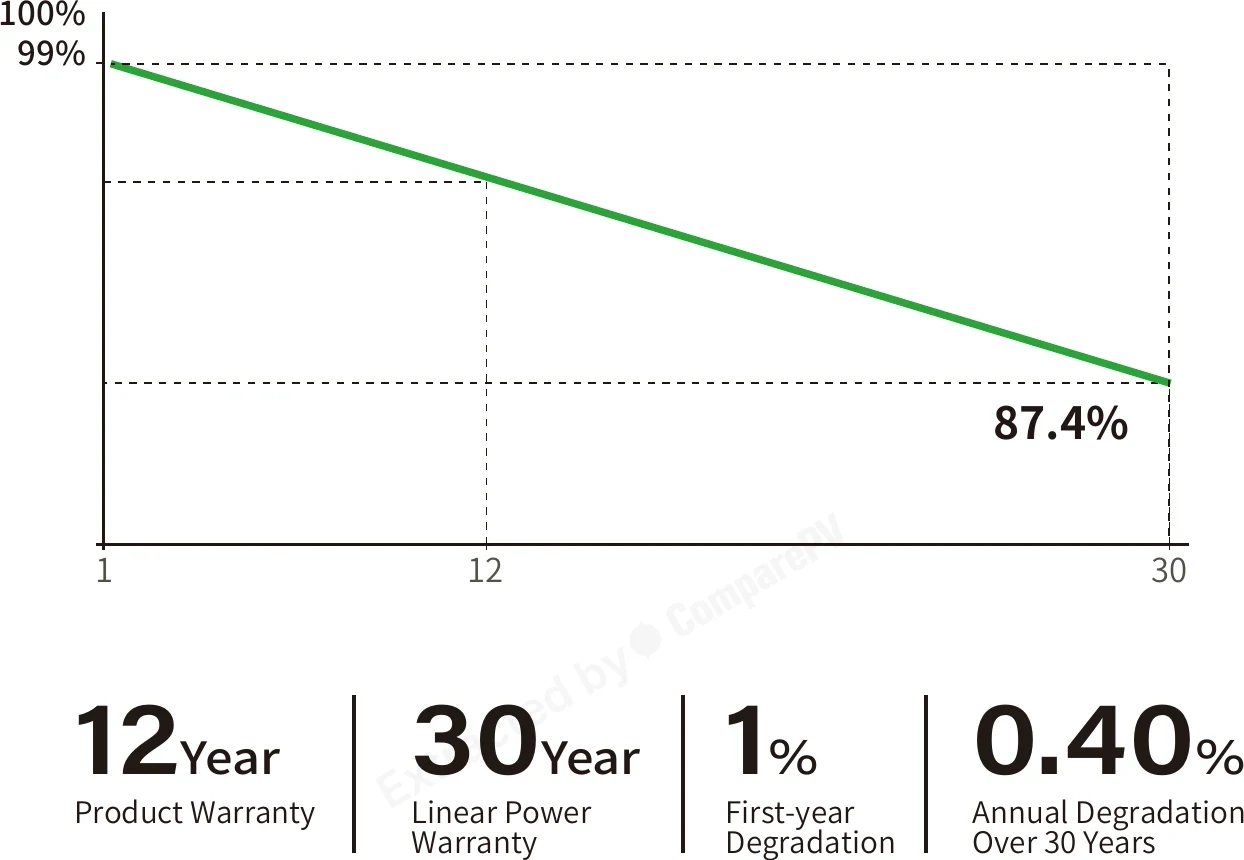
30-year linear power warranty, 87.4% retention

Jinko guarantees at least 87.4% of rated power output after 30 years of operation (degradation ≤0.4%/year) and 99% after Year 1. Many competitors in this price segment offer only 20- or 25-year power warranties, representing meaningfully higher risk in long-horizon financial models (P50/P90).

Bifacial dual glass + 5,400 Pa snow load rating

The glass-glass bifacial design enables albedo-driven energy gain (Jinko claims up to +20% power gain depending on surface reflectivity), while certified mechanical load ratings of 5,400 Pa (snow) and 2,400 Pa (wind) allow deployment in demanding climate zones without additional racking reinforcement.

BNEF #1 Bankability – sole 100% rating

JinkoSolar earned the top spot in Bloomberg BNEF's 2025 PV Module Bankability Survey for the tenth consecutive year, the only manufacturer to receive a 100% bankability rating from participating financial institutions. For EPC contractors and utility-scale developers, this directly reduces project financing costs and simplifies due diligence.

Trade-offs
Module weight ~34 kg – structural demands

The glass-glass construction weighs approximately 34–34.6 kg depending on variant, roughly 4–6 kg heavier than comparable glass-backsheet modules in the same power class. For rooftop retrofits and commercial installations, this may require structural load assessment and additional BoS costs for racking reinforcement.

2021 release – newer generation available

The Tiger Neo 78HL4-BDV was launched in 2021; Jinko introduced Tiger Neo 3.0 in 2024–2025 with module efficiency up to 24.8%. For investors prioritizing the absolute lowest LCOE or the most advanced module in the manufacturer's lineup, the newer generation offers a meaningful ~1.5 pp efficiency advantage at a similar TOPCon architecture.

Notes from the database
  • Efficiency of 23.2% is 0.9pp above the TOPCon 650-700W median (22.4%)
  • Power density of 232.5 W/m² packs 8.8 W/m² more into the same footprint vs TOPCon 650-700W median (223.7 W/m²)
  • At -0.29%/°C, hot weather performance is typical for TOPCon 650-700W panels
  • #1239 for efficiency, #2165 for temperature performance out of 14005 panels

Specifications

Open datasheet PDF
Nominal power (Pmax) 650 Wp Nameplate at 1000 W/m², 25 °C
Module efficiency 23.25 % Typical Segment median 22.40%
Vmpp · Impp 48.33 V · 13.45 A Operating point at max power
Voc · Isc 57.60 V · 14.10 A Sizes the string length
Max system voltage 1500 V Longer strings than 1000 V modules
Dimensions 2465×1134×30 mm · 2.80 m² of roof
Weight 34.0 kg Typical Typical · median 34.6 kg
Cells 156 · TOPCon Monocrystalline
Coefficient Pmax -0.290 %/°C Typical median -0.290 of its segment
Coefficient Voc · Isc -0.250 · 0.045 %/°C
Product warranty 12 years Hardware defects only
Performance warranty 30 years Typical median 30 yrs · median 30 yrs
End-of-warranty output 87.4 % Equals 568 W guaranteed
Degradation 1.00 → 0.40 % First year, then annual

Datasheet charts

Open datasheet PDF

Measured curves published by Jinko Solar in this model's datasheet. A chart carrying a wattage was measured on that variant alone - only the ones that describe 650 Wp appear here. The rest cover the whole series.
Simulations

Live - change any input
Lifetime output & value
30 years at 1200 kWh/kWp/year and €0.50 per kWh
Power in year 30
-
Lifetime energy
-
Energy value
-

Degradation from this panel's own datasheet figures. No inverter, soiling or shading losses.

Heat losses
-0.290 %/°C against a segment median of -0.290
-
Filter these
Size
Panel Power Eff. Temp. Weight Difference
Jinko Solar JKM625-650N-78HL4-BDV (650W) 650 W 23.25% -0.290 34.0 kg You are here
AIKO-A650-MAE72Mw 650 W 25.20% -0.260 27.0 kg Cooler, lighter, +1.9 pp
AIKO-A680-MDE72Mw 680 W 25.20% -0.260 29.0 kg +30 W, lighter, +1.9 pp
AIKO-A675-MDE72Mw 675 W 25.00% -0.260 29.0 kg Cooler, lighter, +1.8 pp
AIKO-A645-MAE72Mw 645 W 25.00% -0.260 27.0 kg Cooler, lighter, +1.8 pp
AIKO-A700-MAE78Dw 700 W 25.00% -0.260 34.5 kg +50 W, cooler, +1.8 pp
AIKO-A695-MAE78Dw 695 W 24.90% -0.260 34.5 kg +45 W, cooler, +1.6 pp
AIKO-G670-MCH72Mw 670 W 24.80% -0.260 28.2 kg Cooler, lighter, +1.6 pp
JKM605N-78HL4-BDV 605 W 21.64% -0.300 34.6 kg -45 W, hotter, -1.6 pp
JKM610N-78HL4-BDV 610 W 21.82% -0.300 34.6 kg -40 W, hotter, -1.4 pp
JKM615-635N-78HL4-(V)-F6-EN (615W) 615 W 22.00% -0.290 29.5 kg -35 W, lighter, -1.2 pp
JKM615-635N-78HL4-(V)-F6-EN (620W) 620 W 22.18% -0.290 29.5 kg -30 W, lighter, -1.1 pp
LR7-72HVHF-670M 670 W 24.80% -0.260 28.5 kg Cooler, lighter, +1.6 pp
JKM650-670N-66QL6-BDV (670W class) 670 W 24.80% -0.260 32.5 kg +20 W, cooler, +1.6 pp

Found 616 panels of the same or similar size to this one, within ±10 mm. See them here Found 616 panels of the same or similar size to this one, within ±25 mm. See them here Found 616 panels of the same or similar size to this one, within ±50 mm. See them here Found 1813 panels of the same or similar size to this one, within ±100 mm. See them here

Common questions

6 answered
What warranty does the Jinko Solar Tiger Neo 78HL4-BDV come with?
The Tiger Neo 78HL4-BDV series comes with a 12-year product warranty covering manufacturing defects and material faults, plus a 30-year linear power output warranty guaranteeing at least 87.4% of rated power at year 30. Jinko Solar holds Tier 1 manufacturer status, providing financial stability and reliable warranty enforcement throughout the entire coverage period.
How does the TOPCon technology in the Tiger Neo 78HL4-BDV compare to older PERC panels?
N-type TOPCon cells deliver lower LID (light-induced degradation) and higher module efficiency of approximately 22.5%, compared to a typical 20–21% for PERC. The power temperature coefficient of around -0.29%/°C means less output loss on hot days. The Tiger Neo 78HL4-BDV generates more energy from the same roof area, with the improvement being most visible during summer months.
Does the bifacial design of the Tiger Neo 78HL4-BDV actually boost energy yield on flat roofs?
Yes, the bifacial gain is most significant on flat roofs covered with a light-colored membrane or gravel. Reflected irradiance absorbed by the rear glass can increase yield by 5–15% depending on surface albedo. The dual-glass construction also protects the rear cell surface and extends module service life, especially important in installations exposed to moisture and temperature cycling.
How heavy is the Jinko Solar Tiger Neo 78HL4-BDV and can a standard roof structure handle it?
The module measures 2465 × 1134 × 30 mm and weighs approximately 34 kg. This is a standard load for industrial and flat roofs, but a structural assessment is always recommended before installation, especially on older buildings. The module is certified for snow loads of 5400 Pa and wind loads of 2400 Pa, meeting requirements for most central and northern European climate zones.
Is the Tiger Neo 78HL4-BDV suitable for installations in regions with heavy snow and harsh winters?
Yes. The certified snow load rating of 5400 Pa qualifies the panel for demanding winter conditions. The dual-glass construction provides greater mechanical strength than standard backsheet modules. The operating temperature range of -40°C to +85°C ensures the panel withstands severe frost without risk of laminate damage, making it a reliable choice for high-latitude installations.
What is the maximum power output of the Tiger Neo 78HL4-BDV and what type of installations is it designed for?
The top variant in the series reaches 650 Wp under STC conditions. The module is designed primarily for utility-scale PV plants, large commercial rooftops, and industrial installations where high energy yield per square meter and low LCOE matter most. High per-module wattage reduces the total number of modules required, cutting costs on racking, cabling, and labor.
Add to compare