Middle of its segment, modest efficiency
The B60 LE series is primarily distinguished by the use of N-type heterojunction HJT solar cell technology, which provides exceptional efficiency even in low-light and high-temperature conditions - a clear advantage over standard PERC modules commonly available on the market. Double-sided bifacial design with a high bifaciality factor allows for energy generation from both the front and the back of the module - reflected light from the ground or adjacent rows is converted into real energy output without additional investment costs. Glass-on-glass construction with high-quality tempered glass with low iron content provides excellent mechanical and atmospheric resistance, ensuring long-term reliability in demanding operating conditions. The European origin of production is particularly important - modules designed and assembled in Italy meet strict quality standards and gain prominence in the context of sustainable supply chain criteria. The series is primarily targeted at large utility-scale and commercial/industrial installations, where the priority is minimizing BOS (Balance of System) costs and maximizing energy yield per unit area. A 30-year performance warranty with linear and low degradation makes it one of the most competitive offerings in the premium module segment.
Ranking
Signals from the data
Utility-scale, commercial and hot-climate.
Tight roof space, roofs where every square metre has to count and weight-limited structures.
Bottom 11% of the HJT 600-650 W segment, against a median of 22.60%.
Bottom 12% of the HJT 600-650 W segment, against a median of 225.8.
Bottom 13% of the HJT 600-650 W segment, against a median of 54.7.
HJT cells deliver a temperature coefficient of -0.26%/°C vs. -0.30%/°C for TOPCon and -0.35%/°C for PERC. At a cell temperature of 65°C, the HJT panel loses ~10.4% of STC power vs. ~14.0% for a comparable PERC module — a meaningful advantage in utility-scale deployments in warm climates.
HJT cells degrade at ~0.27%/year vs. ~0.40%/year for TOPCon and ~0.50%/year for PERC. Over a 30-year asset life, the HJT vs. TOPCon differential translates to ~3.9 percentage points of higher cumulative energy yield — a measurable improvement in project LCOE.
The bifaciality factor of up to 90% (confirmed for 3SUN B60 LE modules) enables 10–20% additional energy yield in ground-mounted utility-scale installations from reflected irradiance. The glass-glass construction eliminates PID degradation risk and provides robust mechanical protection over the 30-year asset life.
Modules are manufactured in Italy (3SUN/Enel plant in Catania, targeting 3 GW capacity), qualifying for EU regulatory incentives including Italy's 2025 tax break explicitly restricted to EU-manufactured HJT and perovskite modules. Supply chain compliance simplifies ESG-linked project financing and public tender eligibility.
Peak efficiency of 22.6% places the B60 LE above REC Alpha Pro M (22.5%) and on par with MY Solar GOLD HJT (22.61%), reducing BOS land-area requirements. The series sits only 0.3 pp below Suntech Ultra V Pro (22.9%), the highest-efficiency peer comparable in this analysis.
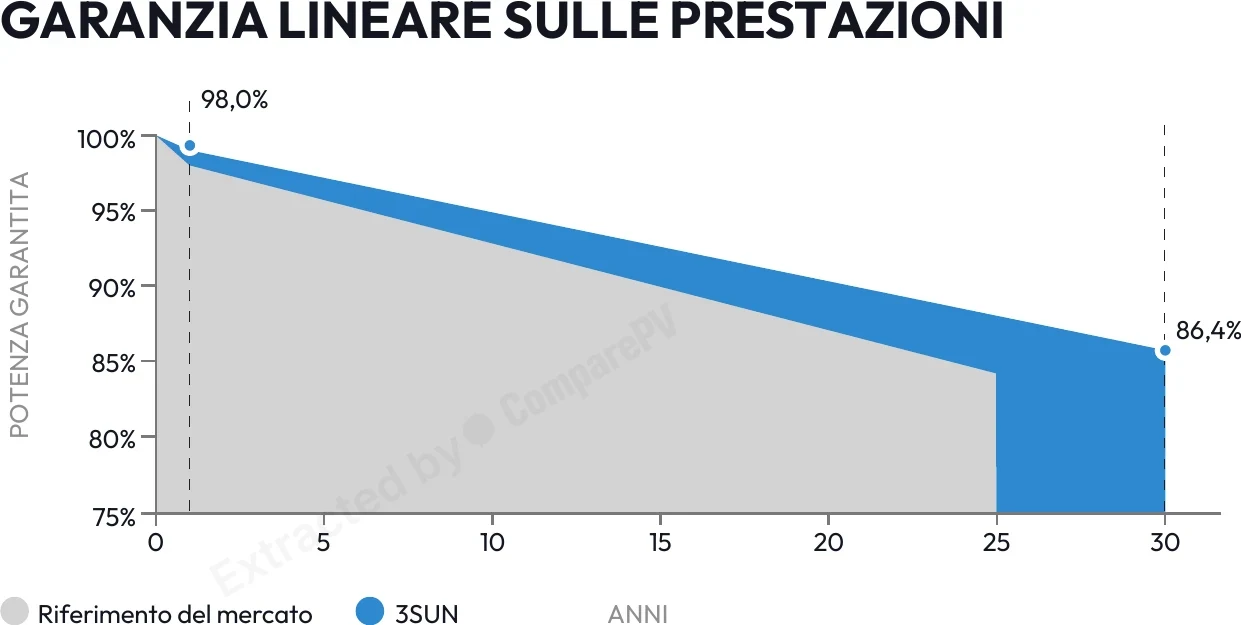
The warranted residual power after 30 years is ≥86.4% Pmax, compared with REC Alpha Pro M's ≥90.75% at ≤0.25%/year degradation. The 4.35 pp gap in warranted end-of-life power may be material when modeling DCF cash flows and satisfying bankability requirements for project-financed utility-scale assets.
The product workmanship warranty covers 15 years, while REC Alpha Pro M provides a standard 20-year product warranty. The shorter coverage period may complicate project finance structures where lenders require manufacturer warranty backing throughout the full loan tenor.
- Module efficiency of 21.9% is 0.7pp below average for HJT 600-650W panels (median: 22.6%)
- Power density of 219.1 W/m² is 6.7 W/m² below HJT 600-650W median (225.8 W/m²) - needs more roof space
- -0.26%/°C temperature coefficient - 0.02pp worse than HJT 600-650W median (-0.24%/°C), expect higher hot weather losses
- At 36.0 kg (2.4 kg above HJT 600-650W median of 33.6 kg), requires checking roof load capacity
- Bifaciality factor of 90% can add 4-14% extra yield with reflective mounting surface
Specifications
Datasheet charts
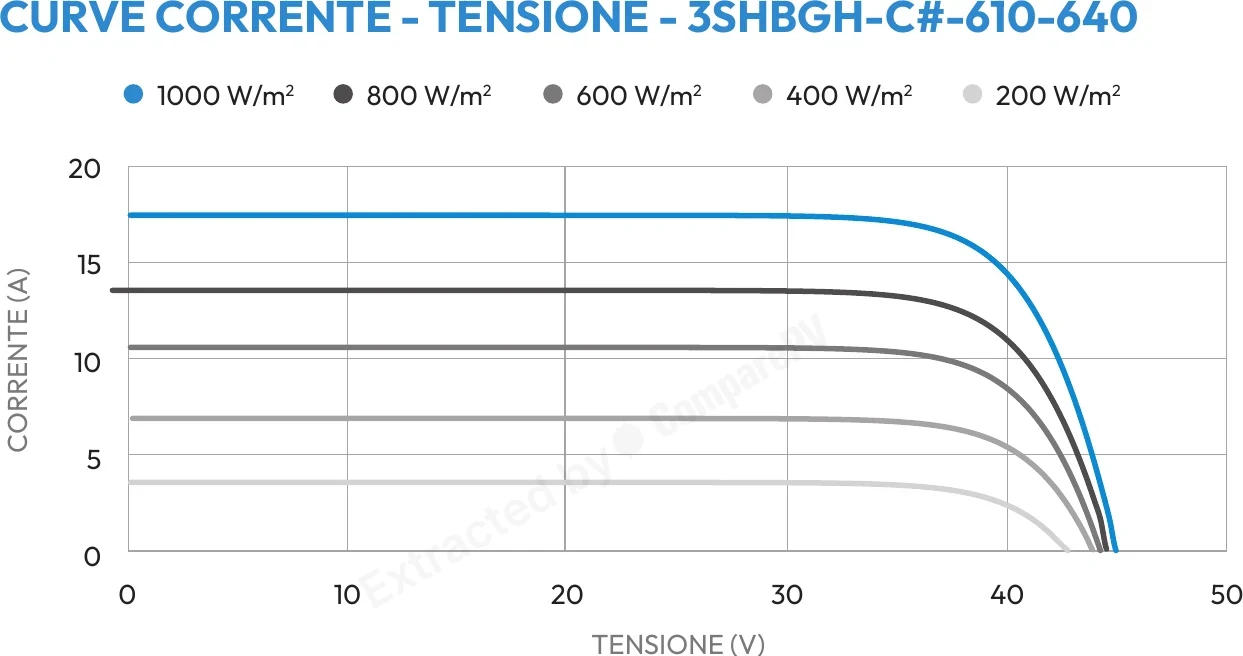
Measured curves published by GL Solar in this model's datasheet. A chart carrying a wattage was measured on that variant alone - only the ones that describe 620 Wp appear here. The rest cover the whole series.
Simulations
Degradation from this panel's own datasheet figures. No inverter, soiling or shading losses.
Model: bifaciality × albedo × 0.6 view factor. A first-order estimate, not a yield simulation.





Found 497 panels of the same or similar size to this one, within ±10 mm. See them here Found 502 panels of the same or similar size to this one, within ±25 mm. See them here Found 502 panels of the same or similar size to this one, within ±50 mm. See them here Found 506 panels of the same or similar size to this one, within ±100 mm. See them here