3SHBGH-C#-625

625 Wp HJT Bifacial 90%
ComparePV verdict

Middle of its segment, heavy for its output

Rank 2,801 of 14,005
Compare panels Datasheet PDF
Power (Wp)
625
Typical for its class
Efficiency (%)
22.10
Weak · bottom 18%
Density (Wp/m²)
220.8
Weak · bottom 16%
Temp (%/°C)
-0.260
Weak · bottom 18%
Weight (kg)
36.0
Weak · 2.4 kg above median
Warranty (yrs)
30
Typical · median 30 yrs

The B60 LE series is primarily distinguished by the use of N-type heterojunction HJT solar cell technology, which provides exceptional efficiency even in low-light and high-temperature conditions - a clear advantage over standard PERC modules commonly available on the market. Double-sided bifacial design with a high bifaciality factor allows for energy generation from both the front and the back of the module - reflected light from the ground or adjacent rows is converted into real energy output without additional investment costs. Glass-on-glass construction with high-quality tempered glass with low iron content provides excellent mechanical and atmospheric resistance, ensuring long-term reliability in demanding operating conditions. The European origin of production is particularly important - modules designed and assembled in Italy meet strict quality standards and gain prominence in the context of sustainable supply chain criteria. The series is primarily targeted at large utility-scale and commercial/industrial installations, where the priority is minimizing BOS (Balance of System) costs and maximizing energy yield per unit area. A 30-year performance warranty with linear and low degradation makes it one of the most competitive offerings in the premium module segment.

Ranking

76 panels in the segment HJT 600-650 W
Metric This panel Median Position in segment Overall rank
Module efficiency 22.10% 22.60% Weak · bottom 18% 6,012
Power density 220.8 225.8 Weak · bottom 16% 6,022
Temperature coefficient -0.260 -0.240 Weak · bottom 18% 511
Weight per kWp 57.6 54.7 Weak · bottom 15% 11,308
Performance warranty 30 yrs 30 yrs Typical 21
Colour key Strong - top 25% Typical - middle 50% Weak - bottom 25%

Signals from the data

5 positive · 5 caution
Best for

Utility-scale, commercial and hot-climate.

Not ideal for

Weight-limited structures, roofs where every square metre has to count and tight roof space.

Watch-outs
57.6 kg per kWp

Bottom 15% of the HJT 600-650 W segment, against a median of 54.7.

220.8 watts per square metre

Bottom 16% of the HJT 600-650 W segment, against a median of 225.8.

22.10% module efficiency

Bottom 18% of the HJT 600-650 W segment, against a median of 22.60%.

What owners get
HJT temperature coefficient: -0.26%/°C

HJT cells deliver a temperature coefficient of -0.26%/°C vs. -0.30%/°C for TOPCon and -0.35%/°C for PERC. At a cell temperature of 65°C, the HJT panel loses ~10.4% of STC power vs. ~14.0% for a comparable PERC module — a meaningful advantage in utility-scale deployments in warm climates.

Lowest annual degradation in class

HJT cells degrade at ~0.27%/year vs. ~0.40%/year for TOPCon and ~0.50%/year for PERC. Over a 30-year asset life, the HJT vs. TOPCon differential translates to ~3.9 percentage points of higher cumulative energy yield — a measurable improvement in project LCOE.

90% bifaciality factor — glass-glass build

The bifaciality factor of up to 90% (confirmed for 3SUN B60 LE modules) enables 10–20% additional energy yield in ground-mounted utility-scale installations from reflected irradiance. The glass-glass construction eliminates PID degradation risk and provides robust mechanical protection over the 30-year asset life.

European manufacturing — EU regulatory upside

Modules are manufactured in Italy (3SUN/Enel plant in Catania, targeting 3 GW capacity), qualifying for EU regulatory incentives including Italy's 2025 tax break explicitly restricted to EU-manufactured HJT and perovskite modules. Supply chain compliance simplifies ESG-linked project financing and public tender eligibility.

Up to 22.6% efficiency — premium segment top

Peak efficiency of 22.6% places the B60 LE above REC Alpha Pro M (22.5%) and on par with MY Solar GOLD HJT (22.61%), reducing BOS land-area requirements. The series sits only 0.3 pp below Suntech Ultra V Pro (22.9%), the highest-efficiency peer comparable in this analysis.

Trade-offs
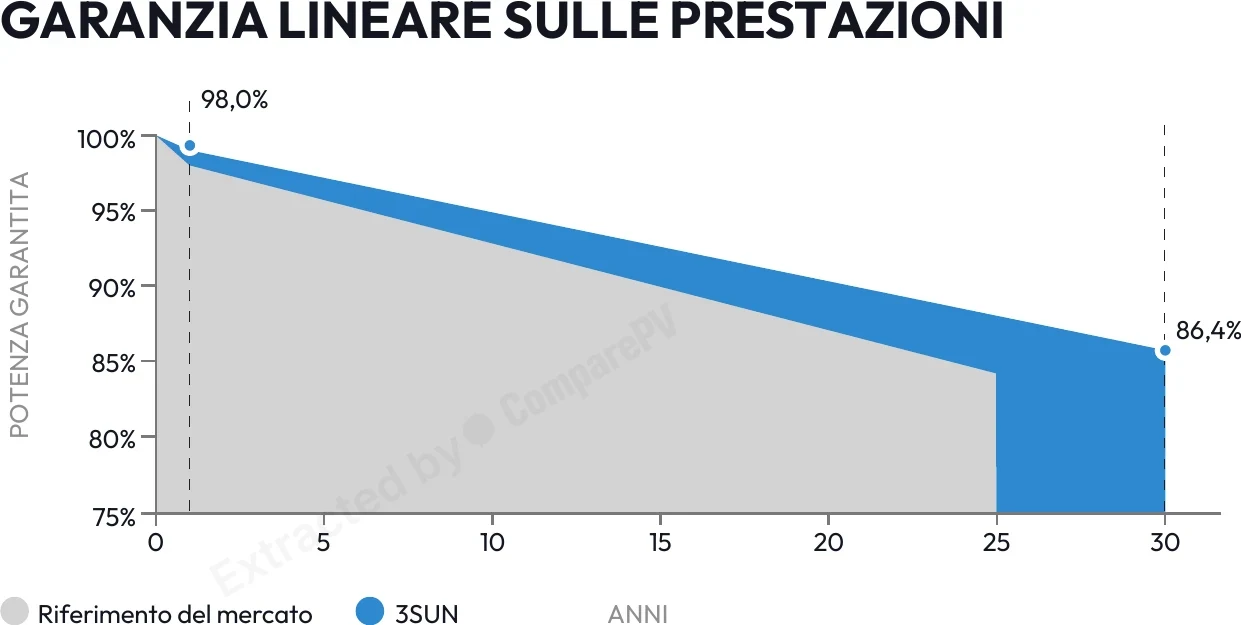
Year-30 power warranty floor: 86.4% vs. 90.75%

The warranted residual power after 30 years is ≥86.4% Pmax, compared with REC Alpha Pro M's ≥90.75% at ≤0.25%/year degradation. The 4.35 pp gap in warranted end-of-life power may be material when modeling DCF cash flows and satisfying bankability requirements for project-financed utility-scale assets.

Product warranty: 15 years vs. 20 years (REC)

The product workmanship warranty covers 15 years, while REC Alpha Pro M provides a standard 20-year product warranty. The shorter coverage period may complicate project finance structures where lenders require manufacturer warranty backing throughout the full loan tenor.

Notes from the database
  • At 22.1% efficiency, this panel is on par with typical HJT 600-650W modules
  • Power density of 220.8 W/m² is 5.0 W/m² below HJT 600-650W median (225.8 W/m²) - needs more roof space
  • At -0.26%/°C, loses 0.02pp more power per degree than HJT 600-650W median (-0.24%/°C)
  • Weight of 36.0 kg is 2.4 kg above HJT 600-650W median (33.6 kg) - verify structural support
  • Bifaciality factor of 90% can add 4-14% extra yield with reflective mounting surface

Specifications

Open datasheet PDF
Nominal power (Pmax) 625 Wp Nameplate at 1000 W/m², 25 °C
Module efficiency 22.10 % Weak Segment median 22.60%
Vmpp · Impp 38.32 V · 16.31 A Operating point at max power
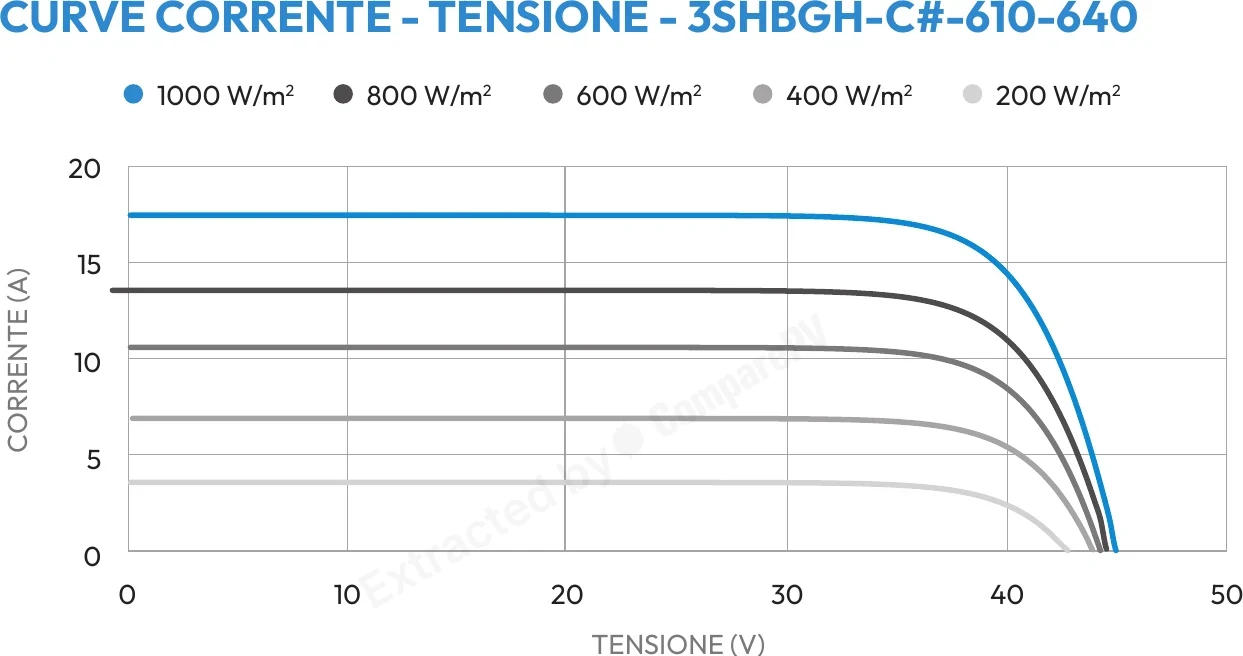
Voc · Isc 45.55 V · 17.44 A Sizes the string length
Max system voltage 1500 V Longer strings than 1000 V modules
Dimensions 2172×1303×35 mm · 2.83 m² of roof
Weight 36.0 kg Weak Weak · 2.4 kg above median
Cells 120 · HJT Monocrystalline
Bifaciality 90 % Rear output as a share of front
Coefficient Pmax -0.260 %/°C Weak bottom 18% of its segment
Coefficient Voc · Isc -0.270 · 0.055 %/°C
NOCT 44 °C At 800 W/m², 20 °C ambient
Product warranty 15 years Hardware defects only
Performance warranty 30 years Typical median 30 yrs · median 30 yrs
End-of-warranty output 86.4 % Equals 540 W guaranteed
Degradation 2.00 → 0.40 % First year, then annual

Datasheet charts

Open datasheet PDF

Measured curves published by GL Solar in this model's datasheet. A chart carrying a wattage was measured on that variant alone - only the ones that describe 625 Wp appear here. The rest cover the whole series.
Simulations

Live - change any input
Lifetime output & value
30 years at 1200 kWh/kWp/year and €0.50 per kWh
Power in year 30
-
Lifetime energy
-
Energy value
-
With bifacial gain
-

Degradation from this panel's own datasheet figures. No inverter, soiling or shading losses.

Heat losses
-0.260 %/°C against a segment median of -0.240
-
Bifacial gain
Rear gain over light concrete: -
-

Model: bifaciality × albedo × 0.6 view factor. A first-order estimate, not a yield simulation.

Filter these
Size
Panel Power Eff. Temp. Weight Difference
GL Solar 3SHBGH-C#-625 625 W 22.10% -0.260 36.0 kg You are here
AIKO-A650-MAE72Mw 650 W 25.20% -0.260 27.0 kg +25 W, lighter, +3.1 pp
AIKO-A675-MDE72Mw 675 W 25.00% -0.260 29.0 kg +50 W, lighter, +2.9 pp
AIKO-A645-MAE72Mw 645 W 25.00% -0.260 27.0 kg +20 W, lighter, +2.9 pp
AIKO-G670-MCH72Mw 670 W 24.80% -0.260 28.2 kg +45 W, lighter, +2.7 pp
LR7-72HVHF-670M 670 W 24.80% -0.260 28.5 kg +45 W, lighter, +2.7 pp
AIKO-A640-MAE72Mw 640 W 24.80% -0.260 27.0 kg +15 W, lighter, +2.7 pp
JKM650-670N-66QL6-BDV (670W class) 670 W 24.80% -0.260 32.5 kg +45 W, lighter, +2.7 pp
3SHBGH-C#-610 610 W 21.60% -0.260 36.0 kg -15 W, -0.5 pp
3SHBGH-C#-615 615 W 21.70% -0.260 36.0 kg -10 W, -0.4 pp
3SHBGH-C#-620 620 W 21.90% -0.260 36.0 kg -0.2 pp
3SHBGH-C#-630 630 W 22.30% -0.260 36.0 kg Very close match
3SHBGH-C#-635 635 W 22.40% -0.260 36.0 kg +10 W, +0.3 pp
3SHBGH-C#-640 640 W 22.60% -0.260 36.0 kg +15 W, +0.5 pp
GKA210N120 680 W 24.03% -0.340 28.0 kg Hotter, lighter, +1.9 pp
GKA210N120-675 675 W 23.85% -0.340 28.0 kg Hotter, lighter, +1.8 pp
QN-670HJT-01 670 W 23.70% -0.240 35.5 kg +45 W, cooler, +1.6 pp

Found 497 panels of the same or similar size to this one, within ±10 mm. See them here Found 502 panels of the same or similar size to this one, within ±25 mm. See them here Found 502 panels of the same or similar size to this one, within ±50 mm. See them here Found 506 panels of the same or similar size to this one, within ±100 mm. See them here

Common questions

6 answered
How does HJT cell technology in the GL Solar B60 LE differ from standard PERC modules?
HJT (heterojunction) cells combine a monocrystalline silicon wafer with amorphous silicon layers, delivering a lower temperature coefficient and higher efficiency under diffuse light compared to standard PERC modules. In practice, this means better energy yield on overcast days and during morning or evening hours, when PERC panels experience more significant performance losses.
What is the power warranty for the GL Solar B60 LE and what does linear degradation mean?
The B60 LE series comes with a 30-year power output warranty and a 15-year product warranty. Linear degradation means the manufacturer guarantees a gradual, predictable power decline following a fixed schedule over the entire warranty period — with no sudden output drops — enabling more reliable financial modeling for the project's lifetime.
Is the 640 Wp GL Solar B60 LE panel suitable for large-scale industrial and utility-scale installations?
Yes, the B60 LE series with a peak output of 640 Wp is designed specifically for utility-scale projects and commercial or industrial facilities. The high per-module power rating reduces the total panel count required, directly lowering BoS (balance of system) costs and simplifying installation logistics across large surface areas.
What does bifacial mean for the GL Solar B60 LE and how much extra energy can I expect from the rear side?
Bifacial means the module generates electricity from both its front and rear surfaces by capturing light reflected from the ground, rooftop, or adjacent panel rows. The actual energy gain depends on the albedo of the underlying surface (light gravel, white membrane, snow), but typically ranges from a few to over ten percent of additional yield at no extra installation cost.
Why does Italian manufacturing matter for the GL Solar B60 LE in tenders and subsidy applications?
Modules designed and assembled in Italy meet strict European quality standards and make it easier to demonstrate a sustainable supply chain — increasingly required in public tenders and subsidy programs based on Made in Europe criteria. European manufacturing also reduces exposure to import tariffs and the risks associated with long, complex logistics chains.
How do GL Solar B60 LE panels perform in high summer temperatures?
HJT technology has a lower temperature coefficient than PERC cells, so B60 LE modules lose less power as temperatures rise. On hot summer days, when cell temperature can exceed 70°C, these panels maintain higher efficiency than comparable monoPERC modules — resulting in meaningfully higher energy yields over the full annual production cycle, especially in high-irradiance environments.
Add to compare