Efficiency leader, weak in heat
The GCL M12/66H photovoltaic module series redefines performance standards in the commercial sector, based on advanced silicon cells with an impressive 210 mm format. The use of M12-type large-area cell technology allows for achieving unprecedented power density, which directly translates into a significant reduction in BOS system costs and a smaller number of required mounting structures. Thanks to the use of a modern Multi-Busbar (MBB) system, these panels guarantee a significantly shorter current flow path, which effectively minimizes resistive losses and increases the module's resistance to potential micro-cracks occurring over many years of operation. This solution is primarily dedicated to conscious investors and developers of large farms who strive to maximize energy yields while simultaneously lowering the LCOE ratio. A key differentiator of the series from the competition is its excellent performance at low solar irradiance, which guarantees stable electricity production even in less favorable weather conditions. Additionally, the precisely designed structure ensures increased mechanical strength against extreme wind pressure and snow loads, which is crucial for the long-term safety of the installation in the Polish climate zone. Choosing GCL M12/66H is a strategic investment in technology that optimizes every square meter of available roof or ground space.
Ranking
Signals from the data
Commercial and utility-scale.
Hot climates and owners who want a long output guarantee.
Top 13% of the PERC 650-700 W segment, against a median of 21.25%.
Top 18% of the PERC 650-700 W segment, against a median of 212.5.
Bottom 10% of the PERC 650-700 W segment, against a median of -0.340.
Bottom 21% of the PERC 650-700 W segment, against a median of 30 yrs.
GCL-SI has maintained continuous Tier-1 status on the Bloomberg NEF list for multiple years (confirmed under the BNEF March 2026 methodology), enabling project financing via non-recourse debt and satisfying the due diligence requirements of most infrastructure funds.
The 210 mm cell format delivers 660-680 W per module, requiring fewer racking structures and DC cables compared to conventional 400-500 W modules, directly lowering the Balance of System (BoS) cost per kWp. The multi-busbar architecture shortens current-flow paths and reduces resistive losses.
Modules have passed salt mist (IEC 61701), ammonia corrosion (IEC 62716), and sand blowing (DIN EN 60068-2-68) tests, making them suitable for coastal, agricultural, and industrial installations and confirming readiness for long-term PPA agreements.
Module efficiency is comparable to direct competitors in the P-type PERC 210 mm segment: SpolarPV SPV680-TG12-132BD and Solaria SPVxxx-TG12-132BD reach 21.92%, indicating that the GCL M12/66H is in line with the segment median and delivers similar power density per m².
The manufacturer declares high resistance to Potential-Induced Degradation (PID) through the selection of encapsulant materials and an automated production line certified to ISO 9001/14001/45001, reducing the risk of premature degradation over the 25-year power output warranty horizon.
In 2025-2026, the utility-scale market is migrating to N-type TOPCon and ABC. The direct peer AIKO Comet 3N72 (ABC N-type) achieves 25.2% efficiency versus 21.9% for the GCL M12/66H - a 3.3 percentage-point gap translating to approximately 15% more module area required to achieve the same plant output. Additionally, PERC exhibits a higher Light-Induced Degradation (LID) rate compared to N-type technologies.
The M12/66H series is monofacial (is_bifacial: false), whereas in the ground-mount segment for plants above 1 MWp, bifacial modules have become the de facto standard, generating 5-20% additional energy from ground-reflected irradiance depending on surface albedo. The absence of bifaciality reduces annual energy yield and project IRR.
The product warranty is 12 years, while leading Tier-1 manufacturers (Jinko Tiger Neo, LONGi Hi-MO 7) have moved to a 15-year standard for commercial modules. In the context of 25-year PPAs or project debt financing, a shorter product warranty period may require additional legal protections or dedicated reserves in the financial model.
- At 21.6% efficiency, this panel is on par with typical PERC 650-700W modules
- 215.7 W/m² power density - 3.2 W/m² more than PERC 650-700W median (212.5 W/m²), more power per roof area
- At -0.35%/°C, hot weather performance is typical for PERC 650-700W panels
- Ranked #7716 out of 14129 panels for efficiency in the database
Specifications
Datasheet charts
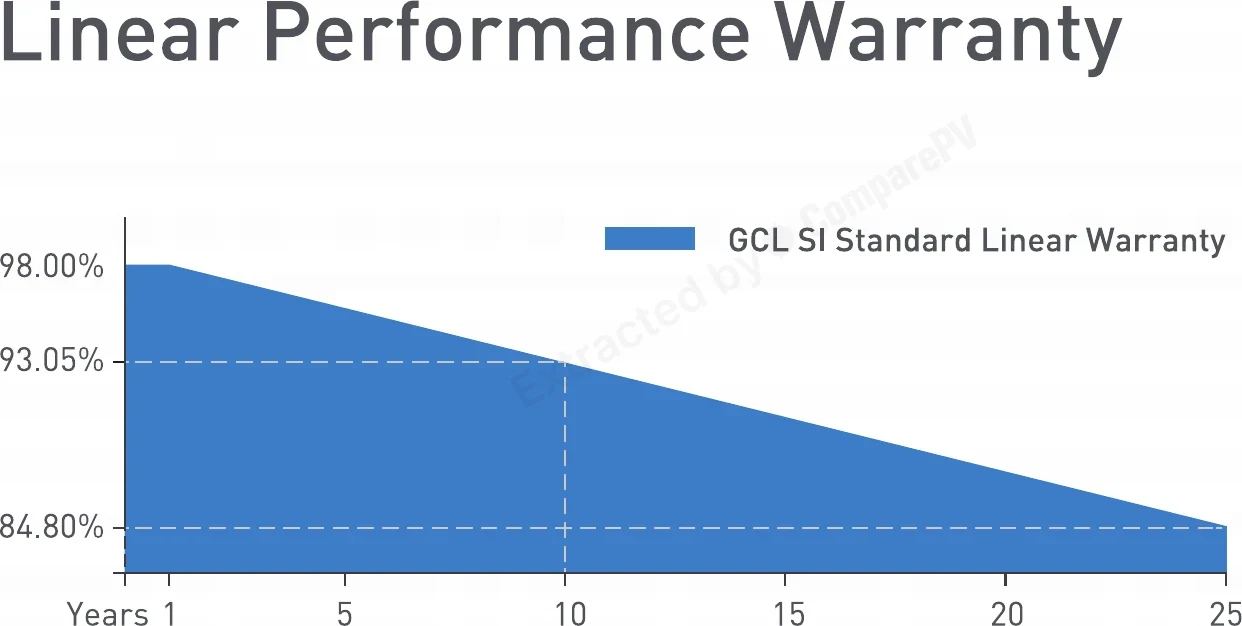
Measured curves published by GCL in this model's datasheet. A chart carrying a wattage was measured on that variant alone - only the ones that describe 670 Wp appear here. The rest cover the whole series.
Simulations
Degradation from this panel's own datasheet figures. No inverter, soiling or shading losses.




Found 1393 panels of the same or similar size to this one, within ±10 mm. See them here Found 1403 panels of the same or similar size to this one, within ±25 mm. See them here Found 1403 panels of the same or similar size to this one, within ±50 mm. See them here Found 1435 panels of the same or similar size to this one, within ±100 mm. See them here
About the M12/66H series
These answers cover the whole series. Where a figure differs, the specification above is this module's own.