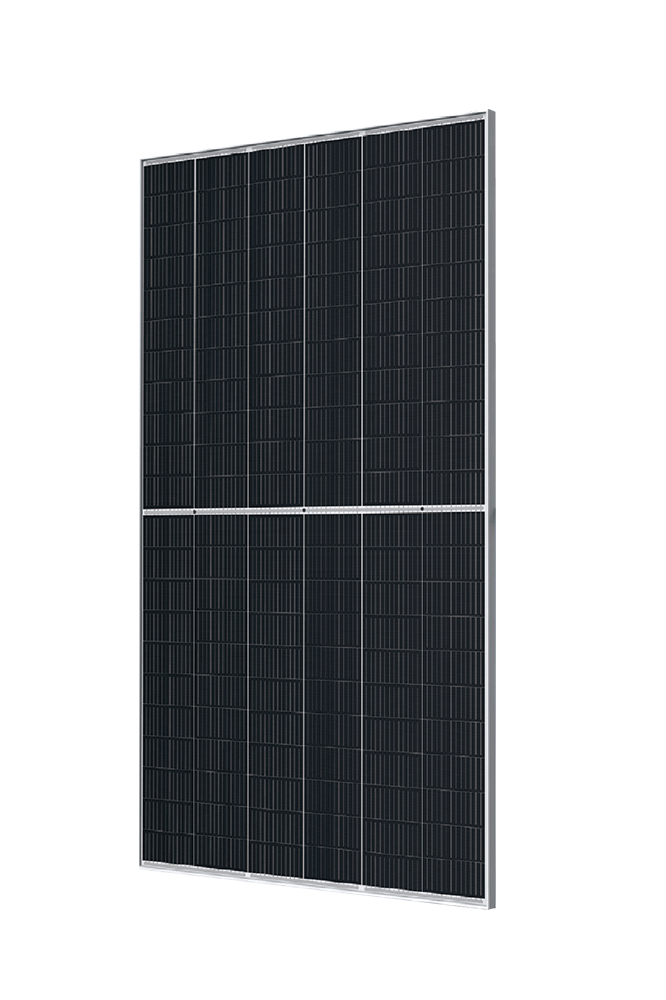
Middle of its segment, heavy for its output
Series GCL GCL-M12/66GDF are modules designed for maximum yield in installations where every meter counts, and reliable performance in challenging conditions. The application of a bifacial structure allows for the actual use of reflected light from the ground, which is particularly beneficial on light surfaces, ground-mounted installations, and where you design higher mounting frames. The key advantage of this series is its dual glass construction - glass-glass - which supports durability, minimizes the risk of degradation related to moisture, and enhances resistance to typical operational issues.
The GCL-M12/66GDF targets safe and predictable yields in projects where the schedule and maintenance are costly: PV farms, agrivoltaics, and <b-floating</b> installations. Thanks to refined production processes, the series is focused on minimizing phenomena such as PID and microcracking, translating to smoother operation and fewer surprises over the long term. In practice, it stands out from the competition by combining high bifacial energy potential with the durability of the glass-glass construction - without compromising on professional applications.
Ranking
Signals from the data
Utility-scale, agrivoltaic and floating.
Weight-limited structures, hot climates and roofs where every square metre has to count.
Bottom 10% of the PERC 650-700 W segment, against a median of 52.3. Ranked 11,892nd in the whole database.
Bottom 10% of the PERC 650-700 W segment, against a median of -0.340.
Bottom 24% of the PERC 650-700 W segment, against a median of 212.5.
The glass-glass encapsulation (2 mm + 2 mm tempered low-iron glass) delivers a snow load rating of up to 5,400 Pa and wind load resistance up to 2,400 Pa. It eliminates moisture-driven degradation risk by removing the rear-side EVA backsheet — a critical advantage in floating and agrivoltaic installations where exposure to condensation is continuous.
The bifacial architecture captures irradiance reflected from the ground surface, yielding an additional 5–25% in annual energy output compared to monofacial modules — depending on the albedo of the mounting surface (grassland ~20%; white roofing membrane ~60–80%). The gain is most significant in ground-mounted systems and agrivoltaic arrays with elevated mounting structures.
The manufacturer guarantees 84.95% of nominal power output after 30 years of operation at an annual degradation rate of ≤0.40%. The peer-comparable Trina Solar Vertex TSM-DE21 675W carries an equivalent warranty scope, confirming that the GCL-M12/66GDF aligns with the top-tier standard for utility-scale modules.
GCL System Integration Technology (GCL-SI) appears on the Bloomberg NEF Tier 1 module manufacturer list, satisfying the rigorous bankability criterion of non-recourse financing for ≥6 projects of ≥10 MW each, backed by ≥6 different lenders. This status directly streamlines project finance for PV plants built on this series.
The peak module efficiency of 21.7% matches the Trina Solar Vertex TSM-DE21 675W (21.7%) and trails the BYD AURO MSTK-33 and Neo Solar Power NESE 655-675-66MHT-G12 (both 21.73%) by only 0.03 percentage points. The gap is below the threshold of practical significance for C&I and utility-scale project design.
P-type PERC cells carry a higher temperature coefficient of Pmax (-0.35%/°C) compared to N-type TOPCon (~-0.29%/°C) and greater susceptibility to LID (Light-Induced Degradation). GCL itself already offers a successor product — the GCL-NT12/66GDF (N-type TOPCon, 700 W, 22.53% efficiency) — indicating that the M12/66GDF series represents technology the market is progressively phasing out; TOPCon is projected to reach approximately 60% share of global module production by 2030.
- At 21.1% efficiency, this panel is on par with typical PERC 650-700W modules
- Power density of 210.9 W/m² matches the PERC 650-700W median
- At -0.35%/°C, hot weather performance is typical for PERC 650-700W panels
- At 38.5 kg, this panel is 4.0 kg heavier than the PERC 650-700W median (34.5 kg) - more demanding for installation crews
- Bifaciality factor of 70% can add 4-10% extra yield with reflective mounting surface
Specifications
Simulations
Degradation from this panel's own datasheet figures. No inverter, soiling or shading losses.
Model: bifaciality × albedo × 0.6 view factor. A first-order estimate, not a yield simulation.




Found 1390 panels of the same or similar size to this one, within ±10 mm. See them here Found 1400 panels of the same or similar size to this one, within ±25 mm. See them here Found 1400 panels of the same or similar size to this one, within ±50 mm. See them here Found 1432 panels of the same or similar size to this one, within ±100 mm. See them here