
Middle of its segment, heavy for its output
The Astronergy ASTRO N7 CHSM66RN(DG)/F-BH series represents a breakthrough in energy efficiency, utilizing state-of-the-art n-type TOPCon 4.0 cells with rectangular silicon wafer technology. This solution eliminates the problem of limited installation space, offering significantly higher power density than standard modules. Thanks to the bifacial double glass construction, these panels effectively absorb light reflected from the ground, which, combined with a double layer of tempered glass, drastically increases resistance to degradation caused by external factors and the PID phenomenon. It is an excellent choice for demanding industrial investors and solar farm owners for whom the lowest levelized cost of energy (LCOE) in a long-term perspective is key. What sets them apart from the competition is an exceptionally low temperature coefficient and better performance in diffused light conditions, which guarantees stable yields even on less sunny days typical of the Polish climate. Innovative SMBB (Super Multi-Busbar) technology optimizes current flow and protects against micro-cracks, ensuring investment security. This series is dedicated to professional systems where the priority is maximum durability and reliability under heavy mechanical loads, making it a leader in the premium bifacial module segment.
Ranking
Signals from the data
Utility-scale, commercial and hot-climate.
Weight-limited structures.
Bottom 18% of the TOPCon 600-650 W segment, against a median of 53.1.
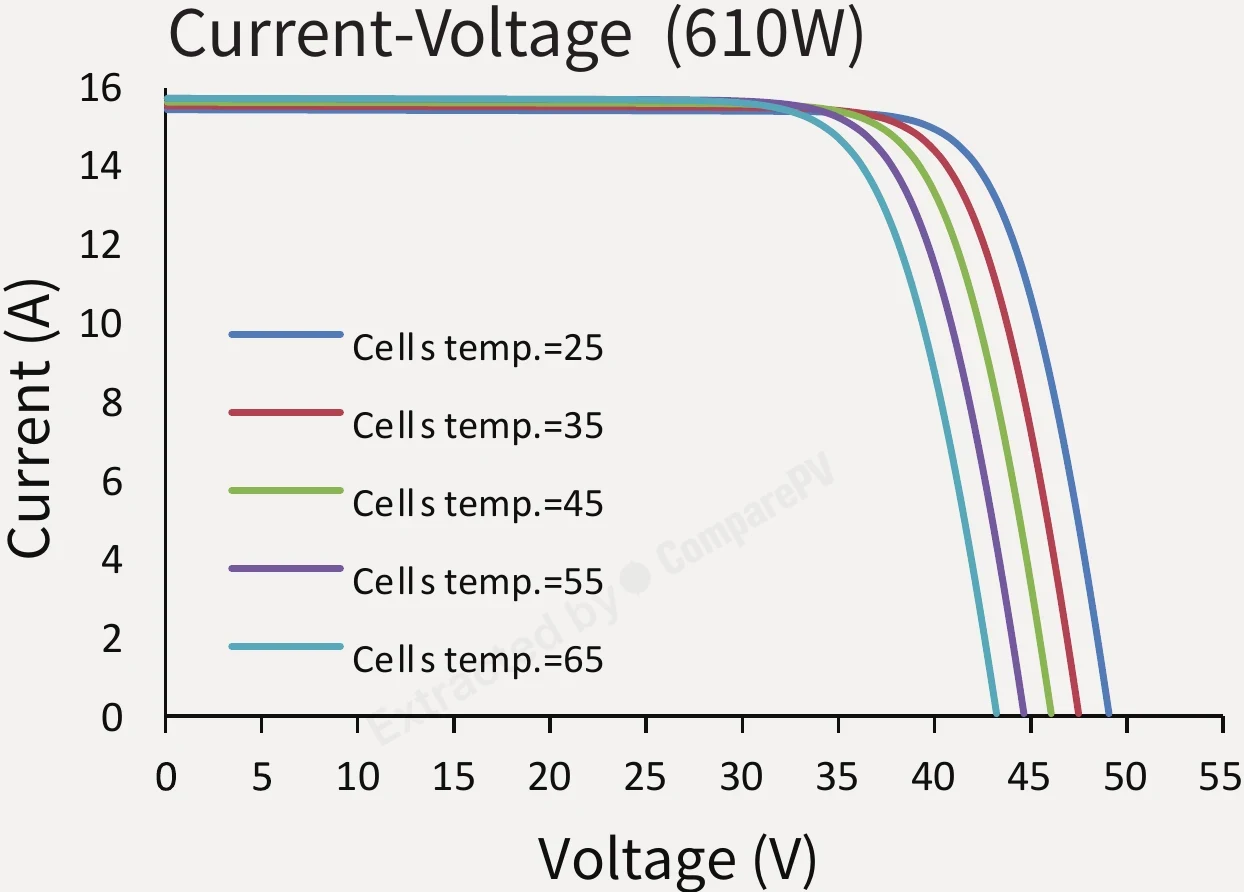
N-type cells exhibit a significantly lower temperature coefficient (~-0.29%/°C) compared to mainstream P-type PERC modules (~-0.35%/°C), translating into measurably higher energy yield on hot days. TOPCon 4.0 technology also eliminates Light-Induced Degradation (LID), a known issue with p-type cells, ensuring more stable output power throughout the module's entire service life.
Dual tempered glass (front/rear) delivers a bifaciality factor of ~85%, which—given appropriate installation conditions (reflective ground surface, suitable tilt angle)—generates an additional 5–25% energy yield from the rear side. The double-glass construction fully eliminates Potential-Induced Degradation (PID) and EVA creep, extending mechanical durability beyond 30 years.
Astronergy guarantees a minimum of 87.4% of nominal power output after 30 years of operation, with an annual degradation rate below 0.40%. The series is directly comparable to the best peer benchmarks in its segment (HT-SAAE, Weran Solar), which offer equivalent 30-year warranty terms, confirming its position among the top-tier quality leaders.
The datasheet officially states that both the product warranty and the power output warranty are underwritten by an international insurer. This is a rare feature in the segment—it provides investors with financial protection even in the event of manufacturer liquidity issues, which is particularly significant for utility-scale solar projects with project finance structures.
In BloombergNEF's 2023 bankability ranking, Astronergy advanced to the Top 6 among global module manufacturers, maintaining Tier-1 status through Q1 2026. This standing facilitates access to project financing from commercial banks and development finance institutions, which is critical for large-scale utility PV projects.
While leading premium-segment manufacturers (Jinko Solar, JA Solar, Trina Solar, LONGi) standardly offer 25-year product warranties covering frames, coatings, and wiring, the Astronergy N7 is limited to 15 years—40% shorter. For long-term industrial projects and PPAs extending beyond 15 years, this may require additional service provisions to be incorporated into contracts, even though the warranty risk is partially mitigated by the insurer-backed coverage.
- Efficiency of 22.6% matches the TOPCon 600-650W median
- At 225.8 W/m² power density, roof space requirements are typical for TOPCon 600-650W panels
- Temperature coefficient of -0.29%/°C matches the TOPCon 600-650W median
- Ranked #3658 out of 14005 panels for efficiency in the database
Specifications
Datasheet charts
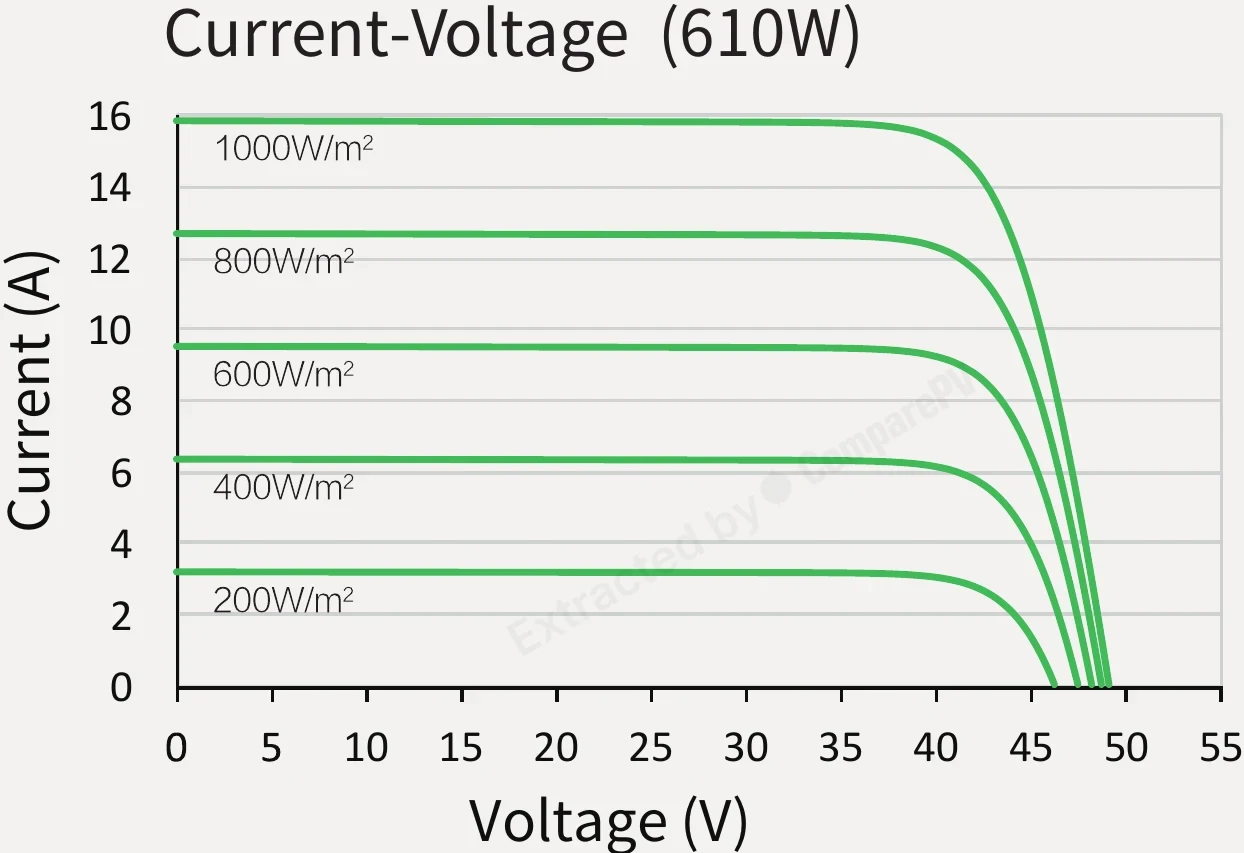
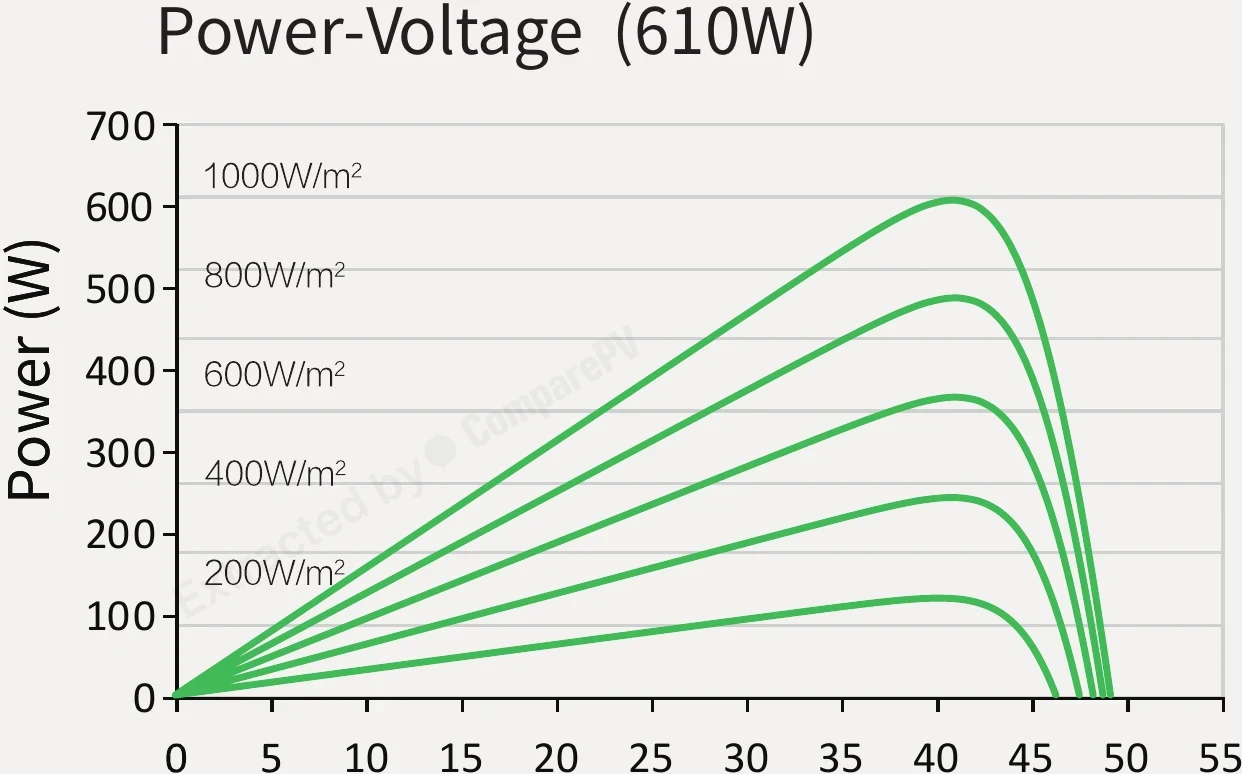
Measured curves published by Astronergy in this model's datasheet. A chart carrying a wattage was measured on that variant alone - only the ones that describe 610 Wp appear here. The rest cover the whole series.

Simulations
Degradation from this panel's own datasheet figures. No inverter, soiling or shading losses.
Model: bifaciality × albedo × 0.6 view factor. A first-order estimate, not a yield simulation.



Found 1119 panels of the same or similar size to this one, within ±10 mm. See them here Found 1125 panels of the same or similar size to this one, within ±25 mm. See them here Found 1236 panels of the same or similar size to this one, within ±50 mm. See them here Found 1917 panels of the same or similar size to this one, within ±100 mm. See them here