Middle of its segment, needs the roof space
The Akcome Kookaburra series redefines efficiency standards on the Polish photovoltaic market, utilizing advanced N-type TOPCon cells. The choice of this technology effectively addresses the issue of light-induced degradation, which guarantees investors stable and predictable energy production over a very long time horizon. These panels are characterized by excellent responsiveness in low irradiance conditions, making them an ideal choice for the Polish climate zone, where cloud cover is frequent. The SMBB technology applied in the modules minimizes the risk of micro-cracks and optimizes current flow, which significantly increases the reliability of the entire system. The Kookaburra series is dedicated to both single-family homeowners looking for real savings and large enterprises focusing on maximum energy independence. It is distinguished from the competition primarily by its exceptionally low temperature coefficient, which allows the modules to maintain high efficiency even during extreme summer heat. The solid frame construction and high resistance to mechanical loads make it a product prepared for the toughest weather conditions. By investing in this series, the user receives maximum yield per unit area, which directly shortens the return on investment time and ensures peace of mind for years.
Ranking
Signals from the data
Commercial, utility-scale and hot-climate.
Roofs where every square metre has to count, tight roof space and weight-limited structures.
Bottom 8% of the HJT 700-750 W segment, against a median of 230.2. Ranked 3,989th in the whole database.
Bottom 13% of the HJT 700-750 W segment, against a median of 23.02%.
Bottom 15% of the HJT 700-750 W segment, against a median of 53.6.
The HJT technology achieves a Pmax temperature coefficient of -0.24%/°C, while N-type TOPCon achieves -0.28%/°C. At a typical module temperature of 55°C (i.e., 30°C above STC), this difference translates to approximately 1.2% higher peak power output on a hot day, which realistically improves peak power production during the hot summer months in Poland.
HJT modules achieve a bifaciality efficiency of 85–95%, while TOPCon maintains a range of 80–85%. With a standard ground albedo of approximately 20% and installation at an appropriate height, the higher bifaciality coefficient provides an additional 3–7% in annual energy yield compared to comparable TOPCon panels.
The structure of the HJT cell (amorphous layers on both sides of the crystalline silicon) eliminates light-induced degradation (LID) and potential-induced degradation (PID). The manufacturer confirms the absence of LID/PID in the Kookaburra series datasheet, ensuring stable power output throughout the 30-year operating lifespan without the start-up losses typical of p-type cells.
The most efficient version achieves 22.54%, placing it just below the Sunket SKT680~700M12-132D5 (22.5%) and Mysolar GOLD TOPCon (22.53%) models, and only 0.20% below the Luxor Solar ECO LINE HJT leader (22.74%). For residential installations with limited roof space, this translates to 5–8% more power from the same area compared to standard TOPCon panels with an efficiency of approximately 21%.
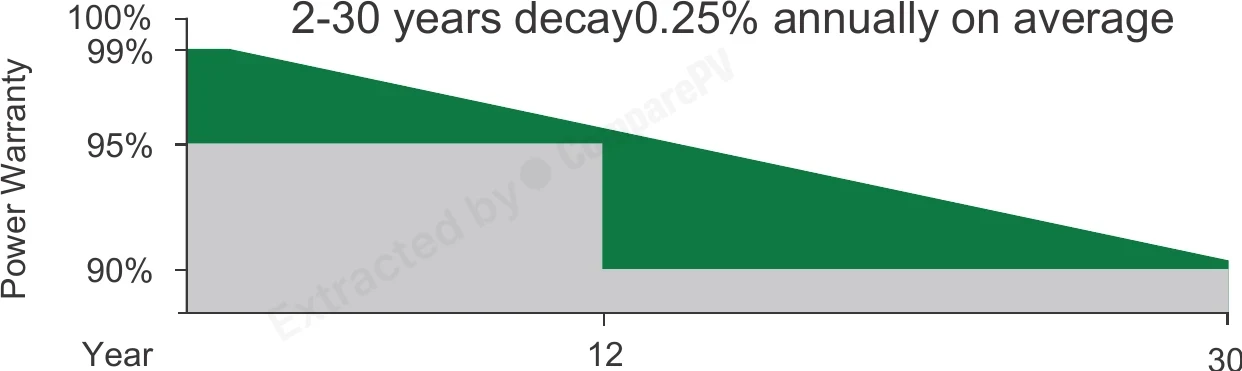
The manufacturer guarantees performance for 30 years, which is the standard for premium HJT technology. The linear warranty minimizes the risk of gradual devaluation when making insurance claims or selling the system.
The warranty on the product (materials and workmanship) is 15 years, while competitors in the HJT segment – such as Luxor Solar ECO LINE HJT – typically offer a standard warranty of 25 years. A shorter product warranty period increases the financial risk for the investor in the event of manufacturing defects that are discovered after 15 years of operation.
Currently, AKCOME is not listed on the BNEF Tier-1 Bankable list (as of Q1-Q2 2025), which may make it difficult or impossible to obtain recourse-free bank financing for solar farm projects exceeding 1 MWp. Banks that finance large-scale installations often require modules from BNEF Tier-1 manufacturers as a condition of the loan agreement.
The HJT technology requires separate production lines and higher silver consumption, which translates to a market price of approximately $0.100/W compared to $0.087/W for TOPCon (data from PV Tech, February 2025). For a 10 kWp installation, this difference amounts to approximately $130, and for a 1 MWp farm, it amounts to approximately $13,000, which reduces the price competitiveness in projects sensitive to capital expenditure (CAPEX).
- At 22.5% efficiency, this panel is on par with typical HJT 700-750W modules
- At 225.3 W/m², this panel generates 4.9 W/m² less per unit area than HJT 700-750W median (230.2 W/m²)
- Temperature coefficient of -0.24%/°C matches the HJT 700-750W median
- Ranked #3920 out of 14005 panels for efficiency in the database
Specifications
Datasheet charts
Measured curves published by AKCOME in this model's datasheet. A chart carrying a wattage was measured on that variant alone - only the ones that describe 700 Wp appear here. The rest cover the whole series.
Simulations
Degradation from this panel's own datasheet figures. No inverter, soiling or shading losses.





Found 1390 panels of the same or similar size to this one, within ±10 mm. See them here Found 1400 panels of the same or similar size to this one, within ±25 mm. See them here Found 1400 panels of the same or similar size to this one, within ±50 mm. See them here Found 1432 panels of the same or similar size to this one, within ±100 mm. See them here