Yingli LF650M10N-66H/BF

Yingli LF650M10N-66H/BF

650 Wp N-type Bifacial 2000%
ComparePV verdict

Solid all-round for its segment

Rank 1,168 of 14,129
Compare panels Datasheet PDF
Power (Wp)
650
Weak · bottom 12%
Efficiency (%)
24.10
Typical · median 23.31%
Density (Wp/m²)
240.6
Typical · median 233.2
Temp (%/°C)
-0.290
Typical · median -0.290
Weight (kg)
32.5
Typical · median 33.5 kg
Warranty (yrs)
30
Typical · median 30 yrs

The Yingli LF650M10N-66H/BF series redefines performance standards through the use of N-type TOPCon cells, which minimize energy losses and offer significantly better resistance to the LID phenomenon compared to traditional solutions. A key distinguishing feature of these modules is bifacial technology, enabling efficient light absorption from both sides of the panel, which, combined with the glass-glass construction, drastically increases the total annual energy yield. This solution perfectly meets the needs of investors implementing utility-scale solar farms and demanding commercial projects where maximizing power from the available area is crucial. Thanks to the use of large M10 wafers and an optimized number of busbars, these panels perform excellently in high-temperature conditions, offering more stable operating characteristics than older generation modules. By choosing this model, the user gains higher efficiency in low-light conditions, which is a significant advantage at Polish latitudes. This design effectively addresses the problem of long-term power degradation, ensuring the security and profitability of the investment for decades. It is a proposition for professionals seeking uncompromising durability and the highest power density, which clearly sets this series apart from standard products currently available on the market.

Ranking

110 panels in the segment N-type 650-700 W
Metric This panel Median Position in segment Overall rank
Module efficiency 24.10% 23.31% Typical 241
Power density 240.6 233.2 Typical 255
Temperature coefficient -0.290 -0.290 Typical 2,220
Weight per kWp 50.0 51.0 Typical 3,329
Performance warranty 30 yrs 30 yrs Typical 21
Colour key Strong - top 25% Typical - middle 50% Weak - bottom 25%

Signals from the data

0 positive · 0 caution
Notes from the database
  • At 24.1% efficiency, this panel is 0.8pp above typical N-type 650-700W modules (median: 23.3%)
  • Power density of 240.6 W/m² packs 7.4 W/m² more into the same footprint vs N-type 650-700W median (233.2 W/m²)
  • Temperature coefficient of -0.29%/°C matches the N-type 650-700W median
  • Weight of 32.5 kg is typical for N-type 650-700W panels
  • Ranked #241 out of 14129 panels for efficiency in the database

Specifications

Open datasheet PDF
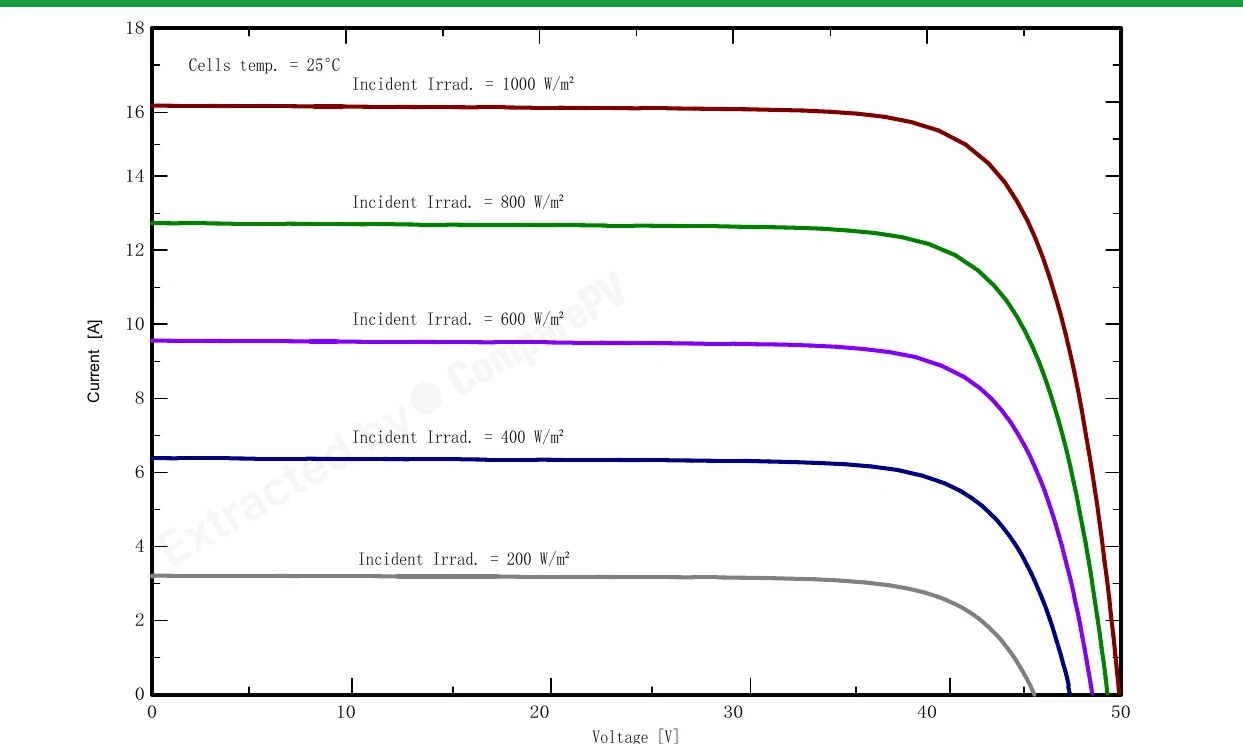
Nominal power (Pmax) 650 Wp Nameplate at 1000 W/m², 25 °C
Module efficiency 24.10 % Typical Segment median 23.31%
Vmpp · Impp 42.05 V · 15.46 A Operating point at max power
Voc · Isc 50.60 V · 16.39 A Sizes the string length
Max system voltage 1500 V Longer strings than 1000 V modules
Dimensions 2382×1134×30 mm · 2.70 m² of roof
Weight 32.5 kg Typical Typical · median 33.5 kg
Cells 132 · N-type Monocrystalline
Bifaciality 2000 % Rear output as a share of front
Coefficient Pmax -0.290 %/°C Typical median -0.290 of its segment
Coefficient Voc · Isc -0.250 · 0.045 %/°C
NOCT 43 °C At 800 W/m², 20 °C ambient
Product warranty 12 years Hardware defects only
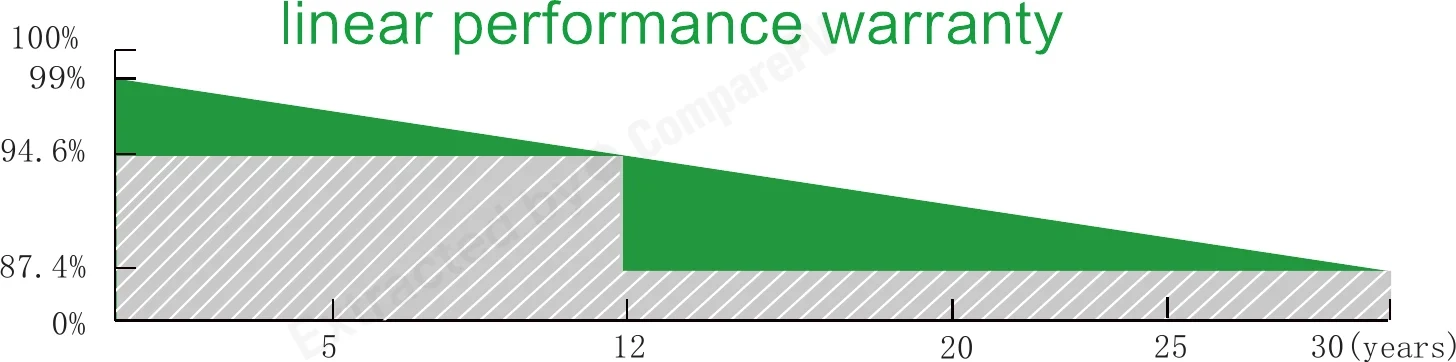
Performance warranty 30 years Typical median 30 yrs · median 30 yrs
End-of-warranty output 87.4 % Equals 568 W guaranteed
Degradation 1.00 → 0.40 % First year, then annual

Datasheet charts

Open datasheet PDF

Measured curves published by Yingli in this model's datasheet. A chart carrying a wattage was measured on that variant alone - only the ones that describe 650 Wp appear here. The rest cover the whole series.
Simulations

Live - change any input
Lifetime output & value
30 years at 1200 kWh/kWp/year and €0.50 per kWh
Power in year 30
-
Lifetime energy
-
Energy value
-
With bifacial gain
-

Degradation from this panel's own datasheet figures. No inverter, soiling or shading losses.

Heat losses
-0.290 %/°C against a segment median of -0.290
-
Bifacial gain
Rear gain over light concrete: -
-

Model: bifaciality × albedo × 0.6 view factor. A first-order estimate, not a yield simulation.

Filter these
Size
Panel Power Eff. Temp. Weight Difference
Yingli LF650M10N-66H/BF 650 W 24.10% -0.290 32.5 kg You are here
AIKO-A650-MAE72Mw 650 W 25.20% -0.260 27.0 kg Cooler, lighter, +1.1 pp
AIKO-A680-MDE72Mw 680 W 25.20% -0.260 29.0 kg +30 W, lighter, +1.1 pp
AIKO-A675-MDE72Mw 675 W 25.00% -0.260 29.0 kg Cooler, lighter, +0.9 pp
AIKO-A645-MAE72Mw 645 W 25.00% -0.260 27.0 kg Cooler, lighter, +0.9 pp
AIKO-A700-MAE78Dw 700 W 25.00% -0.260 34.5 kg +50 W, cooler, +0.9 pp
WST-675BKX72-A2 675 W 25.00% -0.260 32.1 kg +25 W, cooler, +0.9 pp
AIKO-A695-MAE78Dw 695 W 24.90% -0.260 34.5 kg +45 W, cooler, +0.8 pp
AIKO-G670-MCH72Mw 670 W 24.80% -0.260 28.2 kg Cooler, lighter, +0.7 pp
LF610M10N-66H/BF 610 W 22.60% -0.290 32.5 kg -40 W, -1.5 pp
LF615M10N-66H/BF 615 W 22.80% -0.290 32.5 kg -35 W, -1.3 pp
YL620CF66 i/2 620 W 23.00% -0.290 32.0 kg -30 W, -1.1 pp
YL625CF66 i/2 625 W 23.10% -0.290 32.0 kg -25 W, -1.0 pp
YL630CF66 i/2 630 W 23.30% -0.290 32.0 kg -20 W, -0.8 pp
YL635CF66 i/2 635 W 23.50% -0.290 32.0 kg -15 W, -0.6 pp
LR7-72HVHF-670M 670 W 24.80% -0.260 28.5 kg Cooler, lighter, +0.7 pp
JKM650-670N-66QL6-BDV (670W class) 670 W 24.80% -0.260 32.5 kg +20 W, cooler, +0.7 pp

Found 1144 panels of the same or similar size to this one, within ±10 mm. See them here Found 1150 panels of the same or similar size to this one, within ±25 mm. See them here Found 1261 panels of the same or similar size to this one, within ±50 mm. See them here Found 1942 panels of the same or similar size to this one, within ±100 mm. See them here

About the LF650M10N-66H/BF series

6 answered

These answers cover the whole series. Where a figure differs, the specification above is this module's own.

How does N-type TOPCon technology in the Yingli LF650M10N-66H/BF differ from classic PERC cells?
N-type TOPCon cells have lower recombination losses and much better resistance to light-induced degradation (LID) than traditional P-type PERC cells. As a result, the LF650M10N-66H/BF achieves higher initial efficiency and a slower power decline over time, translating into higher energy yield throughout the system's lifetime.
What does the bifacial design of the LF650M10N-66H/BF panel offer, and is it worth the extra cost?
The bifacial module captures light from both the front and rear side thanks to its glass-glass construction. In practice, this means additional energy yield, especially with light-colored ground surfaces, elevated ground-mount racking, or utility-scale PV farms. The premium pays off faster on large, utility-scale installations than on a low-tilt residential roof.
What warranty comes with the Yingli LF650M10N-66H/BF panels?
The manufacturer provides a 12-year product warranty and a 30-year linear power output warranty. Yingli is a Tier 1 manufacturer, which adds further confidence that warranty obligations will be honored even at large sales volumes.
Are the LF650M10N-66H/BF panels suited for large solar farms or for a single-family home roof?
With 650 Wp output, large M10 wafers, and bifacial construction, this series is optimized primarily for utility-scale solar farms and commercial projects, where maximizing power density per hectare is key. On a sloped single-family home roof, the size and weight of these panels can make installation more difficult, so smaller, lighter modules are typically preferred there.
How do the LF650M10N-66H/BF panels perform in high summer temperatures?
Thanks to N-type TOPCon technology and an optimized busbar count, these modules have a better temperature coefficient than older-generation panels, meaning a smaller power drop at high operating temperatures. This is a significant advantage during summer months, when panels can heat up dozens of degrees above ambient temperature.
Will the Yingli LF650M10N-66H/BF perform well under cloudy skies, such as in Poland?
Yes, N-type TOPCon technology delivers better efficiency under low and diffuse light conditions compared to classic P-type cells. This is a meaningful advantage at Poland's latitude, where a significant part of the year is overcast, and the module still generates power more effectively than older solutions.
Add to compare