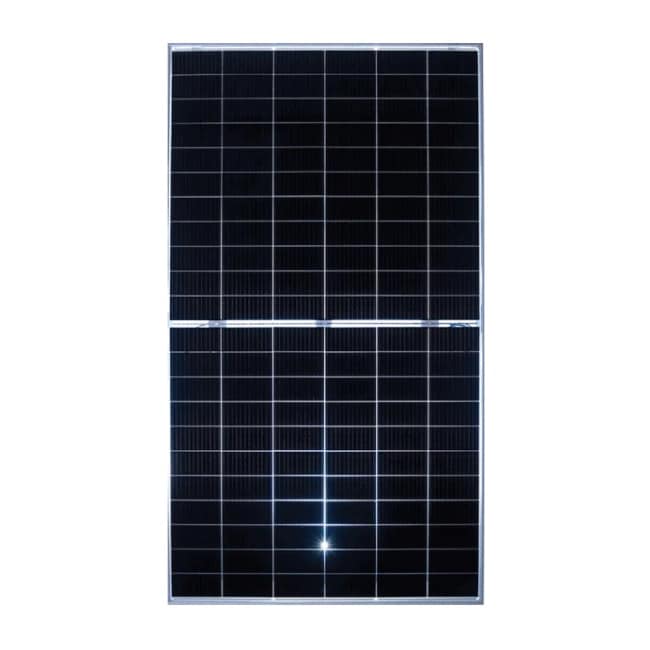
Vikram Solar PARADEA VSMDH.78.AAA.05-600

Vikram Solar PARADEA VSMDH.78.AAA.05-600

600 Wp PERC Bifacial 70%
ComparePV verdict

Efficiency leader, heavy for its output

Rank 4,913 of 14,129
Compare panels Datasheet PDF
Power (Wp)
600
Weak · bottom 16%
Efficiency (%)
21.61
Strong · top 15%
Density (Wp/m²)
215.4
Typical · median 213.8
Temp (%/°C)
-0.350
Weak · bottom 20%
Weight (kg)
36.5
Weak · 2.5 kg above median
Warranty (yrs)
30
Typical · median 30 yrs

The Vikram Solar PARADEA series consists of bifacial glass-glass modules with a multi busbar (MBB) architecture, designed to effectively increase energy yield even under less-than-ideal conditions. Due to its bifacial operation, the panel can utilize not only direct sunlight, but also reflected light from the ground, which is particularly beneficial for installations on reflective surfaces (e.g., gravel, sand, snow). In practice, this results in better production in the morning and evening, as well as higher daily yield, without the need for over-sizing the system.

The double-glass construction provides greater resistance to environmental factors, while the solutions in the connection box and the wiring configuration support more stable operation under partial shading. This makes it a good choice for investors who are looking for lower LCOE and BOS costs, as the higher power density facilitates the optimization of the structure and wiring. PARADEA is suitable for PV farms, commercial projects, and selected rooftop installations, where durability, yield, and predictability are key.

Ranking

217 panels in the segment PERC 600-650 W
Metric This panel Median Position in segment Overall rank
Module efficiency 21.61% 21.38% Strong · top 15% 7,713
Power density 215.4 213.8 Typical 7,843
Temperature coefficient -0.350 -0.340 Weak · bottom 20% 10,489
Weight per kWp 60.8 55.7 Weak · bottom 1% 12,639
Performance warranty 30 yrs 30 yrs Typical 21
Colour key Strong - top 25% Typical - middle 50% Weak - bottom 25%

Signals from the data

1 positive · 2 caution
Best for

Commercial, utility-scale and shaded-installations.

Not ideal for

Weight-limited structures and hot climates.

Strengths
21.61% module efficiency

Top 15% of the PERC 600-650 W segment, against a median of 21.38%.

Watch-outs
60.8 kg per kWp

Bottom 1% of the PERC 600-650 W segment, against a median of 55.7. Ranked 12,639th in the whole database.

-0.350 %/°C temperature coefficient

Bottom 20% of the PERC 600-650 W segment, against a median of -0.340.

Notes from the database
  • At 21.6% efficiency, this panel is on par with typical PERC 600-650W modules
  • Power density of 215.4 W/m² matches the PERC 600-650W median
  • Temperature coefficient of -0.35%/°C matches the PERC 600-650W median
  • At 36.5 kg, this panel is 2.5 kg heavier than the PERC 600-650W median (34.0 kg) - more demanding for installation crews
  • Bifaciality factor of 70% can add 4-10% extra yield with reflective mounting surface

Specifications

Open datasheet PDF
Nominal power (Pmax) 600 Wp Nameplate at 1000 W/m², 25 °C
Module efficiency 21.61 % Strong Segment median 21.38%
Vmpp · Impp 45.50 V · 13.23 A Operating point at max power
Voc · Isc 54.00 V · 13.91 A Sizes the string length
Max system voltage 1500 V Longer strings than 1000 V modules
Dimensions 2456×1134×35 mm · 2.79 m² of roof
Weight 36.5 kg Weak Weak · 2.5 kg above median
Cells 156 · PERC Monocrystalline
Bifaciality 70 % Rear output as a share of front
Coefficient Pmax -0.350 %/°C Weak bottom 20% of its segment
Coefficient Voc · Isc -0.270 · 0.050 %/°C
NOCT 45 °C At 800 W/m², 20 °C ambient
Product warranty 12 years Hardware defects only
Performance warranty 30 years Typical median 30 yrs · median 30 yrs
End-of-warranty output 83.5 % Equals 501 W guaranteed
Degradation 2.00 → 0.50 % First year, then annual

Datasheet charts

Open datasheet PDF

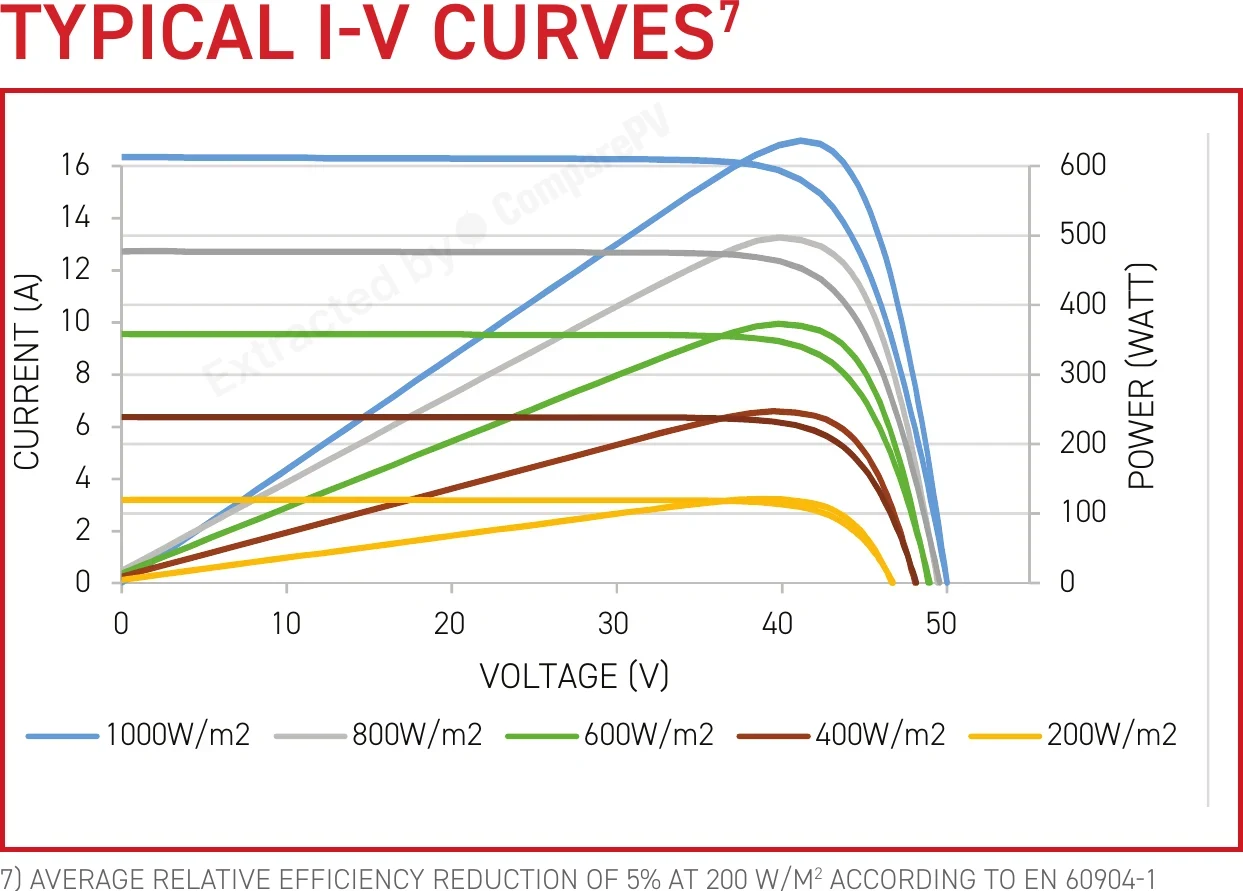
Measured curves published by Vikram Solar in this model's datasheet. A chart carrying a wattage was measured on that variant alone - only the ones that describe 600 Wp appear here. The rest cover the whole series.
Simulations

Live - change any input
Lifetime output & value
30 years at 1200 kWh/kWp/year and €0.50 per kWh
Power in year 30
-
Lifetime energy
-
Energy value
-
With bifacial gain
-

Degradation from this panel's own datasheet figures. No inverter, soiling or shading losses.

Heat losses
-0.350 %/°C against a segment median of -0.340
-
Bifacial gain
Rear gain over light concrete: -
-

Model: bifaciality × albedo × 0.6 view factor. A first-order estimate, not a yield simulation.

Filter these
Size
Panel Power Eff. Temp. Weight Difference
Vikram Solar PARADEA VSMDH.78.AAA.05-600 600 W 21.61% -0.350 36.5 kg You are here
AIKO-A650-MAE72Mw 650 W 25.20% -0.260 27.0 kg Cooler, lighter, +3.6 pp
AIKO-A645-MAE72Mw 645 W 25.00% -0.260 27.0 kg Cooler, lighter, +3.4 pp
LR7-60HVH-560M 560 W 24.80% -0.260 25.0 kg Cooler, lighter, +3.2 pp
AIKO-A640-MAE72Mw 640 W 24.80% -0.260 27.0 kg Cooler, lighter, +3.2 pp
LR7-60HVH-555M 555 W 24.60% -0.260 25.0 kg Cooler, lighter, +3.0 pp
AIKO-A635-MAE72Mw 635 W 24.60% -0.260 27.0 kg Cooler, lighter, +3.0 pp
PARADEA VSMDH.78.AAA.05-585 585 W 21.02% -0.350 36.5 kg -15 W, -0.6 pp
PARADEA VSMDH.78.AAA.05-590 590 W 21.22% -0.350 36.5 kg -10 W, -0.4 pp
PARADEA VSMDH.78.AAA.05-595 595 W 21.41% -0.350 36.5 kg Very close match
HYPERSOL VSMDH.78.605.05 605 W 21.72% -0.300 35.0 kg Cooler, lighter
AIKO-A680-MDE72Mw 680 W 25.20% -0.260 29.0 kg +80 W, cooler, +3.6 pp
AIKO-A675-MDE72Mw 675 W 25.00% -0.260 29.0 kg +75 W, cooler, +3.4 pp
AIKO-A700-MAE78Dw 700 W 25.00% -0.260 34.5 kg +100 W, cooler, +3.4 pp
WST-675BKX72-A2 675 W 25.00% -0.260 32.1 kg +75 W, cooler, +3.4 pp
AIKO-A695-MAE78Dw 695 W 24.90% -0.260 34.5 kg +95 W, cooler, +3.3 pp
AIKO-G670-MCH72Mw 670 W 24.80% -0.260 28.2 kg Cooler, lighter, +3.2 pp

Found 613 panels of the same or similar size to this one, within ±10 mm. See them here Found 616 panels of the same or similar size to this one, within ±25 mm. See them here Found 616 panels of the same or similar size to this one, within ±50 mm. See them here Found 1838 panels of the same or similar size to this one, within ±100 mm. See them here

About the PARADEA series

6 answered

These answers cover the whole series. Where a figure differs, the specification above is this module's own.

What is the maximum power output of the Vikram Solar PARADEA panel, and where does the extra yield from bifacial technology come from?
The highest-power variants of the PARADEA series reach up to 680 Wp, thanks to a 132-cell half-cut design and multi busbar (MBB) architecture. The panel operates bifacially, capturing not only direct sunlight on the front side but also light reflected from the ground beneath the module. Depending on the albedo of the mounting surface (e.g., gravel, white roofing, snow), the additional rear-side yield can reach up to 25%, without increasing the installation footprint.
What warranty comes with Vikram Solar PARADEA panels?
The manufacturer covers the PARADEA series with a 12-year product warranty and a 30-year linear power warranty, guaranteeing at least 83.5% of nominal power after 30 years of operation, with a minimum of 98% in the first year. This is a standard typical of premium-class panels and allows investors to precisely model power degradation in PV system financial projections.
Are Vikram Solar PARADEA panels still available for purchase?
The PARADEA series has been discontinued from Vikram Solar's current production lineup and replaced by newer models in the manufacturer's portfolio. Panels may still be available through distributors as clearance or remaining stock, but when planning larger installations or expanding an existing system, it's worth confirming availability of the specific power rating and production batch with your supplier, since continuity of supply is no longer guaranteed.
How does the multi busbar (MBB) technology in PARADEA panels differ from classic designs with fewer busbars?
PERC cells with a multi busbar architecture have more thin connecting paths than older 4-5 busbar designs, shortening the current collection path and reducing resistive losses as well as the risk of microcracks. In practice, this translates into higher module efficiency, better performance under partial shading, and greater mechanical reliability, which is especially important in the glass-glass construction used in the PARADEA series.
Are PARADEA panels suitable for a residential rooftop, or only for utility-scale solar farms?
Due to their large dimensions, weight of around 39.5 kg, and power output of up to 680 Wp, the PARADEA series was designed primarily for solar farms and commercial installations, where power density per hectare and low BoS cost matter most. On sloped residential rooftops, it's less common and mainly suited to large, reinforced roof sections due to the module's size and mass.
How does the glass-glass construction of PARADEA panels affect durability and performance in harsh conditions?
A dual glass layer in place of the rear polymer backsheet increases the module's resistance to moisture ingress, cell microcracks, PID, and UV degradation, resulting in a longer lifespan and more stable power degradation over time. The temperature coefficient of power is -0.35%/°C, so the panel loses relatively little efficiency in high heat compared to cheaper glass-backsheet modules.
Add to compare