Vikram Solar PARADEA VSMDH.66.AAA.05-665

PARADEA VSMDH.66.AAA.05-665

665 Wp PERC Bifacial 70%
ComparePV verdict

Middle of its segment, heavy for its output

Rank 2,826 of 14,005
Compare panels Datasheet PDF
Power (Wp)
665
Typical for its class
Efficiency (%)
21.41
Typical · median 21.25%
Density (Wp/m²)
214.1
Typical · median 212.5
Temp (%/°C)
-0.350
Weak · bottom 10%
Weight (kg)
39.5
Weak · 5.0 kg above median
Warranty (yrs)
30
Typical · median 30 yrs

The Vikram Solar PARADEA (VSMDH.66.AAA.05) series are bifacial glass-glass modules designed to effectively increase energy yield, even when conditions on the roof or ground are not ideal. By operating from both sides of the module, they better utilize reflected light, resulting in higher yields in locations with reflective surfaces or in installations on elevated structures. Key features include:

* Bifacial glass-glass technology, which enhances durability in harsh environments and reduces the risk of microcracks and deformations. * Multi busbar (MBB) technology, which improves current collection and resistance to micro-damage. * Half-cut monocrystalline solar cells, which help reduce losses and improve stability, while connection box solutions support better performance under partial shading.

This makes it a good choice for PV farms, large commercial and industrial installations, and projects where lower energy costs and reduced operating losses over the long term are priorities.

Ranking

320 panels in the segment PERC 650-700 W
Metric This panel Median Position in segment Overall rank
Module efficiency 21.41% 21.25% Typical 8,280
Power density 214.1 212.5 Typical 8,250
Temperature coefficient -0.350 -0.340 Weak · bottom 10% 10,419
Weight per kWp 59.4 52.3 Weak · bottom 3% 12,127
Performance warranty 30 yrs 30 yrs Typical 21
Colour key Strong - top 25% Typical - middle 50% Weak - bottom 25%

Signals from the data

0 positive · 2 caution
Best for

Utility-scale, commercial and shaded-installations.

Not ideal for

Weight-limited structures and hot climates.

Watch-outs
59.4 kg per kWp

Bottom 3% of the PERC 650-700 W segment, against a median of 52.3. Ranked 12,127th in the whole database.

-0.350 %/°C temperature coefficient

Bottom 10% of the PERC 650-700 W segment, against a median of -0.340.

Notes from the database
  • Efficiency of 21.4% matches the PERC 650-700W median
  • Power density of 214.1 W/m² matches the PERC 650-700W median
  • Temperature coefficient of -0.35%/°C matches the PERC 650-700W median
  • Weight of 39.5 kg is 5.0 kg above PERC 650-700W median (34.5 kg) - verify structural support
  • 70% bifaciality enables rear-side power generation, boosting yield by 4-10% on reflective surfaces

Specifications

Open datasheet PDF
Nominal power (Pmax) 665 Wp Nameplate at 1000 W/m², 25 °C
Module efficiency 21.41 % Typical Segment median 21.25%
Vmpp · Impp 38.70 V · 17.20 A Operating point at max power
Voc · Isc 46.30 V · 18.05 A Sizes the string length
Max system voltage 1500 V Longer strings than 1000 V modules
Dimensions 2384×1303×35 mm · 3.11 m² of roof
Weight 39.5 kg Weak Weak · 5.0 kg above median
Cells 132 · PERC Monocrystalline
Bifaciality 70 % Rear output as a share of front
Coefficient Pmax -0.350 %/°C Weak bottom 10% of its segment
Coefficient Voc · Isc -0.270 · 0.050 %/°C
NOCT 45 °C At 800 W/m², 20 °C ambient
Product warranty 12 years Hardware defects only
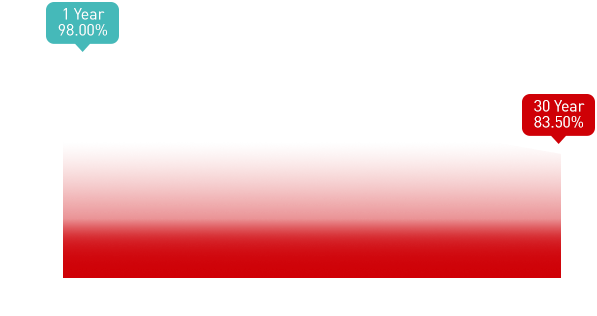
Performance warranty 30 years Typical median 30 yrs · median 30 yrs
End-of-warranty output 83.5 % Equals 555 W guaranteed
Degradation 2.00 → 0.50 % First year, then annual

Simulations

Live - change any input
Lifetime output & value
30 years at 1200 kWh/kWp/year and €0.50 per kWh
Power in year 30
-
Lifetime energy
-
Energy value
-
With bifacial gain
-

Degradation from this panel's own datasheet figures. No inverter, soiling or shading losses.

Heat losses
-0.350 %/°C against a segment median of -0.340
-
Bifacial gain
Rear gain over light concrete: -
-

Model: bifaciality × albedo × 0.6 view factor. A first-order estimate, not a yield simulation.

Filter these
Size
Panel Power Eff. Temp. Weight Difference
Vikram Solar PARADEA VSMDH.66.AAA.05-665 665 W 21.41% -0.350 39.5 kg You are here
AIKO-A650-MAE72Mw 650 W 25.20% -0.260 27.0 kg Cooler, lighter, +3.8 pp
AIKO-A680-MDE72Mw 680 W 25.20% -0.260 29.0 kg Cooler, lighter, +3.8 pp
AIKO-A675-MDE72Mw 675 W 25.00% -0.260 29.0 kg Cooler, lighter, +3.6 pp
AIKO-A645-MAE72Mw 645 W 25.00% -0.260 27.0 kg Cooler, lighter, +3.6 pp
AIKO-A700-MAE78Dw 700 W 25.00% -0.260 34.5 kg Cooler, lighter, +3.6 pp
AIKO-A695-MAE78Dw 695 W 24.90% -0.260 34.5 kg Cooler, lighter, +3.5 pp
AIKO-G670-MCH72Mw 670 W 24.80% -0.260 28.2 kg Cooler, lighter, +3.4 pp
PARADEA VSMDH.66.AAA.05-655 655 W 21.09% -0.350 39.5 kg -10 W, -0.3 pp
PARADEA VSMDH.66.AAA.05-660 660 W 21.25% -0.350 39.5 kg Very close match
AIKO-A805-GRH78Dw 805 W 25.10% -0.260 39.8 kg +140 W, cooler, +3.7 pp
AIKO-A800-GRH78Dw 800 W 24.90% -0.260 39.8 kg +135 W, cooler, +3.5 pp
AIKO-A795-GRH78Dw 795 W 24.80% -0.260 39.8 kg +130 W, cooler, +3.4 pp
AIKO-A790-GRH78Dw 790 W 24.60% -0.260 39.8 kg +125 W, cooler, +3.2 pp
TSM-NEG21C.20Q-760 760 W 24.50% -0.260 38.3 kg +95 W, cooler, +3.1 pp
AIKO-A785-GRH78Dw 785 W 24.40% -0.260 39.8 kg +120 W, cooler, +3.0 pp
GK-4-78HGBD-780M 780 W 24.30% -0.260 38.7 kg +115 W, cooler, +2.9 pp

Found 1390 panels of the same or similar size to this one, within ±10 mm. See them here Found 1400 panels of the same or similar size to this one, within ±25 mm. See them here Found 1400 panels of the same or similar size to this one, within ±50 mm. See them here Found 1432 panels of the same or similar size to this one, within ±100 mm. See them here

Common questions

6 answered
Is the Vikram Solar PARADEA VSMDH.66.AAA.05 panel still available for purchase?
No, this specific version of the PARADEA series (VSMDH.66.AAA.05) has been discontinued. Vikram Solar continues to develop the PARADEA line under newer model codes, so availability of this exact SKU is now limited to remaining distributor stock. Buyers should confirm current inventory with the seller and compare specs against the manufacturer's current lineup.
How much extra energy does bifacial technology actually add compared to standard panels in the PARADEA series?
The glass-glass design of PARADEA panels captures light reflected off the ground surface through the rear side of the module. The gain depends on ground albedo and mounting height, but in typical ground-mount installations over light-colored surfaces or gravel, this usually adds several to over ten percent more annual energy yield compared to a monofacial panel of the same rated power.
What warranty comes with the PARADEA VSMDH.66.AAA.05 modules and what does it cover?
Vikram Solar provides a 12-year product warranty covering material and workmanship defects, plus a 30-year linear power performance warranty guaranteeing limited output degradation over time. This is standard for Tier 1 manufacturers and gives investors confidence in long-term returns from the installation.
Do half-cut cell PARADEA panels handle partial shading better?
Yes, the monocrystalline half-cut cells combined with multi busbar (MBB) technology divide the module into smaller electrical sections. This means partial shading from leaves or a chimney causes a smaller drop in overall panel output compared to conventional full-cell modules.
What installations are the 680 Wp PARADEA panels best suited for?
Thanks to their high per-unit power output of up to 680 Wp and bifacial glass-glass construction, the PARADEA series is best suited for large-scale PV farms and commercial and industrial (C&I) installations, where a lower levelized cost of energy and reduced long-term operational losses matter most.
How does glass-glass construction differ from standard backsheet panels, and is it worth the extra cost?
In glass-glass panels, the cells are laminated between two glass sheets instead of glass and a polymer backsheet. This increases module rigidity, reduces the risk of micro-cracks and warping, and improves resistance to moisture and degradation in harsh climates. The added cost typically pays off through longer service life and bifacial energy gain.
Add to compare