Trina Solar TSM-NEG20C.20-650

Trina Solar TSM-NEG20C.20-650

650 Wp TOPCon Bifacial 80%
ComparePV verdict

Solid all-round for its segment

Rank 1,815 of 14,129
Compare panels Datasheet PDF
Power (Wp)
650
Weak · bottom 13%
Efficiency (%)
23.00
Typical · median 22.40%
Density (Wp/m²)
229.7
Typical · median 223.7
Temp (%/°C)
-0.290
Typical · median -0.290
Weight (kg)
34.9
Typical · median 34.6 kg
Warranty (yrs)
30
Typical · median 30 yrs

Trina Solar Vertex N (TSM-NEG20C.20) is designed for maximum energy yield in real-world conditions - not just in the lab. The use of n-type i-TOPCon cells means higher operational stability and reduced susceptibility to typical phenomena that gradually reduce energy production in many standard modules. In practice, this translates to more predictable yields and better long-term profitability for installations.

A major difference is also the bifacial dual-glass construction, which allows for capturing reflected light from the ground while simultaneously increasing mechanical durability and resilience in challenging locations. The Vertex N series also utilizes multi-busbar technology, improving current collection and maintaining performance under less-than-ideal sunlight conditions. For investors, low temperature coefficient is also important, helping maintain production during hot summer months.

This makes it an excellent choice for utility-scale PV farms, commercial installations, and modern projects where the focus is on the energy payback and long-term reliability, not just the specifications on the datasheet.

Ranking

254 panels in the segment TOPCon 650-700 W
Metric This panel Median Position in segment Overall rank
Module efficiency 23.00% 22.40% Typical 1,970
Power density 229.7 223.7 Typical 2,212
Temperature coefficient -0.290 -0.290 Typical 2,220
Weight per kWp 53.7 53.1 Typical 7,779
Performance warranty 30 yrs 30 yrs Typical 21
Colour key Strong - top 25% Typical - middle 50% Weak - bottom 25%

Signals from the data

0 positive · 0 caution
Best for

Commercial, utility-scale, hot-climate and shaded-installations.

Notes from the database
  • 23.0% module efficiency - 0.6pp better than the TOPCon 650-700W median of 22.4%
  • Power density of 229.7 W/m² packs 6.0 W/m² more into the same footprint vs TOPCon 650-700W median (223.7 W/m²)
  • At -0.29%/°C, hot weather performance is typical for TOPCon 650-700W panels
  • Bifaciality factor of 80% can add 4-12% extra yield with reflective mounting surface
  • #1970 for efficiency, #2220 for temperature performance out of 14129 panels

Specifications

Open datasheet PDF
Nominal power (Pmax) 650 Wp Nameplate at 1000 W/m², 25 °C
Module efficiency 23.00 % Typical Segment median 22.40%
Vmpp · Impp 37.40 V · 17.38 A Operating point at max power
Voc · Isc 45.10 V · 18.42 A Sizes the string length
Max system voltage 1500 V Longer strings than 1000 V modules
Dimensions 2172×1303×33 mm · 2.83 m² of roof
Weight 34.9 kg Typical Typical · median 34.6 kg
Cells 120 · TOPCon Monocrystalline
Bifaciality 80 % Rear output as a share of front
Coefficient Pmax -0.290 %/°C Typical median -0.290 of its segment
Coefficient Voc · Isc -0.240 · 0.040 %/°C
NOCT 43 °C At 800 W/m², 20 °C ambient
Product warranty 12 years Hardware defects only
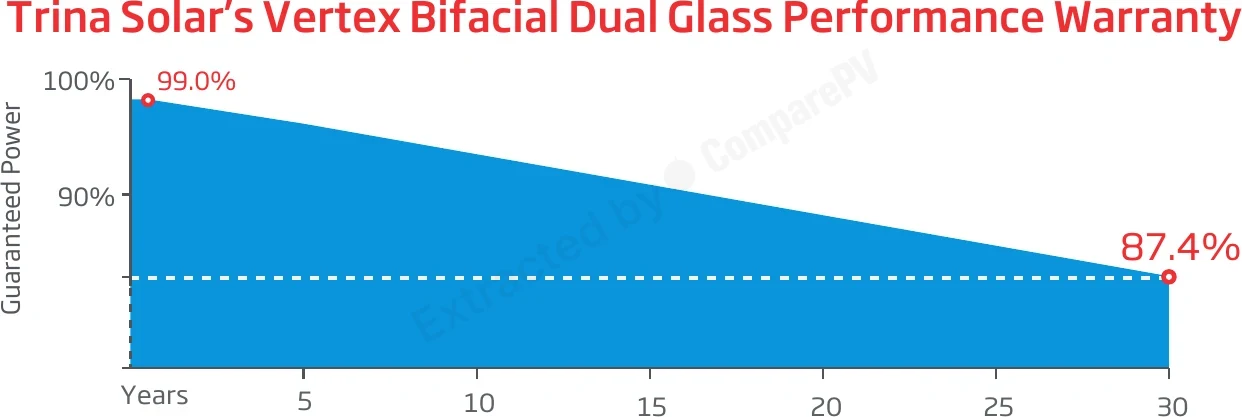
Performance warranty 30 years Typical median 30 yrs · median 30 yrs
End-of-warranty output 87.4 % Equals 568 W guaranteed
Degradation 1.00 → 0.40 % First year, then annual

Datasheet charts

Open datasheet PDF

Measured curves published by Trina Solar in this model's datasheet. A chart carrying a wattage was measured on that variant alone - only the ones that describe 650 Wp appear here. The rest cover the whole series.
Simulations

Live - change any input
Lifetime output & value
30 years at 1200 kWh/kWp/year and €0.50 per kWh
Power in year 30
-
Lifetime energy
-
Energy value
-
With bifacial gain
-

Degradation from this panel's own datasheet figures. No inverter, soiling or shading losses.

Heat losses
-0.290 %/°C against a segment median of -0.290
-
Bifacial gain
Rear gain over light concrete: -
-

Model: bifaciality × albedo × 0.6 view factor. A first-order estimate, not a yield simulation.

Filter these
Size
Panel Power Eff. Temp. Weight Difference
Trina Solar TSM-NEG20C.20-650 650 W 23.00% -0.290 34.9 kg You are here
AIKO-A650-MAE72Mw 650 W 25.20% -0.260 27.0 kg Cooler, lighter, +2.2 pp
AIKO-A680-MDE72Mw 680 W 25.20% -0.260 29.0 kg +30 W, lighter, +2.2 pp
AIKO-A675-MDE72Mw 675 W 25.00% -0.260 29.0 kg Cooler, lighter, +2.0 pp
AIKO-A645-MAE72Mw 645 W 25.00% -0.260 27.0 kg Cooler, lighter, +2.0 pp
AIKO-A700-MAE78Dw 700 W 25.00% -0.260 34.5 kg +50 W, cooler, +2.0 pp
WST-675BKX72-A2 675 W 25.00% -0.260 32.1 kg Cooler, lighter, +2.0 pp
AIKO-A695-MAE78Dw 695 W 24.90% -0.260 34.5 kg +45 W, cooler, +1.9 pp
AIKO-G670-MCH72Mw 670 W 24.80% -0.260 28.2 kg Cooler, lighter, +1.8 pp
TSM-DEG20C.20-585W 585 W 20.70% -0.340 34.9 kg -65 W, hotter, -2.3 pp
TSM-DEG20C.20-590W 590 W 20.80% -0.340 34.9 kg -60 W, hotter, -2.2 pp
TSM-DEG20C.20-595W 595 W 21.00% -0.340 34.9 kg -55 W, hotter, -2.0 pp
TSM-DEG20C.20-600W 600 W 21.20% -0.340 34.9 kg -50 W, hotter, -1.8 pp
TSM-DEG20C.20-605W 605 W 21.40% -0.340 34.9 kg -45 W, hotter, -1.6 pp
TSM-NEG20C.20-625 625 W 22.10% -0.290 34.9 kg -25 W, -0.9 pp
TSM-NEG20C.20-630 630 W 22.30% -0.290 34.9 kg -20 W, -0.7 pp
TSM-NEG20C.20-635 635 W 22.40% -0.290 34.9 kg -15 W, -0.6 pp
GKA210N120 680 W 24.03% -0.340 28.0 kg Hotter, lighter, +1.0 pp

Found 497 panels of the same or similar size to this one, within ±10 mm. See them here Found 502 panels of the same or similar size to this one, within ±25 mm. See them here Found 502 panels of the same or similar size to this one, within ±50 mm. See them here Found 502 panels of the same or similar size to this one, within ±100 mm. See them here

About the Vertex N (TSM-NEG20C.20) series

6 answered

These answers cover the whole series. Where a figure differs, the specification above is this module's own.

Is the Trina Solar Vertex N TSM-NEG20C.20 series still available for purchase?
No, this series has been discontinued. Trina Solar replaced it with newer Vertex N models, including the TSM-NEG21C.20 rated up to 720 Wp. Some TSM-NEG20C.20 units may still be found through distributors clearing existing stock, so buyers should check the manufacturing date and remaining warranty coverage before purchasing.
How do the n-type i-TOPCon cells in Vertex N differ from standard PERC cells?
N-type i-TOPCon cells exhibit lower LID and LeTID degradation and a slower power decline in the early years of operation compared to cheaper p-type PERC cells. In practice, this translates to higher and more predictable energy yield over the module's lifetime, which matters most for large-scale solar farms evaluated over a 25-30 year cycle.
How much extra energy does the bifacial dual-glass design actually deliver?
The rear-side energy gain depends on ground albedo and mounting height, but with high-reflectance surfaces such as gravel or white roofing, annual gains can range from a few percent to over ten percent compared to a monofacial module. The dual-glass construction also improves mechanical strength and durability in harsher environments.
What warranty does Trina Vertex N TSM-NEG20C.20 come with?
The manufacturer provides a 12-year product warranty and a 30-year power output warranty, which is standard for premium n-type TOPCon panels. Note that despite production being discontinued, the warranty remains valid for already-installed systems as long as the manufacturer's service conditions are met.
Does the Vertex N TSM-NEG20C.20 perform well in high summer temperatures?
Yes, n-type TOPCon technology has a lower temperature coefficient of power than traditional PERC cells, meaning less output loss as the module heats up. This is a meaningful advantage for ground-mount and flat-roof installations where panels reach high operating temperatures during summer.
What kind of installations is the 650 Wp Vertex N TSM-NEG20C.20 series best suited for?
Given its high per-unit power, bifacial capability, and dual-glass build, this series was designed mainly for solar farms and large commercial installations, where a low cost per Wp and long-term reliability matter most, rather than for typical residential pitched-roof setups.
Add to compare