TM3G66M-600

600 Wp TOPCon Bifacial 80%
ComparePV verdict

Middle of its segment, heavy for its output

Rank 4,177 of 14,005
Compare panels Datasheet PDF
Power (Wp)
600
Weak · bottom 5%
Efficiency (%)
22.20
Weak · bottom 12%
Density (Wp/m²)
222.1
Weak · bottom 13%
Temp (%/°C)
-0.290
Typical · median -0.290
Weight (kg)
33.7
Weak · 1.0 kg above median
Warranty (yrs)
30
Typical · median 30 yrs

Talesun TM3G66M (BIPRO) are bifacial glass-glass modules designed for maximum energy yield where every square meter counts. Their unique combination of N-type TOPCon cell technology and bifaciality allows them to harness not only direct light but also reflections from the ground - effectively boosting production in ground-mounted installations, on light-colored rooftops, and carport structures.

The application of half-cut with 16BB minimizes internal losses and helps maintain stable performance under weaker sunlight, which is crucial given Poland's weather conditions. The glass-glass construction enhances resistance to environmental factors, while high PID resistance supports long-term reliability in demanding installations.

TM3G66M (BIPRO) is an excellent choice for PV farms, large industrial rooftops, and projects focused on low energy costs over the entire life cycle.

Ranking

1,086 panels in the segment TOPCon 600-650 W
Metric This panel Median Position in segment Overall rank
Module efficiency 22.20% 22.80% Weak · bottom 12% 5,817
Power density 222.1 227.7 Weak · bottom 13% 5,783
Temperature coefficient -0.290 -0.290 Typical 2,165
Weight per kWp 56.2 53.1 Weak · bottom 5% 10,451
Performance warranty 30 yrs 30 yrs Typical 21
Colour key Strong - top 25% Typical - middle 50% Weak - bottom 25%

Signals from the data

0 positive · 3 caution
Best for

Commercial, utility-scale and shaded-installations.

Not ideal for

Weight-limited structures, tight roof space and roofs where every square metre has to count.

Watch-outs
56.2 kg per kWp

Bottom 5% of the TOPCon 600-650 W segment, against a median of 53.1. Ranked 10,451st in the whole database.

22.20% module efficiency

Bottom 12% of the TOPCon 600-650 W segment, against a median of 22.80%.

222.1 watts per square metre

Bottom 13% of the TOPCon 600-650 W segment, against a median of 227.7.

Notes from the database
  • Efficiency of 22.2% is 0.6pp below the TOPCon 600-650W median (22.8%)
  • 222.1 W/m² power density is 5.6 W/m² below TOPCon 600-650W median (227.7 W/m²) - requires larger installation area
  • Temperature coefficient of -0.29%/°C matches the TOPCon 600-650W median
  • Weight of 33.7 kg is typical for TOPCon 600-650W panels
  • Bifaciality factor of 80% can add 4-12% extra yield with reflective mounting surface

Specifications

Open datasheet PDF
Nominal power (Pmax) 600 Wp Nameplate at 1000 W/m², 25 °C
Module efficiency 22.20 % Weak Segment median 22.80%
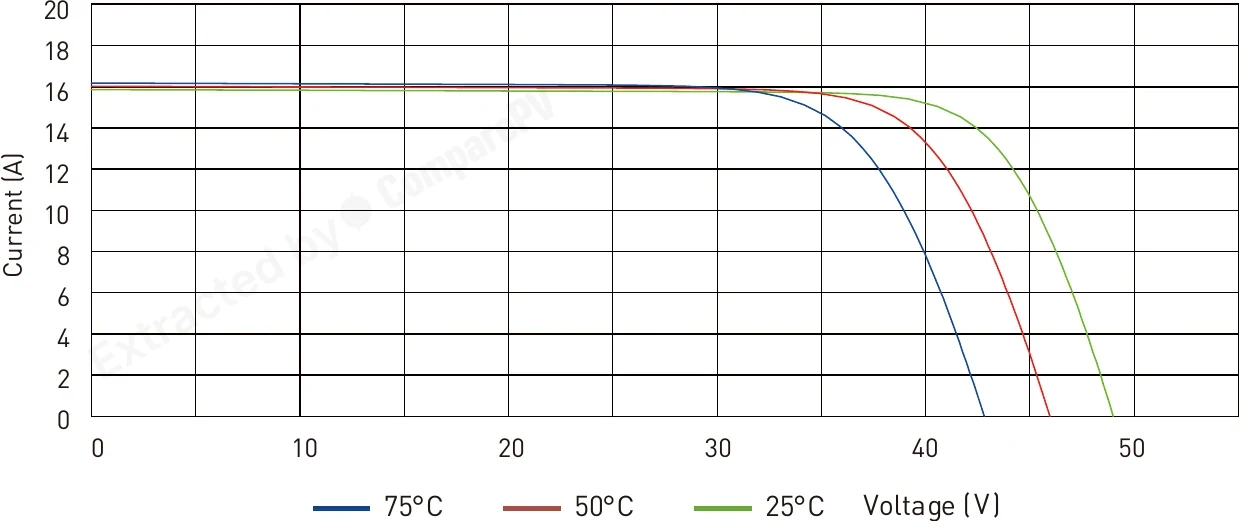
Vmpp · Impp 40.30 V · 14.91 A Operating point at max power
Voc · Isc 48.40 V · 15.80 A Sizes the string length
Max system voltage 1500 V Longer strings than 1000 V modules
Dimensions 2382×1134×30 mm · 2.70 m² of roof
Weight 33.7 kg Weak Weak · 1.0 kg above median
Cells 132 · TOPCon Monocrystalline
Bifaciality 80 % Rear output as a share of front
Coefficient Pmax -0.290 %/°C Typical median -0.290 of its segment
Coefficient Voc · Isc -0.240 · 0.043 %/°C
NOCT 43 °C At 800 W/m², 20 °C ambient
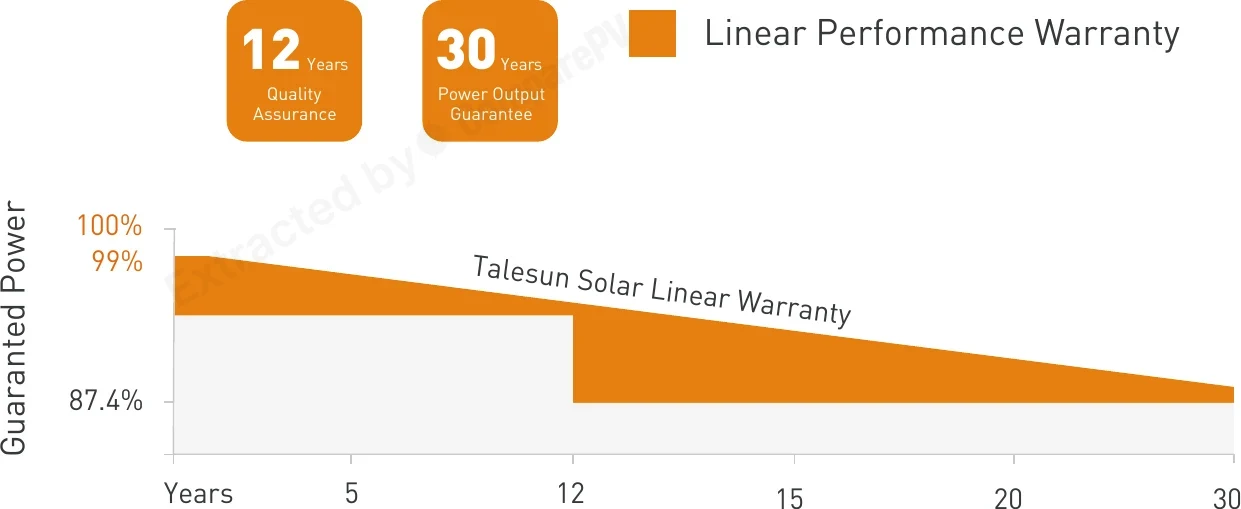
Product warranty 12 years Hardware defects only
Performance warranty 30 years Typical median 30 yrs · median 30 yrs
End-of-warranty output 87.4 % Equals 524 W guaranteed
Degradation 1.00 → 0.40 % First year, then annual

Datasheet charts

Open datasheet PDF

Measured curves published by Talesun in this model's datasheet. A chart carrying a wattage was measured on that variant alone - only the ones that describe 600 Wp appear here. The rest cover the whole series.
Simulations

Live - change any input
Lifetime output & value
30 years at 1200 kWh/kWp/year and €0.50 per kWh
Power in year 30
-
Lifetime energy
-
Energy value
-
With bifacial gain
-

Degradation from this panel's own datasheet figures. No inverter, soiling or shading losses.

Heat losses
-0.290 %/°C against a segment median of -0.290
-
Bifacial gain
Rear gain over light concrete: -
-

Model: bifaciality × albedo × 0.6 view factor. A first-order estimate, not a yield simulation.

Filter these
Size
Panel Power Eff. Temp. Weight Difference
Talesun TM3G66M-600 600 W 22.20% -0.290 33.7 kg You are here
AIKO-A650-MAE72Mw 650 W 25.20% -0.260 27.0 kg +50 W, lighter, +3.0 pp
AIKO-A645-MAE72Mw 645 W 25.00% -0.260 27.0 kg +45 W, lighter, +2.8 pp
LR7-60HVH-560M 560 W 24.80% -0.260 25.0 kg -40 W, lighter, +2.6 pp
AIKO-A640-MAE72Mw 640 W 24.80% -0.260 27.0 kg +40 W, lighter, +2.6 pp
LR7-60HVH-555M 555 W 24.60% -0.260 25.0 kg -45 W, lighter, +2.4 pp
AIKO-A635-MAE72Mw 635 W 24.60% -0.260 27.0 kg +35 W, lighter, +2.4 pp
TM3G66M-605 605 W 22.40% -0.290 33.7 kg Very close match
TM9G72M-610W 610 W 22.60% -0.290 33.8 kg +10 W, +0.4 pp
TM9G72M-615W 615 W 22.80% -0.290 33.8 kg +15 W, +0.6 pp
AIKO-A680-MDE72Mw 680 W 25.20% -0.260 29.0 kg +80 W, lighter, +3.0 pp
AIKO-A675-MDE72Mw 675 W 25.00% -0.260 29.0 kg +75 W, lighter, +2.8 pp
AIKO-A700-MAE78Dw 700 W 25.00% -0.260 34.5 kg +100 W, cooler, +2.8 pp
AIKO-A695-MAE78Dw 695 W 24.90% -0.260 34.5 kg +95 W, cooler, +2.7 pp
AIKO-G670-MCH72Mw 670 W 24.80% -0.260 28.2 kg +70 W, lighter, +2.6 pp
LR7-72HVHF-670M 670 W 24.80% -0.260 28.5 kg +70 W, lighter, +2.6 pp
JKM650-670N-66QL6-BDV (670W class) 670 W 24.80% -0.260 32.5 kg +70 W, cooler, +2.6 pp

Found 1119 panels of the same or similar size to this one, within ±10 mm. See them here Found 1125 panels of the same or similar size to this one, within ±25 mm. See them here Found 1236 panels of the same or similar size to this one, within ±50 mm. See them here Found 1917 panels of the same or similar size to this one, within ±100 mm. See them here

Common questions

6 answered
How does N-type TOPCon technology in Talesun TM3G66M panels differ from older PERC cells?
N-type TOPCon cells have a lower degradation rate over time and are less susceptible to LID and LeTID compared to conventional P-type PERC cells. This gives the TM3G66M higher efficiency (up to 605 Wp) and better power retention throughout its lifespan, resulting in higher and more stable energy output over 25-30 years.
Are Talesun TM3G66M (BIPRO) panels suitable for a residential roof, or only for large-scale installations?
The glass-glass construction makes these panels heavier than standard glass-backsheet modules, so roof load capacity should be checked before installation. The series performs best on PV farms, industrial roofs with light-colored surfaces, and carport structures, where bifaciality delivers a real energy gain. On a typical residential pitched roof, the benefit from bifaciality tends to be marginal.
What warranty comes with Talesun TM3G66M (BIPRO) panels, and is Talesun a Tier 1 manufacturer?
The manufacturer provides a 12-year product warranty and a 30-year power output warranty. Talesun is classified as a Tier 1 manufacturer, meaning stable financial standing and extensive manufacturing experience, which reduces the risk of warranty claim issues down the line.
How much extra energy does bifaciality add in the TM3G66M series?
The rear-side energy gain depends on ground albedo, mounting height, and distance from the ground. On light gravel, a white roof membrane, or in carport installations, you can expect a few to over ten percent more energy compared to a monofacial panel of the same power rating. On a dark roof or when mounted close to the surface, the effect will be much smaller.
How does the half-cut design with 16 busbars affect panel performance under low light and cold temperatures?
Splitting cells into half-cut segments lowers the current flowing through the interconnects, reducing resistive losses and cell heating, while 16 busbars improve current collection across the cell surface. In practice, this means better performance under cloudy skies, early morning, and late afternoon, and cold winter temperatures increase operating voltage, further supporting stable energy production.
Does high PID resistance in TM3G66M panels matter for large-scale PV farm installations?
Yes, large installations often run high string voltages, which increases the risk of potential induced degradation (PID) and permanent power loss. The TM3G66M series' enhanced PID resistance mitigates this risk, which is especially important on PV farms and industrial-scale projects, where even a small power drop across many panels has a real impact on energy revenue.
Add to compare