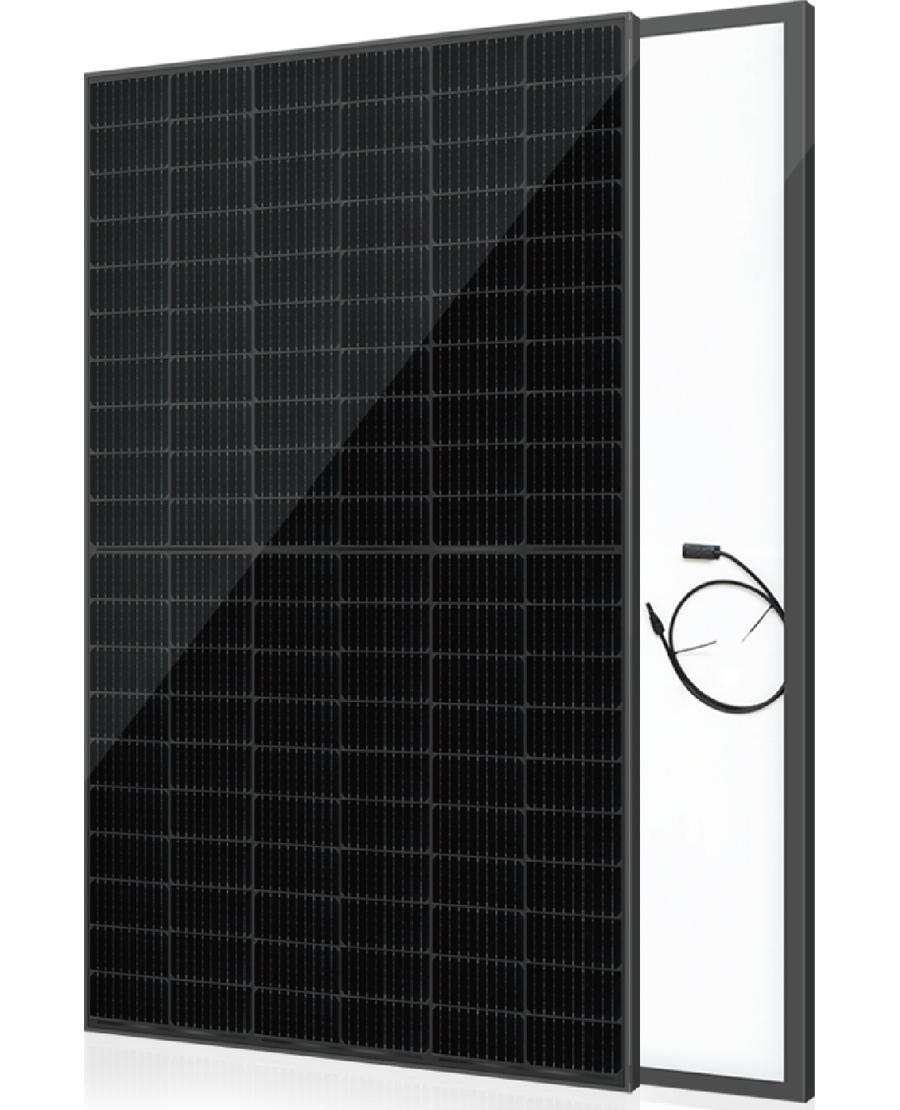
Shinson Technology S700M66NT4BF

S700M66NT4BF

700 Wp TOPCon Bifacial 3000%
ComparePV verdict

Middle of its segment, needs the roof space

Rank 114 of 14,005
Compare panels Datasheet PDF
Power (Wp)
700
Weak · bottom 7%
Efficiency (%)
22.53
Weak · bottom 11%
Density (Wp/m²)
225.3
Weak · bottom 7%
Temp (%/°C)
-0.310
Weak · bottom 8%
Weight (kg)
38.0
Weak · bottom 14%
Warranty (yrs)
30
Typical · median 30 yrs

The Shinson Technology S-Max series consists of modules designed for commercial installations and large-scale PV farms, where maximizing energy yield from each module and quickly reducing construction and cabling costs are key. A key advantage of this series is its high power density, which allows for greater energy generation from the same area and simplifies the BOS (Balance of System) design. Depending on the variant, S-Max utilizes modern approaches to solar cells, including N-type and HJT technology - which is valued for its stable operation at higher temperatures and good performance in low-sunlight conditions.

For investors, long warranties and a focus on durability are also important. The series was marketed as being tested for hail resistance, which increases the safety of operation in more challenging conditions. S-Max is a sensible choice for C&I (Commercial and Industrial) applications, farms, and roofs with limited surface area, when you want to combine high reliability with above-average energy production without paying extra for competitor marketing.

Ranking

420 panels in the segment TOPCon 700-750 W
Metric This panel Median Position in segment Overall rank
Module efficiency 22.53% 23.00% Weak · bottom 11% 3,982
Power density 225.3 230.2 Weak · bottom 7% 3,989
Temperature coefficient -0.310 -0.290 Weak · bottom 8% 8,005
Weight per kWp 54.3 52.9 Weak · bottom 14% 8,524
Performance warranty 30 yrs 30 yrs Typical 21
Colour key Strong - top 25% Typical - middle 50% Weak - bottom 25%

Signals from the data

0 positive · 3 caution
Best for

Commercial and utility-scale.

Not ideal for

Roofs where every square metre has to count, hot climates and tight roof space.

Watch-outs
225.3 watts per square metre

Bottom 7% of the TOPCon 700-750 W segment, against a median of 230.2. Ranked 3,989th in the whole database.

-0.310 %/°C temperature coefficient

Bottom 8% of the TOPCon 700-750 W segment, against a median of -0.290. Ranked 8,005th in the whole database.

22.53% module efficiency

Bottom 11% of the TOPCon 700-750 W segment, against a median of 23.00%.

Notes from the database
  • Efficiency of 22.5% matches the TOPCon 700-750W median
  • At 225.3 W/m², this panel generates 4.9 W/m² less per unit area than TOPCon 700-750W median (230.2 W/m²)
  • At -0.31%/°C, loses 0.02pp more power per degree than TOPCon 700-750W median (-0.29%/°C)
  • In the top 28% for efficiency among all TOPCon panels

Specifications

Open datasheet PDF
Nominal power (Pmax) 700 Wp Nameplate at 1000 W/m², 25 °C
Module efficiency 22.53 % Weak Segment median 23.00%
Vmpp · Impp 39.33 V · 17.80 A Operating point at max power
Voc · Isc 47.26 V · 18.89 A Sizes the string length
Max system voltage 1500 V Longer strings than 1000 V modules
Dimensions 2384×1303×35 mm · 3.11 m² of roof
Weight 38.0 kg Weak Weak · bottom 14%
Cells 132 · TOPCon Monocrystalline
Bifaciality 3000 % Rear output as a share of front
Coefficient Pmax -0.310 %/°C Weak bottom 8% of its segment
Coefficient Voc · Isc -0.260 · 0.046 %/°C
NOCT 42 °C At 800 W/m², 20 °C ambient
Product warranty 30 years Hardware defects only
Performance warranty 30 years Typical median 30 yrs · median 30 yrs
Degradation 0.40 % Per year after the first

Simulations

Live - change any input
Lifetime output & value
30 years at 1200 kWh/kWp/year and €0.50 per kWh
Power in year 30
-
Lifetime energy
-
Energy value
-
With bifacial gain
-

Degradation from this panel's own datasheet figures. No inverter, soiling or shading losses.

Heat losses
-0.310 %/°C against a segment median of -0.290
-
Bifacial gain
Rear gain over light concrete: -
-

Model: bifaciality × albedo × 0.6 view factor. A first-order estimate, not a yield simulation.

Filter these
Size
Panel Power Eff. Temp. Weight Difference
Shinson Technology S700M66NT4BF 700 W 22.53% -0.310 38.0 kg You are here
AIKO-A650-MAE72Mw 650 W 25.20% -0.260 27.0 kg -50 W, lighter, +2.7 pp
AIKO-A680-MDE72Mw 680 W 25.20% -0.260 29.0 kg Cooler, lighter, +2.7 pp
AIKO-A675-MDE72Mw 675 W 25.00% -0.260 29.0 kg Cooler, lighter, +2.5 pp
AIKO-A700-MAE78Dw 700 W 25.00% -0.260 34.5 kg Cooler, lighter, +2.5 pp
AIKO-A695-MAE78Dw 695 W 24.90% -0.260 34.5 kg Cooler, lighter, +2.4 pp
AIKO-G670-MCH72Mw 670 W 24.80% -0.260 28.2 kg Cooler, lighter, +2.3 pp
LR7-72HVHF-670M 670 W 24.80% -0.260 28.5 kg Cooler, lighter, +2.3 pp
JKM650-670N-66QL6-BDV (670W class) 670 W 24.80% -0.260 32.5 kg Cooler, lighter, +2.3 pp
S650M66P4BF 650 W 20.90% -0.340 38.0 kg -50 W, hotter, -1.6 pp
S655M66P4 655 W 21.10% -0.340 34.4 kg -45 W, -1.4 pp, -5 yr warranty
S660M66P4BF 660 W 21.20% -0.340 38.0 kg -40 W, hotter, -1.3 pp
S665M66P4BF 665 W 21.40% -0.340 38.0 kg -35 W, hotter, -1.1 pp
S670M66P4 670 W 21.60% -0.340 34.4 kg Lighter, -0.9 pp, -5 yr warranty
S680M66NT4BF 680 W 21.89% -0.310 38.0 kg -20 W, -0.6 pp
S685M66NT4BF 685 W 22.05% -0.310 38.0 kg -15 W, -0.5 pp
AIKO-A805-GRH78Dw 805 W 25.10% -0.260 39.8 kg +105 W, cooler, +2.6 pp

Found 1390 panels of the same or similar size to this one, within ±10 mm. See them here Found 1400 panels of the same or similar size to this one, within ±25 mm. See them here Found 1400 panels of the same or similar size to this one, within ±50 mm. See them here Found 1432 panels of the same or similar size to this one, within ±100 mm. See them here

Common questions

6 answered
What is TOPCon technology and why does the Shinson S-Max series use it?
TOPCon (Tunnel Oxide Passivated Contact) is an N-type cell technology that reduces recombination losses, achieving higher efficiency than conventional PERC cells. In the S-Max series, this translates to up to 720 Wp per module, better temperature stability, and lower power loss on hot days. For large-scale C&I and utility projects, every efficiency point has a direct impact on the overall LCOE of the system.
What warranty do Shinson Technology S-Max panels carry?
The S-Max series comes with a 30-year product warranty and a 30-year linear power output warranty. The manufacturer guarantees a defined minimum power level for three decades of operation. For developers financing PV farms or C&I installations, this is one of the most important parameters in the investment return calculation and project bankability assessment.
What is the peak power output of a Shinson S-Max module and how much does it reduce construction costs?
The top S-Max variant delivers 720 Wp per module. This high unit power reduces the total module count for a given capacity, shortens DC string runs, and lowers overall BoS costs. For a 1 MWp utility farm you need roughly 1,389 S-Max 720 Wp modules instead of over 1,600 at 600 Wp. Shinson claims BoS cost savings of more than 15% compared to lower-wattage modules.
Are Shinson S-Max panels suitable for an industrial rooftop or warehouse?
Yes — the S-Max series was designed primarily for commercial and industrial (C&I) rooftop systems and large-scale PV farms. Its high power density maximizes energy yield from the limited roof area of warehouses and production facilities. Before installation, the roof structure should be verified for load-bearing capacity, as 720 Wp modules have larger dimensions and correspondingly higher weight.
Are Shinson S-Max panels hail-resistant?
Yes. The S-Max series has successfully passed a 45 mm hailstone impact test. This is a meaningful durability credential for installations in regions prone to severe hailstorms. Hail resistance is one of the key resilience benchmarks Shinson highlights for this series, alongside the 30-year product and power output warranty.
How do Shinson S-Max modules perform in overcast conditions and high summer temperatures?
N-type TOPCon cells have a lower temperature coefficient (Pmax) than conventional PERC cells, meaning less power loss on hot days. N-type technology also delivers better performance under diffuse irradiance on cloudy days. For year-round installations in climates with frequent cloud cover, this translates to a measurably higher annual energy yield compared to older PERC-based modules.
Add to compare