QN-605HT-02

605 Wp N-type Bifacial 80%
ComparePV verdict

Middle of its segment, weak in heat

Rank 3,064 of 14,005
Compare panels Datasheet PDF
Power (Wp)
605
Weak · bottom 10%
Efficiency (%)
22.40
Typical · median 22.77%
Density (Wp/m²)
224.0
Typical · median 227.7
Temp (%/°C)
-0.300
Weak · bottom 11%
Weight (kg)
32.8
Typical · median 32.5 kg
Warranty (yrs)
30
Typical · median 30 yrs

The Q-SUN Solar Qrystal N10 series is designed for projects where maximizing energy yield from every square meter and ensuring stable performance in challenging conditions are paramount. The modules utilize N-type cells, which translates to improved resistance to typical operational losses and more predictable energy production over the long term. The use of a double glass construction enhances the module's mechanical strength and reduces the impact of moisture and microcracks, which is important for PV farms and industrial rooftops exposed to loads. The Qrystal N10 also stands out for its reliability, with the manufacturer emphasizing PID resistance and hot-spot loss reduction, which are issues that can reduce yield and accelerate degradation in poorly ventilated or unevenly illuminated installations. This is a good option for investors who want to reduce BOS (Balance of System) costs due to the module's high power output and are looking for a series that is suited for harsh environments and offers long-term profitability.

Ranking

359 panels in the segment N-type 600-650 W
Metric This panel Median Position in segment Overall rank
Module efficiency 22.40% 22.77% Typical 4,774
Power density 224.0 227.7 Typical 4,780
Temperature coefficient -0.300 -0.290 Weak · bottom 11% 6,093
Weight per kWp 54.2 52.7 Typical 8,441
Performance warranty 30 yrs 30 yrs Typical 21
Colour key Strong - top 25% Typical - middle 50% Weak - bottom 25%

Signals from the data

5 positive · 3 caution
Best for

Commercial and utility-scale.

Not ideal for

Hot climates.

Watch-outs
-0.300 %/°C temperature coefficient

Bottom 11% of the N-type 600-650 W segment, against a median of -0.290.

What owners get
N-type cells with up to 23% efficiency

Efficiency of 21.8-23% puts the Qrystal N10 on par with segment leaders such as HT-SAAE HT66-18X(ND)-F and Astronergy ASTRO N7 (both 23%), and clearly ahead of Jinko Tiger Neo 78HL4-BDV (22.18%) at the same 620 Wp max power.

Double-glass construction and bifacial design

Double glass limits moisture ingress and microcrack impact, while bifacial technology adds rear-side energy yield from albedo — relevant for utility-scale PV farms and industrial roofs exposed to mechanical loads and moisture.

PID resistance and reduced hot-spot losses

The manufacturer states resistance to potential-induced degradation (PID) and reduced hot-spot losses, supporting more stable output in installations with uneven irradiance or poor ventilation.

Wide power range across 10 variants

The series spans 10 power variants from 485 to 620 Wp, giving investors flexibility in module selection per project and helping optimize BoS costs without switching suppliers.

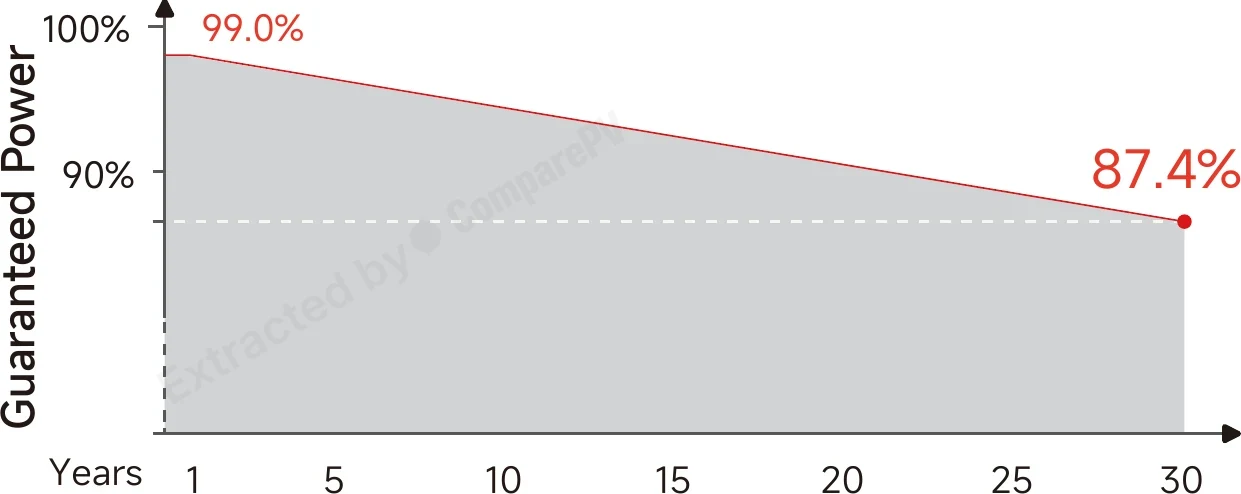
Strong 30-year linear power warranty

The 30-year power warranty paired with a 15-year product warranty matches the premium standard for N-type modules and is comparable to terms offered by Tier-1 manufacturers such as Jinko Solar.

Trade-offs
Manufacturer not on BNEF Tier-1 list

Q-SUN Solar does not appear on the BloombergNEF Tier 1 list, unlike comparable series from HT-SAAE, Astronergy, or Jinko Solar. This may complicate bank financing for projects, especially larger commercial installations.

Limited market track record

The company was founded in 2014, and the Qrystal N10 series only launched in 2024, meaning there is limited long-term field performance data compared to Tier-1 manufacturers with decades of market presence.

Notes from the database
  • Efficiency of 22.4% matches the N-type 600-650W median
  • 224.0 W/m² power density is 3.7 W/m² below N-type 600-650W median (227.7 W/m²) - requires larger installation area
  • At -0.30%/°C, hot weather performance is typical for N-type 600-650W panels
  • Bifaciality factor of 80% can add 4-12% extra yield with reflective mounting surface
  • #4774 for efficiency, #6093 for temperature performance out of 14005 panels

Specifications

Open datasheet PDF
Nominal power (Pmax) 605 Wp Nameplate at 1000 W/m², 25 °C
Module efficiency 22.40 % Typical Segment median 22.77%
Vmpp · Impp 40.01 V · 15.12 A Operating point at max power
Voc · Isc 47.65 V · 16.07 A Sizes the string length
Max system voltage 1500 V Longer strings than 1000 V modules
Dimensions 2382×1134×35 mm · 2.70 m² of roof
Weight 32.8 kg Typical Typical · median 32.5 kg
Cells 132 · N-type Monocrystalline
Bifaciality 80 % Rear output as a share of front
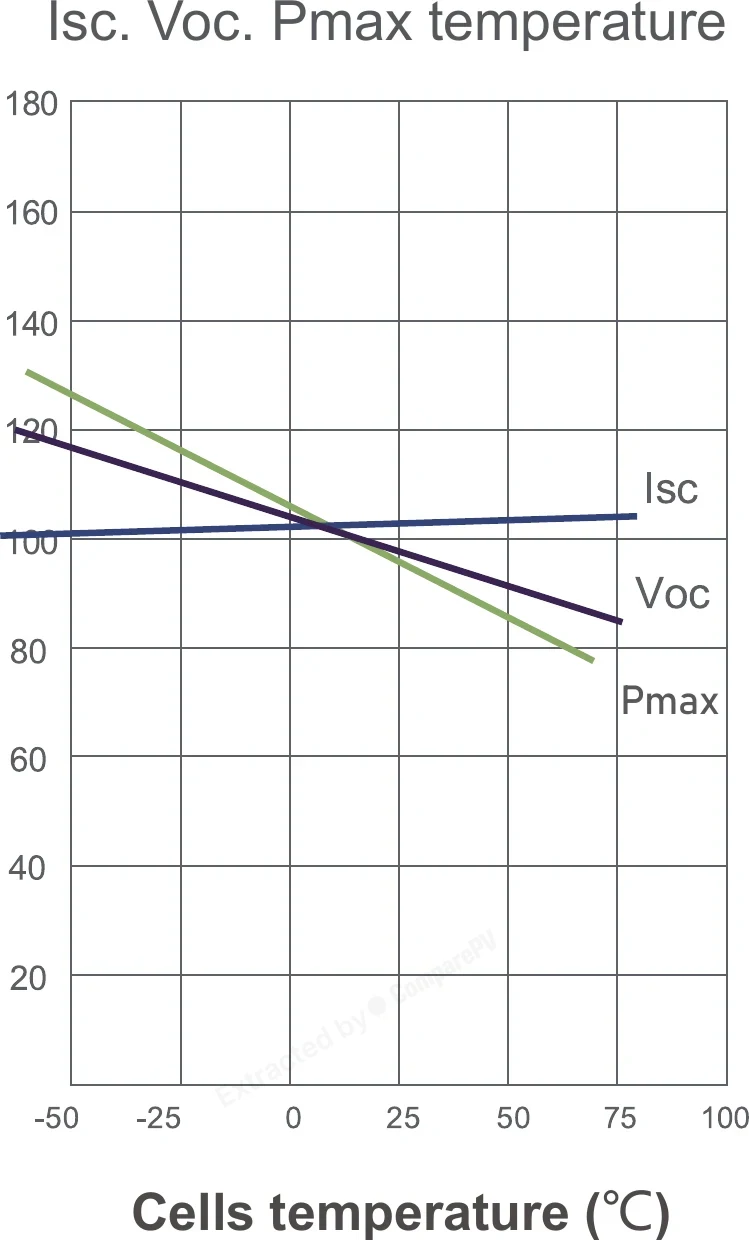
Coefficient Pmax -0.300 %/°C Weak bottom 11% of its segment
Coefficient Voc · Isc -0.250 · 0.040 %/°C
NOCT 42 °C At 800 W/m², 20 °C ambient
Product warranty 15 years Hardware defects only
Performance warranty 30 years Typical median 30 yrs · median 30 yrs
End-of-warranty output 87.4 % Equals 529 W guaranteed
Degradation 1.00 → 0.40 % First year, then annual

Datasheet charts

Open datasheet PDF

Measured curves published by Q-SUN Solar in this model's datasheet. A chart carrying a wattage was measured on that variant alone - only the ones that describe 605 Wp appear here. The rest cover the whole series.
Simulations

Live - change any input
Lifetime output & value
30 years at 1200 kWh/kWp/year and €0.50 per kWh
Power in year 30
-
Lifetime energy
-
Energy value
-
With bifacial gain
-

Degradation from this panel's own datasheet figures. No inverter, soiling or shading losses.

Heat losses
-0.300 %/°C against a segment median of -0.290
-
Bifacial gain
Rear gain over light concrete: -
-

Model: bifaciality × albedo × 0.6 view factor. A first-order estimate, not a yield simulation.

Alternatives

All Q-SUN Solar panels
Filter these
Size
Panel Power Eff. Temp. Weight Difference
Q-SUN Solar QN-605HT-02 605 W 22.40% -0.300 32.8 kg You are here
AIKO-A650-MAE72Mw 650 W 25.20% -0.260 27.0 kg +45 W, lighter, +2.8 pp
AIKO-A645-MAE72Mw 645 W 25.00% -0.260 27.0 kg +40 W, lighter, +2.6 pp
LR7-60HVH-560M 560 W 24.80% -0.260 25.0 kg -45 W, lighter, +2.4 pp
AIKO-A640-MAE72Mw 640 W 24.80% -0.260 27.0 kg Cooler, lighter, +2.4 pp
LR7-60HVH-555M 555 W 24.60% -0.260 25.0 kg -50 W, lighter, +2.2 pp
AIKO-A635-MAE72Mw 635 W 24.60% -0.260 27.0 kg Cooler, lighter, +2.2 pp
QN-600HT-02 600 W 22.20% -0.300 32.8 kg Very close match
QN-610HT-02 610 W 22.60% -0.300 32.8 kg +0.2 pp
QN-615HT-02 615 W 22.80% -0.300 32.8 kg +10 W, +0.4 pp
QN-620HT-02 620 W 23.00% -0.300 32.8 kg +15 W, +0.6 pp
AIKO-A680-MDE72Mw 680 W 25.20% -0.260 29.0 kg +75 W, cooler, +2.8 pp
AIKO-A675-MDE72Mw 675 W 25.00% -0.260 29.0 kg +70 W, cooler, +2.6 pp
AIKO-A700-MAE78Dw 700 W 25.00% -0.260 34.5 kg +95 W, cooler, +2.6 pp
AIKO-A695-MAE78Dw 695 W 24.90% -0.260 34.5 kg +90 W, cooler, +2.5 pp
AIKO-G670-MCH72Mw 670 W 24.80% -0.260 28.2 kg +65 W, lighter, +2.4 pp
LR7-72HVHF-670M 670 W 24.80% -0.260 28.5 kg +65 W, lighter, +2.4 pp

Found 1119 panels of the same or similar size to this one, within ±10 mm. See them here Found 1125 panels of the same or similar size to this one, within ±25 mm. See them here Found 1236 panels of the same or similar size to this one, within ±50 mm. See them here Found 1917 panels of the same or similar size to this one, within ±100 mm. See them here

Common questions

6 answered
What is the warranty on Q-SUN Solar Qrystal N10 panels?
Q-SUN Solar provides a 15-year product warranty and a 30-year power output warranty on the Qrystal N10 series. This means the modules are guaranteed to maintain a specified power level for three decades. For investors, the extended linear power warranty is a key metric when calculating LCOE and managing financial risk on commercial rooftop or utility-scale projects.
Are the Qrystal N10 panels bifacial, and does that actually increase energy yield?
Yes, the Qrystal N10 series uses bifacial cell architecture, generating electricity from both the front and rear surfaces. Real-world rear-side gain depends on ground albedo — light-colored gravel, white membranes, or snow reflect more irradiance — and mounting height. On ground-mount installations, bifacial modules can realistically add several to over ten percent in additional yield compared to monofacial modules.
Are Q-SUN Solar Qrystal N10 modules suitable for utility-scale solar farms?
Yes, the Qrystal N10 is engineered for large-scale applications. At up to 620 Wp per module, fewer units are needed to reach target system capacity, directly reducing BoS costs. The double glass construction provides superior mechanical resistance to wind and snow loads, while built-in PID resistance is critical for long strings common in utility-scale DC systems.
What does N-type cell technology mean in the Qrystal N10, and how does it compare to PERC?
N-type cells are doped with phosphorus rather than boron, which eliminates LID (Light-Induced Degradation) that affects P-type PERC modules. As a result, Qrystal N10 panels degrade more slowly — especially in the first years of operation. A better temperature coefficient and higher resistance to elevated operating temperatures translate to more predictable energy output throughout the 30-year power warranty period.
Do the Qrystal N10 panels perform reliably in harsh conditions — rain, snow, high humidity?
Yes. The double glass construction replaces the standard polymer backsheet with a second glass layer, significantly reducing moisture ingress and the risk of microcracks caused by cyclic mechanical stress. The Qrystal N10 series is specifically designed for industrial rooftops and solar farms where prolonged exposure to rain, frost, and snow loads is expected throughout the module's service life.
What is the maximum power output of the Q-SUN Solar Qrystal N10, and how does it affect system design?
The Qrystal N10 series reaches up to 620 Wp per module. Compared to typical residential modules at 400–430 Wp, the higher unit power means fewer modules, less cabling, and a smaller racking footprint are needed to achieve the same total system capacity. This directly reduces BoS costs and installation time — a significant advantage on large commercial or industrial projects where labor and structural costs are substantial.
Add to compare