LP182*199-M-72-NB-630W

630 Wp TOPCon Bifacial 80%
ComparePV verdict

Middle of its segment, weak in heat

Rank 1,122 of 14,005
Compare panels Datasheet PDF
Power (Wp)
630
Typical for its class
Efficiency (%)
22.54
Typical · median 22.80%
Density (Wp/m²)
225.4
Typical · median 227.7
Temp (%/°C)
-0.300
Weak · bottom 19%
Weight (kg)
34.3
Weak · 1.6 kg above median
Warranty (yrs)
30
Typical · median 30 yrs

The Leapton LP182*199-M-72-NB series are N-type TOPCon modules with a dual glass construction, designed for stable energy production over many years - even in challenging operating conditions. The bidirectional architecture allows for better utilization of light reflected from the ground, which effectively supports yields in ground-mounted installations, on bright roofs, and in systems with larger ground clearance. The use of N-type cells helps to minimize typical aging losses, while the TOPCon technology improves the module's performance at high temperatures and in variable sunlight conditions, which is important in the Polish climate.

A key feature is the enhanced mechanical strength resulting from the glass-glass construction, which is important under heavy snow and wind loads. The modules are also designed with a focus on PID resistance and operation in corrosive environments (salty mist, ammonia), making them well-suited for use near industrial areas, farms, and coastal areas. This is a choice for investors who expect long-term yield predictability and a robust construction, rather than just high power on paper.

Ranking

1,086 panels in the segment TOPCon 600-650 W
Metric This panel Median Position in segment Overall rank
Module efficiency 22.54% 22.80% Typical 3,920
Power density 225.4 227.7 Typical 3,907
Temperature coefficient -0.300 -0.290 Weak · bottom 19% 6,093
Weight per kWp 54.4 53.1 Weak · bottom 24% 8,755
Performance warranty 30 yrs 30 yrs Typical 21
Colour key Strong - top 25% Typical - middle 50% Weak - bottom 25%

Signals from the data

5 positive · 3 caution
Best for

Commercial and utility-scale.

Not ideal for

Hot climates and weight-limited structures.

Watch-outs
-0.300 %/°C temperature coefficient

Bottom 19% of the TOPCon 600-650 W segment, against a median of -0.290.

54.4 kg per kWp

Bottom 24% of the TOPCon 600-650 W segment, against a median of 53.1.

What owners get
High mechanical load rating of 5400 Pa/2400 Pa

The dual-glass construction, verified through TÜV Nord testing, withstands snow loads up to 5400 Pa and wind loads up to 2400 Pa, matching or exceeding typical aluminum-frame module ratings and giving an edge in regions with heavy snowfall.

30-year linear power warranty

The manufacturer offers a 30-year power warranty and a 25-year product warranty, matching leading market offerings (e.g., Jinko Tiger Neo, Canadian Solar TOPBiHiKu6) and exceeding the standard 25/12-year terms found among many Tier-2 manufacturers.

N-type TOPCon technology with low LID/LeTID degradation

N-type cells reduce the typical aging losses (LID/LeTID) characteristic of older P-type PERC cells, resulting in more predictable energy yield over a 25-30 year operating lifetime.

Bifacial dual-glass design boosting energy yield

The dual-glass construction with bifacial cells captures light reflected from the ground surface, meaningfully increasing energy production in ground-mounted installations and on light-colored roofs, particularly with greater ground clearance.

BNEF Tier-1 status and Japanese technology origin

Leapton holds Tier-1 status according to BloombergNEF (Q1 2026 update), confirming module use in at least six projects financed by different non-recourse project finance banks - an important factor for bank-financed investments.

Trade-offs
Efficiency trails top-tier competitors

Efficiency of 22.18-22.54% is notably lower than comparable series at the same 630 Wp power class - Canadian Solar TOPBiHiKu6 Anti-Dust (23.3%), Resun RS8H-M-BD (23.32%), and Jinko Tiger Neo 66HL4M-BDV (23.32%) - a gap of roughly 0.8-1.1 percentage points meaning lower yield from the same roof area.

Notes from the database
  • Efficiency of 22.5% matches the TOPCon 600-650W median
  • At 225.4 W/m² power density, roof space requirements are typical for TOPCon 600-650W panels
  • At -0.30%/°C, hot weather performance is typical for TOPCon 600-650W panels
  • At 34.3 kg, this panel is 1.6 kg heavier than the TOPCon 600-650W median (32.7 kg) - more demanding for installation crews
  • 80% bifaciality enables rear-side power generation, boosting yield by 4-12% on reflective surfaces

Specifications

Open datasheet PDF
Nominal power (Pmax) 630 Wp Nameplate at 1000 W/m², 25 °C
Module efficiency 22.54 % Typical Segment median 22.80%
Vmpp · Impp 43.88 V · 14.36 A Operating point at max power
Voc · Isc 52.49 V · 15.21 A Sizes the string length
Max system voltage 1500 V Longer strings than 1000 V modules
Dimensions 2465×1134×30 mm · 2.80 m² of roof
Weight 34.3 kg Weak Weak · 1.6 kg above median
Cells 144 · TOPCon Monocrystalline
Bifaciality 80 % Rear output as a share of front
Coefficient Pmax -0.300 %/°C Weak bottom 19% of its segment
Coefficient Voc · Isc -0.250 · 0.046 %/°C
NOCT 41 °C At 800 W/m², 20 °C ambient
Product warranty 25 years Hardware defects only
Performance warranty 30 years Typical median 30 yrs · median 30 yrs
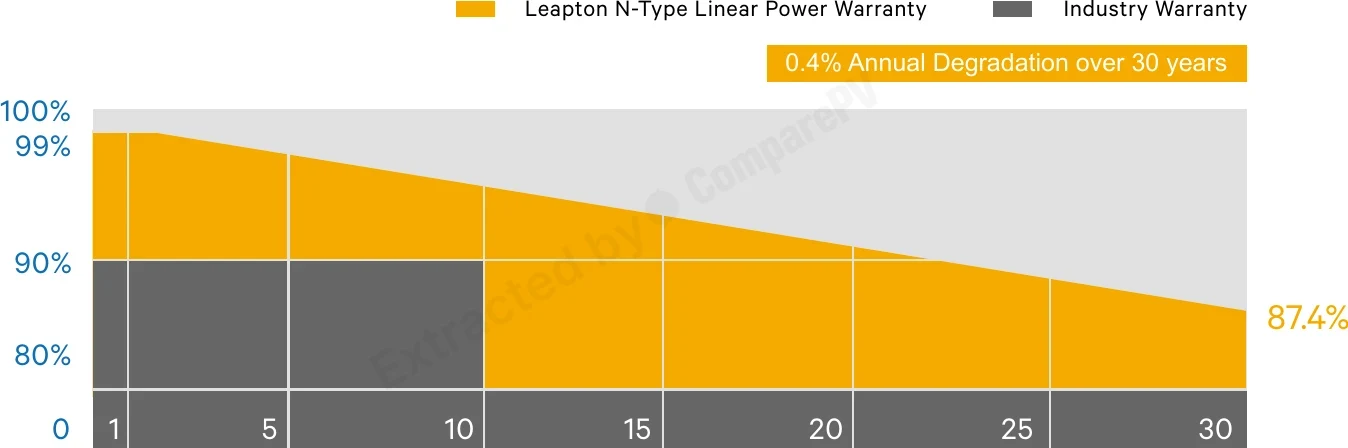
End-of-warranty output 87.4 % Equals 551 W guaranteed
Degradation 1.00 → 0.40 % First year, then annual

Datasheet charts

Open datasheet PDF

Measured curves published by Leapton in this model's datasheet. A chart carrying a wattage was measured on that variant alone - only the ones that describe 630 Wp appear here. The rest cover the whole series.
Simulations

Live - change any input
Lifetime output & value
30 years at 1200 kWh/kWp/year and €0.50 per kWh
Power in year 30
-
Lifetime energy
-
Energy value
-
With bifacial gain
-

Degradation from this panel's own datasheet figures. No inverter, soiling or shading losses.

Heat losses
-0.300 %/°C against a segment median of -0.290
-
Bifacial gain
Rear gain over light concrete: -
-

Model: bifaciality × albedo × 0.6 view factor. A first-order estimate, not a yield simulation.

Filter these
Size
Panel Power Eff. Temp. Weight Difference
Leapton LP182*199-M-72-NB-630W 630 W 22.54% -0.300 34.3 kg You are here
AIKO-A650-MAE72Mw 650 W 25.20% -0.260 27.0 kg Cooler, lighter, +2.7 pp
AIKO-A680-MDE72Mw 680 W 25.20% -0.260 29.0 kg +50 W, lighter, +2.7 pp
AIKO-A675-MDE72Mw 675 W 25.00% -0.260 29.0 kg +45 W, lighter, +2.5 pp
AIKO-A645-MAE72Mw 645 W 25.00% -0.260 27.0 kg Cooler, lighter, +2.5 pp
AIKO-G670-MCH72Mw 670 W 24.80% -0.260 28.2 kg +40 W, lighter, +2.3 pp
LR7-72HVHF-670M 670 W 24.80% -0.260 28.5 kg +40 W, lighter, +2.3 pp
AIKO-A640-MAE72Mw 640 W 24.80% -0.260 27.0 kg Cooler, lighter, +2.3 pp
LP182*182-M-78-NH-610W 610 W 21.82% -0.300 29.0 kg -20 W, lighter, -0.7 pp
LP182*182-M-78-NH-615W 615 W 22.00% -0.300 29.0 kg -15 W, lighter, -0.5 pp
LP182*199-M-72-NH-620W 620 W 22.18% -0.300 29.0 kg -10 W, lighter, -0.4 pp
LP182*199-M-72-NB-625W 625 W 22.36% -0.300 34.3 kg Very close match
AIKO-A700-MAE78Dw 700 W 25.00% -0.260 34.5 kg +70 W, cooler, +2.5 pp
AIKO-A695-MAE78Dw 695 W 24.90% -0.260 34.5 kg +65 W, cooler, +2.4 pp
JKM650-670N-66QL6-BDV (670W class) 670 W 24.80% -0.260 32.5 kg +40 W, cooler, +2.3 pp

Found 616 panels of the same or similar size to this one, within ±10 mm. See them here Found 616 panels of the same or similar size to this one, within ±25 mm. See them here Found 616 panels of the same or similar size to this one, within ±50 mm. See them here Found 1813 panels of the same or similar size to this one, within ±100 mm. See them here

Common questions

6 answered
What warranty comes with the Leapton LP182*199-M-72-NB modules?
The LP182*199-M-72-NB series carries a 25-year product warranty covering materials and workmanship, plus a 30-year power output warranty. After 30 years, the manufacturer guarantees at least 87.4% of nominal power. First-year degradation is capped at 1%, which is standard for N-type TOPCon cells and better than conventional PERC modules.
What does bifacial design actually mean for the LP182*199-M-72-NB, and when does it pay off?
Bifacial modules capture light reflected off the ground or rooftop surface through the rear glass, delivering 5–25% additional energy depending on surface albedo. You'll see the best gains in ground-mount systems with bright substrates, on white TPO or PVC roofing membranes, or wherever panels are elevated well above the surface. On a dark roof with no clearance, the bifacial gain is negligible.
Can the LP182*199-M-72-NB modules handle heavy snow loads typical in Central Europe?
Yes. The dual glass construction — two 2.0 mm tempered glass panes — gives the module a certified snow load rating of 5,400 Pa and a wind load rating of 2,400 Pa, both well above what standard backsheet modules offer. The glass-glass build also eliminates backsheet bubbling and reduces the risk of micro-cracks during temperature cycling.
How do the N-type TOPCon cells in the LP182*199-M-72-NB compare to PERC modules?
N-type TOPCon cells have a lower temperature coefficient (−0.30%/°C vs. roughly −0.35% for PERC), which means less power loss on hot days. They are also far less prone to LID and LeTID degradation. Over a 30-year lifespan, a TOPCon module with the same nameplate wattage will generate more total energy than a comparable PERC panel.
Are the Leapton LP182*199-M-72-NB modules suitable for coastal or industrial environments?
Yes. The NB series is tested for salt spray and ammonia corrosion resistance, making it a solid choice for coastal installations and sites near chemical plants or large livestock facilities. The sealed dual glass structure also provides superior moisture barrier compared to standard backsheet modules, reducing the risk of cell corrosion over time.
How heavy is the LP182*199-M-72-NB module and will a standard roof structure support it?
Each module weighs approximately 35.3 kg and measures 2465 × 1134 × 30 mm. That is significantly heavier than lightweight backsheet modules at 20–23 kg. For sloped roof installations, especially older buildings, a structural engineer should verify roof load capacity before installation. Ground-mount and flat-roof ballasted systems generally have no issue with the added weight.
Add to compare