Solid all-round for its segment
The DMEGC GH400M10T-B48HST series was designed for installations in agri-PV and greenhouse environments, where reliable performance in challenging conditions and predictable energy yield are essential. These modules feature a monocrystalline structure with N-type cells, highly regarded for their lower susceptibility to typical operational losses and superior parameter repeatability over a long lifespan. The use of double glazing protects the laminate from moisture, ammonia, and temperature fluctuations - exactly what often accelerates panel aging in agricultural settings and high-humidity facilities.
The GH400M10T-B48HST also boasts adaptability to high system voltages, facilitating the design of longer strings and optimizing cabling in larger installations. This is an excellent choice for C&I investors, agricultural farms, technological canopies, and projects where module longevity and a lower risk of yield degradation over time are top priorities.
Ranking
Signals from the data
Agrivoltaic and commercial.
N-type cells exhibit significantly lower light-induced degradation (LID) and are far less susceptible to light and elevated temperature-induced degradation (LeTID) than p-type PERC cells, as confirmed by NREL research (PVRW 2025) and the IEA-PVPS T13-30 report (2025). In practice, this translates to measurably higher annual energy yield over the full 30-year operating lifetime.
The hermetically sealed double-glass design protects the laminate against moisture ingress and ammonia exposure – the two primary drivers of accelerated panel degradation in agricultural and greenhouse environments. The bifacial architecture additionally captures reflected irradiance from the ground surface (e.g., straw mulch, plastic mulching film), increasing energy yield without any increase in installed area.
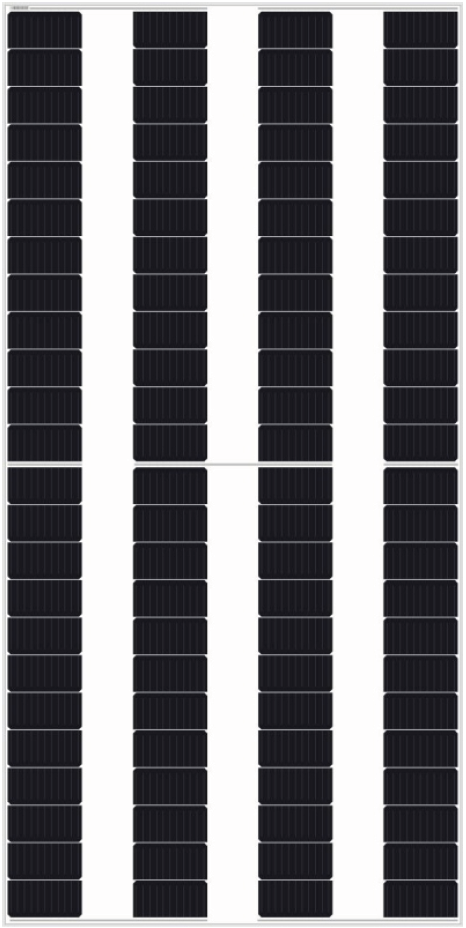
The 48-cell configuration (versus the standard 54–60 cells) creates intentional inter-row gaps between cell strings, allowing partial light transmission to crops below – a critical design parameter in certified agrivoltaic installations. None of the identified peer comparables (Meyer Burger White, Solaria PowerXT, Heckert NEMO) offer this capability, as those are modules designed for conventional installations, not agri-PV.
DMEGC Solar maintained its Tier 1 status in the BloombergNEF bankability ranking in Q3 2025, confirming full bankability – lenders can finance projects on a non-recourse basis without requiring additional credit enhancements. For C&I investors and agri-PV project developers, this is a material prerequisite for financial close.
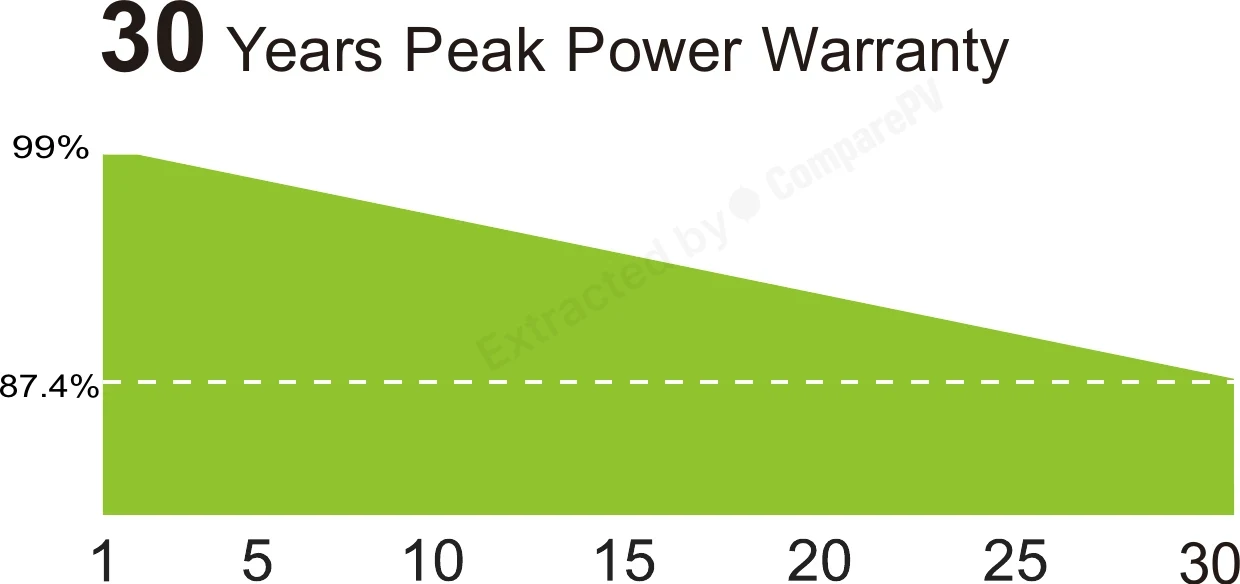
The manufacturer guarantees a minimum of 80% of rated power output after 30 years, consistent with the premium module standard. The implied annual linear degradation rate is materially lower than that of legacy PERC modules carrying 25-year warranties, and provides lenders with a predictable, modelable yield degradation profile over the full financing term.
The low area efficiency is an intentional consequence of the 48-cell layout's inter-row gaps, but outside dedicated agrivoltaic installations it requires approximately 35–45% more surface area per kWp than standard N-type modules (Meyer Burger White: 21.7%, Heckert NEMO: 20.5%). This effectively disqualifies the series from conventional rooftop installations or densely developed ground-mount solar farms.
The workmanship warranty stands at 15 years, whereas most premium-tier modules (Meyer Burger, Heckert Solar) carry 25–30-year product warranties. For projects with financing tenors exceeding 15 years, this may present a limitation during technical due diligence and residual risk valuation.
- Module efficiency of 15.3% is 0.7pp below average for TOPCon 0-400W panels (median: 16.0%)
- At 152.9 W/m², this panel generates 6.9 W/m² less per unit area than TOPCon 0-400W median (159.8 W/m²)
- At -0.29%/°C, hot weather performance is typical for TOPCon 0-400W panels
- At 31.7 kg, this panel is 8.2 kg heavier than the TOPCon 0-400W median (23.5 kg) - more demanding for installation crews
- Bifaciality factor of 80% can add 4-12% extra yield with reflective mounting surface
Specifications
Datasheet charts
Measured curves published by DMEGC in this model's datasheet. A chart carrying a wattage was measured on that variant alone - only the ones that describe 395 Wp appear here. The rest cover the whole series.
Simulations
Degradation from this panel's own datasheet figures. No inverter, soiling or shading losses.
Model: bifaciality × albedo × 0.6 view factor. A first-order estimate, not a yield simulation.





Found 2326 panels of the same or similar size to this one, within ±10 mm. See them here Found 2368 panels of the same or similar size to this one, within ±25 mm. See them here Found 2382 panels of the same or similar size to this one, within ±50 mm. See them here Found 2547 panels of the same or similar size to this one, within ±100 mm. See them here