
Strong in heat, modest efficiency
The DMEGC Greenhouse series is a specialized solution in the field of agrivoltaics that redefines the way modern agriculture is combined with green energy production. The key distinguishing feature of these modules is their unique construction transparency, which allows for the free flow of sunlight necessary for proper plant growth. The use of advanced N-type TOPCon bifacial cell technology ensures the panels generate electricity from both sides, maximizing yields even in specific mounting conditions above crops. They solve the land deficit problem, enabling efficient dual use of the surface for crops and renewable energy installations simultaneously. Unlike traditional modules, the Greenhouse series provides optimal lighting for crops and protects them from severe weather events such as hail or heavy rain. Thanks to the glass-glass structure, the product is characterized by extreme resistance to ammonia and moisture, making it reliable in aggressive agricultural environments. The innovative approach to construction allows for easy installation on various types of support systems used in horticulture. It is an ideal choice for farms seeking energy independence without reducing production acreage. The applied technology eliminates the risk of hot-spots and guarantees stable operation for decades, setting these panels apart from standard market solutions.
Ranking
Signals from the data
Agrivoltaic.
Tight roof space, roofs where every square metre has to count and weight-limited structures.
Top 13% of the N-type 200-400 W segment, against a median of -0.320.
Top 23% of the N-type 200-400 W segment, against a median of 25 yrs.
Bottom 5% of the N-type 200-400 W segment, against a median of 19.49%. Ranked 13,992nd in the whole database.
Bottom 5% of the N-type 200-400 W segment, against a median of 194.9. Ranked 13,982nd in the whole database.
Bottom 5% of the N-type 200-400 W segment, against a median of 63.8. Ranked 13,929th in the whole database.
The Greenhouse series (evolved toward the G12RT) offers a light transmittance spectrum from 2% to 50%, enabling precise module selection to match the requirements of a specific crop and climate. None of the listed peer comparables (Jinko Tiger Neo, Q-Cells Q.TRON BLACK, Astronergy ASTRO N7s) feature this capability — it is a unique characteristic exclusive to DMEGC's agrivoltaic series.
N-type TOPCon cells exhibit lower LID degradation rates and a superior temperature coefficient compared to PERC technology (typically -0.29%/°C vs. -0.35%/°C). The glass-glass laminate provides exceptional resistance to moisture and ammonia — critical in greenhouse and livestock environments where standard backsheets undergo accelerated degradation.
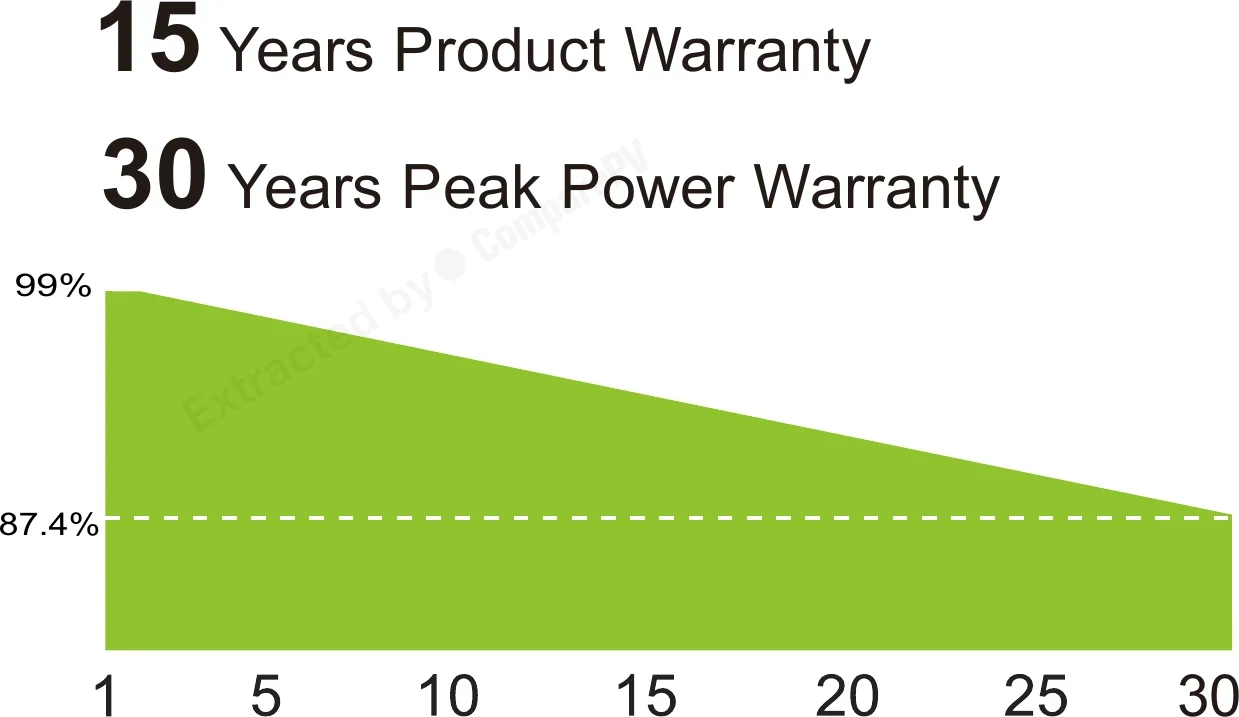
DMEGC guarantees ≥99% power output after year 1 and ≥85% after 30 years, corresponding to a slower degradation curve than the standard 25-year warranties offered by many competing series. For agrivoltaic projects with a typical investment horizon of 25–30 years, this has a direct impact on project bankability.
DMEGC Solar has maintained BloombergNEF Tier 1 status continuously through at least Q3 2025 (annual production capacity: 21 GW). This status is required by the majority of renewable energy project lenders for non-recourse financing, directly reducing the cost of capital for agrivoltaic farm developments.
DMEGC has been in operation since 1980, which — in the context of a 30-year power warranty — is a significant credibility argument. Manufacturer insolvency risk is lower than with newer market entrants, a factor that banks and project insurers typically price as reduced risk premiums for renewable energy projects.
The Greenhouse series has is_bifacial = false, whereas agrivoltaic installations are among the use cases where bifacial technology delivers the greatest benefits — light reflected from the ground surface and crops can increase energy yield by 5–30% (Oxford Clean Energy, 2024). The direct peer, Astronergy ASTRO N7s, is a bifacial series with 22.3% efficiency, which in above-crop mounting configurations may translate into a measurably higher annual energy yield.
The series' maximum efficiency of 21.91% falls short of all three listed peer comparables, which achieve 22.27–22.3% (Jinko Tiger Neo, Q-Cells Q.TRON BLACK, Astronergy ASTRO N7s). The ~0.4 percentage point gap translates to approximately 2% more module area required for the same power target — a meaningful constraint in installations with limited greenhouse floor space.
- At 11.6% efficiency, this panel is 7.9pp below the N-type 0-400W median of 19.5%
- Power density of 116.1 W/m² is 78.8 W/m² below N-type 0-400W median (194.9 W/m²) - needs more roof space
- -0.29%/°C temperature coefficient (median: -0.32%/°C) - retains ~1% more power at high temperatures
- At 31.0 kg, this panel is 9.0 kg heavier than the N-type 0-400W median (22.0 kg) - more demanding for installation crews
- 80% bifaciality enables rear-side power generation, boosting yield by 4-12% on reflective surfaces
Specifications
Datasheet charts
Measured curves published by DMEGC in this model's datasheet. A chart carrying a wattage was measured on that variant alone - only the ones that describe 300 Wp appear here. The rest cover the whole series.
Simulations
Degradation from this panel's own datasheet figures. No inverter, soiling or shading losses.
Model: bifaciality × albedo × 0.6 view factor. A first-order estimate, not a yield simulation.






Found 2326 panels of the same or similar size to this one, within ±10 mm. See them here Found 2368 panels of the same or similar size to this one, within ±25 mm. See them here Found 2382 panels of the same or similar size to this one, within ±50 mm. See them here Found 2547 panels of the same or similar size to this one, within ±100 mm. See them here