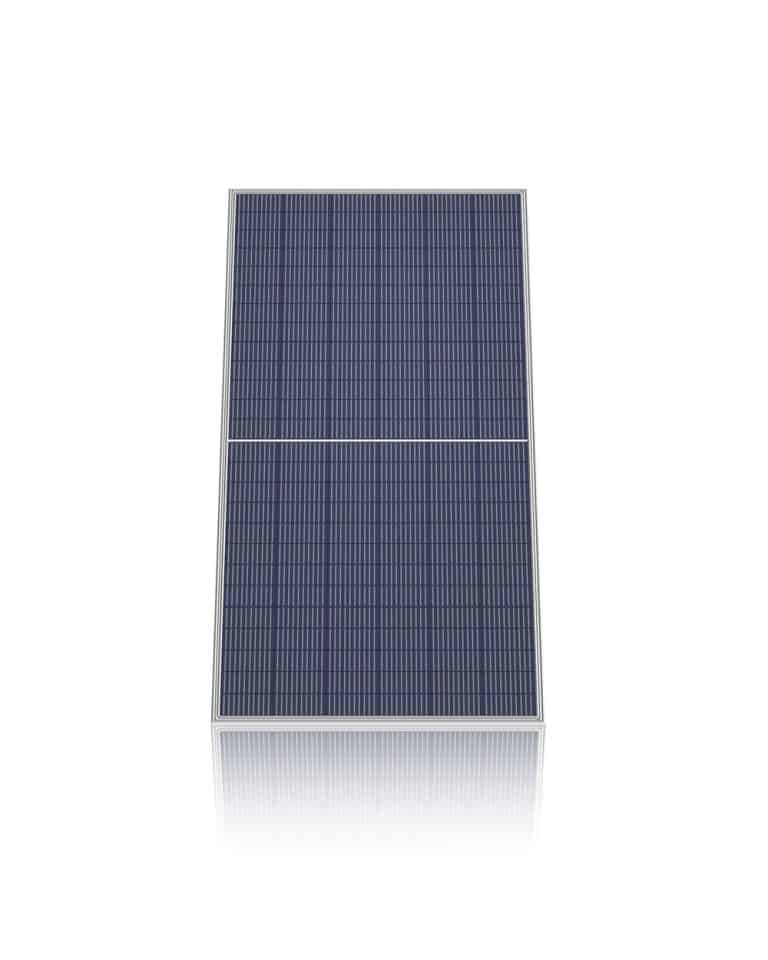
Middle of its segment, needs the roof space
The Heliene 156HC M10 SL Bifacial Module series is designed for maximum energy yield, where every square meter of installation matters. The use of a bifacial design allows for the utilization of reflected light from the ground, which significantly increases energy production in PV farms, ground-mounted systems, and on bright industrial roofs. The modules are based on single-crystal PERC cells in M10 format, and the half-cut design minimizes losses and improves performance under partial shading - which is particularly important in rows of tables, fences, or installations near technical facilities. The split junction box also supports even current flow and the overall stability of the module. In practice, this series solves the problem of reduced yield in challenging operating conditions, while also offering high environmental resistance and durability, which are essential for long-term financed projects. This makes it a good choice for investors and contractors looking for predictable performance and better energy production without complicating the project.
Ranking
Signals from the data
Utility-scale, commercial and shaded-installations.
Roofs where every square metre has to count, tight roof space and owners who want a long output guarantee.
Bottom 11% of the PERC 550-600 W segment, against a median of 212.9.
Bottom 13% of the PERC 550-600 W segment, against a median of 21.29%.
Bottom 24% of the PERC 550-600 W segment, against a median of 27 yrs.
The module harvests energy from both faces: M10 PERC half-cut cells reduce CTM losses, and the rear glass enables a typical bifacial gain of 10–20% on high-albedo surfaces (gravel, light concrete, TPO membranes). The split junction box further stabilizes current flow under partial shading conditions.
Heliene is recognized as a bankable manufacturer (confirmed by context data and distributors), simplifying lender due diligence and meeting the requirements of standard project finance agreements. This is particularly relevant for utility-scale PV projects with long-term debt financing.
Datasheet rev.02 confirms: power ≥86% Pnom after 25 years, with 2% first-year degradation and 0.5%/yr thereafter. This meets the utility-class benchmark and is sufficient for standard LCOE analyses over a 20–25-year project horizon.
Compatibility with 1500 V inverters allows longer string configurations and reduced BoS costs: fewer DC cables and fewer MPPT trackers per megawatt — a standard requirement for utility-scale installations above 1 MWp.
The series peaks at 20.9% efficiency, while direct peer comparables offer: Hanersun Hitouch 5N – 22.65%, Risen RSM144-9 – 22.6%, Q-SUN Qrystal N8 – 22.65%. The ~1.7–2.4 pp gap translates to approximately 8–10% less peak power from the same row footprint, increasing the module count, mounting costs, and land area required to achieve the same farm output.
Heliene provides a 15-year product warranty, while a growing portion of the market (including Risen, Q Cells, Trina) is standardizing on 25 years. In projects with 20-year PPAs or insurer requirements, this may necessitate additional risk assessment or individual negotiations with the manufacturer.
In 2024, TOPCon N-type modules exceeded 66% of global production capacity (per PV-Tech/CEA), relegating PERC to generationally older technology status. PERC bifaciality factor is typically ~70% vs. ~80–85% for TOPCon, directly limiting the rear-side energy harvest efficiency of this series compared to N-type competitors offering the same nominal power.
- At 20.8% efficiency, this panel is on par with typical PERC 550-600W modules
- 207.6 W/m² power density is 5.3 W/m² below PERC 550-600W median (212.9 W/m²) - requires larger installation area
- Temperature coefficient of -0.34%/°C matches the PERC 550-600W median
- Bifaciality factor of 70% can add 4-10% extra yield with reflective mounting surface
- Ranked #10457 out of 14005 panels for efficiency in the database
Specifications
Simulations
Degradation from this panel's own datasheet figures. No inverter, soiling or shading losses.
Model: bifaciality × albedo × 0.6 view factor. A first-order estimate, not a yield simulation.
Alternatives





Found 616 panels of the same or similar size to this one, within ±10 mm. See them here Found 616 panels of the same or similar size to this one, within ±25 mm. See them here Found 616 panels of the same or similar size to this one, within ±50 mm. See them here Found 1813 panels of the same or similar size to this one, within ±100 mm. See them here