HiS-T630NJ

630 Wp TOPCon Bifacial 80%
ComparePV verdict

Middle of its segment, heavy for its output

Rank 2,702 of 14,005
Compare panels Datasheet PDF
Power (Wp)
630
Typical for its class
Efficiency (%)
22.54
Typical · median 22.80%
Density (Wp/m²)
225.4
Typical · median 227.7
Temp (%/°C)
-0.290
Typical · median -0.290
Weight (kg)
34.7
Weak · 2.0 kg above median
Warranty (yrs)
30
Typical · median 30 yrs

Hyundai NJ Series (Premium N-Type TOPCon Module) are modules designed for maximizing energy yield in real-world operating conditions - beyond the laboratory. The use of N-Type TOPCon cells enables better light utilization under low irradiance conditions and higher parameter stability over time, translating to predictable production and peace of mind for the investor. In practice, this is an excellent choice where high yield per square meter and resistance to typical operational losses matter.

What sets this series apart from many standard modules is its bifacial construction, allowing the panels to also operate "from the back," utilizing reflected light from the ground. Combined with double glazing, the NJ series performs exceptionally well on ground-mounted constructions, flat roofs, carports, and industrial installations, where environmental conditions can be demanding. An additional argument is the long warranty protection, crucial for projects focused on multi-year returns and bankability.

Ranking

1,086 panels in the segment TOPCon 600-650 W
Metric This panel Median Position in segment Overall rank
Module efficiency 22.54% 22.80% Typical 3,920
Power density 225.4 227.7 Typical 3,907
Temperature coefficient -0.290 -0.290 Typical 2,165
Weight per kWp 55.1 53.1 Weak · bottom 16% 9,493
Performance warranty 30 yrs 30 yrs Typical 21
Colour key Strong - top 25% Typical - middle 50% Weak - bottom 25%

Signals from the data

5 positive · 2 caution
Best for

Commercial, utility-scale, shaded-installations and hot-climate.

Not ideal for

Weight-limited structures.

Watch-outs
55.1 kg per kWp

Bottom 16% of the TOPCon 600-650 W segment, against a median of 53.1.

What owners get
22.54–22.9% efficiency — segment leader

The NJ Series reaches up to 22.9% module efficiency, matching Suntech Ultra V Pro (22.9%) and clearly outperforming REC Alpha Pro M (22.5%) and MY Solar HJT (22.61%). This translates to higher energy yield per unit of roof or ground area, reducing the overall LCOE of the installation.

Low Pmax temperature coefficient of -0.30%/°C

N-type TOPCon cell technology delivers a Pmax temperature coefficient of -0.30%/°C, outperforming conventional PERC modules (-0.35 to -0.40%/°C). This results in lower power losses during hot weather and a higher annual yield in temperate climates.

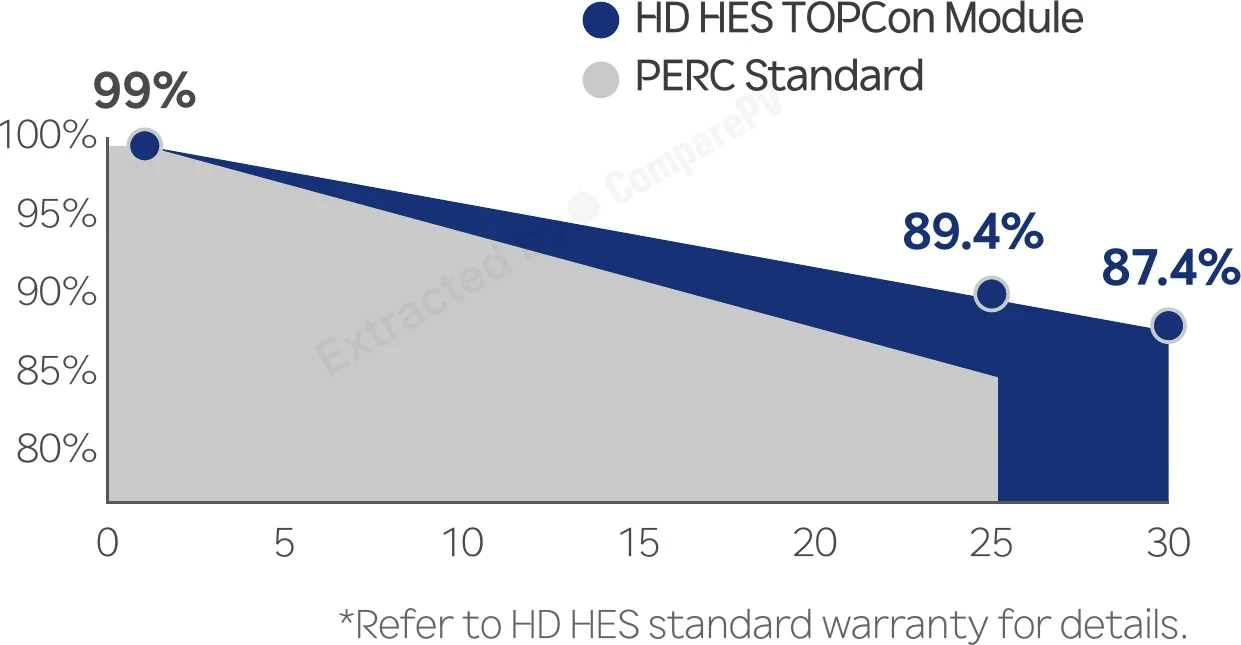
30-year linear power warranty, min. 87.4%

The manufacturer guarantees at least 87.4% of nominal power after 30 years of operation, implying an annual degradation rate of ~0.40%/year. The direct peer comparable REC Alpha Pro M offers a performance warranty for only 25 years (92% in year 25); over a 30-year horizon, the Hyundai NJ Series holds a clear advantage in bankability and NPV financial models.

PVEL PQP Top Performer 2025

The NJ Series earned the Top Performer designation in the Kiwa PVEL Product Quality Program (PQP) 2025, demonstrating positive results across independent climate sequence tests (DH, TC, HF). This is a key argument for bank financing and utility-scale project due diligence.

Bifacial 80% + dual glass + 5400 Pa

An 80% (±5%) bifaciality factor allows the capture of 19–25% additional energy from ground-reflected irradiance in ground-mount and carport installations. Dual 2.0 mm AR-coated glass and a 5400 Pa mechanical load rating (front and rear) qualify the series for industrial facilities and high-snow-load regions.

Trade-offs
Only 12-year product warranty

The Hyundai NJ Series carries a 12-year product warranty covering material and workmanship defects, while the direct peer comparable REC Alpha Pro M provides 20 years (extendable to 25 years under the ProTrust program). The shorter coverage period may be a limiting factor for projects where lenders require a minimum 15-year product warranty — a common clause in EPC and project finance agreements.

Notes from the database
  • At 22.5% efficiency, this panel is on par with typical TOPCon 600-650W modules
  • Power density of 225.4 W/m² matches the TOPCon 600-650W median
  • At -0.29%/°C, hot weather performance is typical for TOPCon 600-650W panels
  • Weight of 34.7 kg is 2.0 kg above TOPCon 600-650W median (32.7 kg) - verify structural support
  • 80% bifaciality enables rear-side power generation, boosting yield by 4-12% on reflective surfaces

Specifications

Open datasheet PDF
Nominal power (Pmax) 630 Wp Nameplate at 1000 W/m², 25 °C
Module efficiency 22.54 % Typical Segment median 22.80%
Vmpp · Impp 47.41 V · 13.29 A Operating point at max power
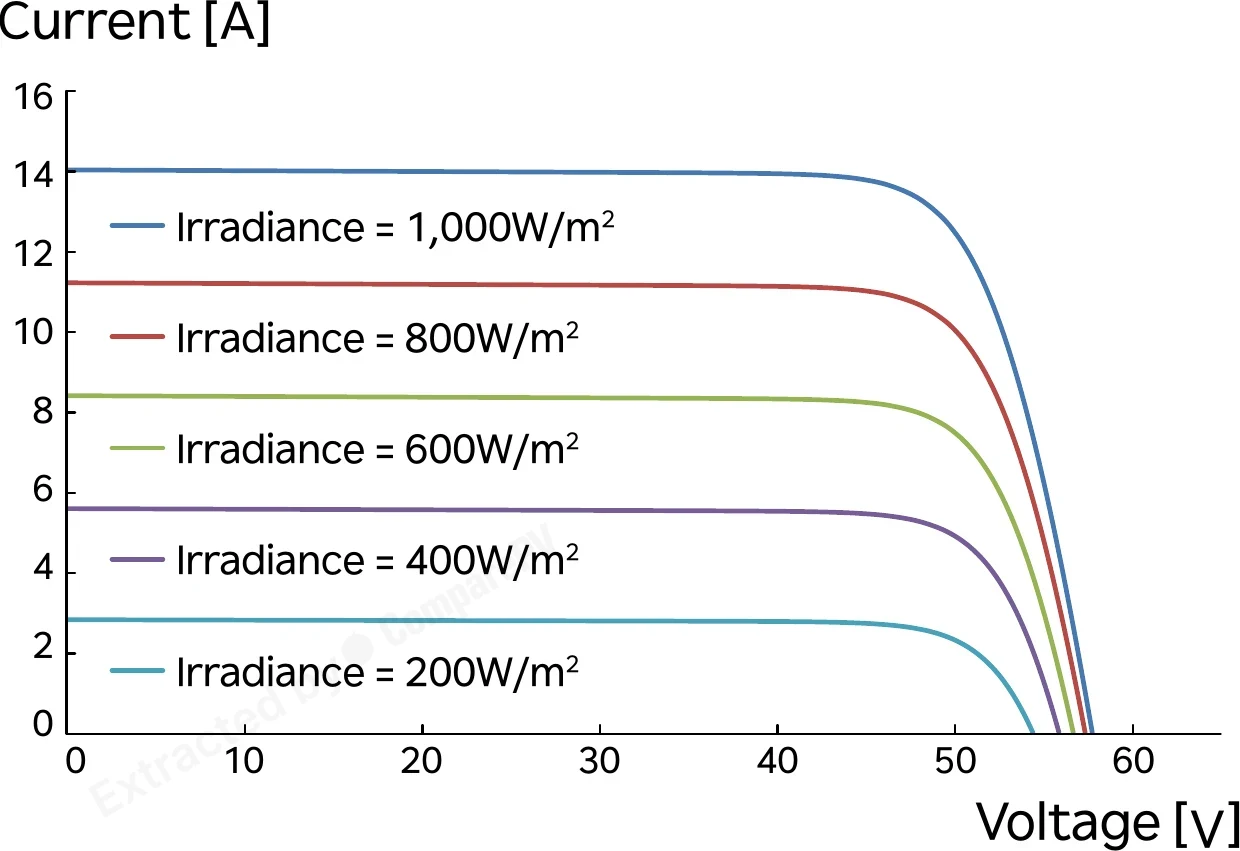
Voc · Isc 57.36 V · 13.90 A Sizes the string length
Max system voltage 1500 V Longer strings than 1000 V modules
Dimensions 2465×1134×30 mm · 2.80 m² of roof
Weight 34.7 kg Weak Weak · 2.0 kg above median
Cells 156 · TOPCon Monocrystalline
Bifaciality 80 % Rear output as a share of front
Coefficient Pmax -0.290 %/°C Typical median -0.290 of its segment
Coefficient Voc · Isc -0.250 · 0.043 %/°C
NOCT 41 °C At 800 W/m², 20 °C ambient
Product warranty 12 years Hardware defects only
Performance warranty 30 years Typical median 30 yrs · median 30 yrs
End-of-warranty output 87.4 % Equals 551 W guaranteed
Degradation 1.00 → 0.40 % First year, then annual

Datasheet charts

Open datasheet PDF

Measured curves published by Hyundai in this model's datasheet. A chart carrying a wattage was measured on that variant alone - only the ones that describe 630 Wp appear here. The rest cover the whole series.
Simulations

Live - change any input
Lifetime output & value
30 years at 1200 kWh/kWp/year and €0.50 per kWh
Power in year 30
-
Lifetime energy
-
Energy value
-
With bifacial gain
-

Degradation from this panel's own datasheet figures. No inverter, soiling or shading losses.

Heat losses
-0.290 %/°C against a segment median of -0.290
-
Bifacial gain
Rear gain over light concrete: -
-

Model: bifaciality × albedo × 0.6 view factor. A first-order estimate, not a yield simulation.

Filter these
Size
Panel Power Eff. Temp. Weight Difference
Hyundai HiS-T630NJ 630 W 22.54% -0.290 34.7 kg You are here
AIKO-A650-MAE72Mw 650 W 25.20% -0.260 27.0 kg Cooler, lighter, +2.7 pp
AIKO-A680-MDE72Mw 680 W 25.20% -0.260 29.0 kg +50 W, lighter, +2.7 pp
AIKO-A675-MDE72Mw 675 W 25.00% -0.260 29.0 kg +45 W, lighter, +2.5 pp
AIKO-A645-MAE72Mw 645 W 25.00% -0.260 27.0 kg Cooler, lighter, +2.5 pp
AIKO-G670-MCH72Mw 670 W 24.80% -0.260 28.2 kg +40 W, lighter, +2.3 pp
LR7-72HVHF-670M 670 W 24.80% -0.260 28.5 kg +40 W, lighter, +2.3 pp
AIKO-A640-MAE72Mw 640 W 24.80% -0.260 27.0 kg Cooler, lighter, +2.3 pp
HiS-T635NJ 635 W 22.72% -0.290 34.7 kg Very close match
HiS-T640NJ 640 W 22.90% -0.290 34.7 kg +10 W, +0.4 pp
AIKO-A700-MAE78Dw 700 W 25.00% -0.260 34.5 kg +70 W, cooler, +2.5 pp
AIKO-A695-MAE78Dw 695 W 24.90% -0.260 34.5 kg +65 W, cooler, +2.4 pp
JKM650-670N-66QL6-BDV (670W class) 670 W 24.80% -0.260 32.5 kg +40 W, cooler, +2.3 pp

Found 616 panels of the same or similar size to this one, within ±10 mm. See them here Found 616 panels of the same or similar size to this one, within ±25 mm. See them here Found 616 panels of the same or similar size to this one, within ±50 mm. See them here Found 1813 panels of the same or similar size to this one, within ±100 mm. See them here

Common questions

6 answered
How does the N-Type TOPCon cell technology in the Hyundai NJ Series compare to standard PERC modules?
N-Type TOPCon cells in the NJ Series deliver lower annual degradation (approx. 0.4% after year one) and better performance at elevated temperatures compared to PERC. Hyundai backs the NJ Series with a 30-year linear power warranty guaranteeing at least 87.4% of nominal output at year 30, while typical PERC modules usually warranty 80–83% at the same point. In practice, this means measurably higher lifetime energy yield over the full project horizon.
What warranties come with the Hyundai NJ Series panels, and who backs them?
The NJ Series includes a 12-year product workmanship warranty and a 30-year linear power output warranty. First-year degradation is capped at 1%, with a maximum of 0.4% per year thereafter. At year 30, the module is guaranteed to retain at least 87.4% of its nominal power. All warranties are backed by Hyundai Energy Solutions, a Tier 1 South Korean manufacturer recognized by leading PV market analysts.
Do bifacial Hyundai NJ panels actually produce more energy than standard monofacial modules?
Yes — under favorable conditions, the bifacial design of the NJ Series can capture up to 19% additional energy from the module's rear side using light reflected off the ground or surrounding surfaces (80% bifaciality factor). The gain is most significant on ground-mount systems, carports, and flat roofs with bright or gravel surfaces. On dark-colored pitched roofs, rear-side gain will be minimal, making bifacial output less relevant for typical residential rooftop installations.
Is the Hyundai NJ 640W panel a good fit for commercial rooftops or utility-scale PV farms?
Absolutely. The 640 W power class and ~2465 × 1134 mm form factor are standard for commercial and utility-scale segments. Dual-glass construction, a 5,400 Pa snow load rating, and a 2,400 Pa wind load rating make the module resilient in demanding environments. The NJ Series is well-suited for ground-mount farms, large industrial rooftops, and carports where maximizing output per square meter and long-term bankability are top priorities.
How does the Hyundai NJ Series perform in overcast or cold conditions typical of Central European climates?
N-Type TOPCon cells have a more favorable temperature coefficient than PERC, meaning lower power losses on hot days. In diffuse or low-irradiance conditions, TOPCon technology converts scattered light more efficiently than older P-Type cells. With a module efficiency of approximately 22.9%, the NJ Series maintains a solid energy yield in climates like Poland's, where cloudy days are frequent and consistent low-light performance directly impacts annual LCOE.
How heavy is the Hyundai NJ 640W module, and is it practical for residential rooftop installation?
The Hyundai NJ 640W module weighs approximately 34.5 kg (76.1 lbs) and measures 2465 × 1134 × 35 mm, which is standard for large commercial panels rather than residential ones. Due to its size and weight, it is not the ideal choice for small pitched residential rooftops. Its natural environment is ground-mount systems, flat commercial rooftops, and carports, where handling logistics, structural loading, and service access are more manageable.
Add to compare