BYD NLBK-39-650

NLBK-39-650

650 Wp TOPCon Bifacial 80%
ComparePV verdict

Solid all-round for its segment

Rank 1,648 of 14,005
Compare panels Datasheet PDF
Power (Wp)
650
Weak · bottom 13%
Efficiency (%)
23.25
Typical · median 22.40%
Density (Wp/m²)
232.5
Typical · median 223.7
Temp (%/°C)
-0.300
Typical · median -0.290
Weight (kg)
34.0
Typical · median 34.6 kg
Warranty (yrs)
30
Typical · median 30 yrs

The BYD AURO N NLBK-39 series features advanced photovoltaic modules utilizing N-type TOPCon cell technology, which sets new standards for conversion efficiency reaching up to 23.25%. Thanks to the use of N-type doping, these panels are completely resistant to light-induced degradation (LID), guaranteeing users stable energy production for decades. Their unique feature is an exceptional bifaciality factor exceeding 80%, which, under appropriate mounting conditions, allows for additional energy yield from radiation reflected off the ground. The NLBK-39 model effectively addresses performance drops in difficult weather conditions, offering excellent yields under low irradiance, which is crucial in the Polish climate during cloudy days and autumn-winter periods. Furthermore, a low temperature coefficient of power ensures the installation maintains high efficiency even during summer heatwaves, outperforming traditional older-generation modules in this regard. This solution is primarily dedicated to large commercial systems and modern solar farms, where the lowest levelized cost of energy (LCOE) and maximized power density are key. Robust construction and a 30-year linear power warranty confirm the highest manufacturing quality, distinguishing this product from mass-market budget solutions available on the market. Choosing this series is a sound investment in the durability and maximum energy efficiency of any facility.

Ranking

249 panels in the segment TOPCon 650-700 W
Metric This panel Median Position in segment Overall rank
Module efficiency 23.25% 22.40% Typical 1,239
Power density 232.5 223.7 Typical 1,222
Temperature coefficient -0.300 -0.290 Typical 6,093
Weight per kWp 52.3 53.2 Typical 5,769
Performance warranty 30 yrs 30 yrs Typical 21
Colour key Strong - top 25% Typical - middle 50% Weak - bottom 25%

Signals from the data

5 positive · 2 caution
Best for

Commercial, utility-scale and hot-climate.

What owners get
Up to 23.25% Efficiency – Segment Leader

The 650 W variant achieves a module efficiency of 23.25%, placing it on par with the Einnova Solarline TOPCon 650 W (23.25%) and only 0.05 percentage points below the Astronergy ASTRO N5 (23.3%). This is significantly above mainstream P-type PERC modules (≈20–21%), translating into higher power density per m² and a more favorable LCOE on space-constrained rooftops.

Temperature Coefficient of –0.30%/°C

A Pmax(T) value of –0.30%/°C ranks among the best in the TOPCon class and clearly outperforms typical PERC modules (–0.35%/°C). At a cell temperature of 70°C — common during Polish summers with flush roof mounting — power loss is approximately 13.5% versus ~15.75% for PERC, a difference that is genuinely noticeable in daily energy yield during July and August.

Bifaciality >80% – Meaningful Energy Gain

A bifaciality factor above 80% means that, at a ground albedo of 20–25% (light-colored membrane or gravel), a ground-mounted installation can harvest 8–12% additional energy per year. For a 1 MWp plant at 1,100 kWh/kWp/year, this amounts to as much as 80–120 MWh of extra generation annually without increasing the footprint.

30-Year Linear Power Warranty

BYD guarantees a linear power degradation down to at least 87.4% of rated output after 30 years — a premium-class benchmark (by comparison, some Tier-2 manufacturers warrant only 80% after 25 years). As a BNEF Tier-1 manufacturer with operations dating back to 1995, BYD provides a credible basis for enforcing this warranty throughout its full term.

Zero LID Thanks to N-Type Technology

N-type TOPCon technology eliminates light-induced degradation (LID), which is inherent to boron-doped P-type cells. In practice, the module delivers output close to its nameplate rating from the first year of operation, with none of the 1–2% power drop observed in PERC modules — a factor that is particularly relevant for warranty calculations and PV performance audits.

Trade-offs
Lower Efficiency Than the Jinko Tiger Neo

The direct competitor — the Jinko Solar Tiger Neo 66HL4M-BDX 650 W — achieves an efficiency of 24.06% versus 23.25% for the BYD NLBK-39, a gap of 0.81 percentage points. With an identical module footprint, the Jinko unit generates approximately 3.5% more power per panel, a difference that translates into a measurable gap in annual yield at utility scale (e.g., a 5 MWp plant).

12-Year Product Warranty

Competitors such as Jinko Solar (Tiger Neo) and JA Solar (DeepBlue 4.0) routinely offer 15-year product warranties on select series. BYD's shorter 12-year coverage can become a point of negotiation in commercial project tenders and may be scrutinized during risk assessments by insurers and lenders.

Notes from the database
  • Efficiency of 23.2% is 0.9pp above the TOPCon 650-700W median (22.4%)
  • Power density of 232.5 W/m² packs 8.8 W/m² more into the same footprint vs TOPCon 650-700W median (223.7 W/m²)
  • At -0.30%/°C, hot weather performance is typical for TOPCon 650-700W panels
  • 80% bifaciality enables rear-side power generation, boosting yield by 4-12% on reflective surfaces
  • #1239 for efficiency, #6093 for temperature performance out of 14005 panels

Specifications

Open datasheet PDF
Nominal power (Pmax) 650 Wp Nameplate at 1000 W/m², 25 °C
Module efficiency 23.25 % Typical Segment median 22.40%
Vmpp · Impp 46.51 V · 13.98 A Operating point at max power
Voc · Isc 55.49 V · 14.63 A Sizes the string length
Max system voltage 1500 V Longer strings than 1000 V modules
Dimensions 2465×1134×30 mm · 2.80 m² of roof
Weight 34.0 kg Typical Typical · median 34.6 kg
Cells 156 · TOPCon Monocrystalline
Bifaciality 80 % Rear output as a share of front
Coefficient Pmax -0.300 %/°C Typical median -0.290 of its segment
Coefficient Voc · Isc -0.250 · 0.046 %/°C
NOCT 45 °C At 800 W/m², 20 °C ambient
Product warranty 12 years Hardware defects only
Performance warranty 30 years Typical median 30 yrs · median 30 yrs
End-of-warranty output 87.4 % Equals 568 W guaranteed
Degradation 1.00 → 0.40 % First year, then annual

Datasheet charts

Open datasheet PDF

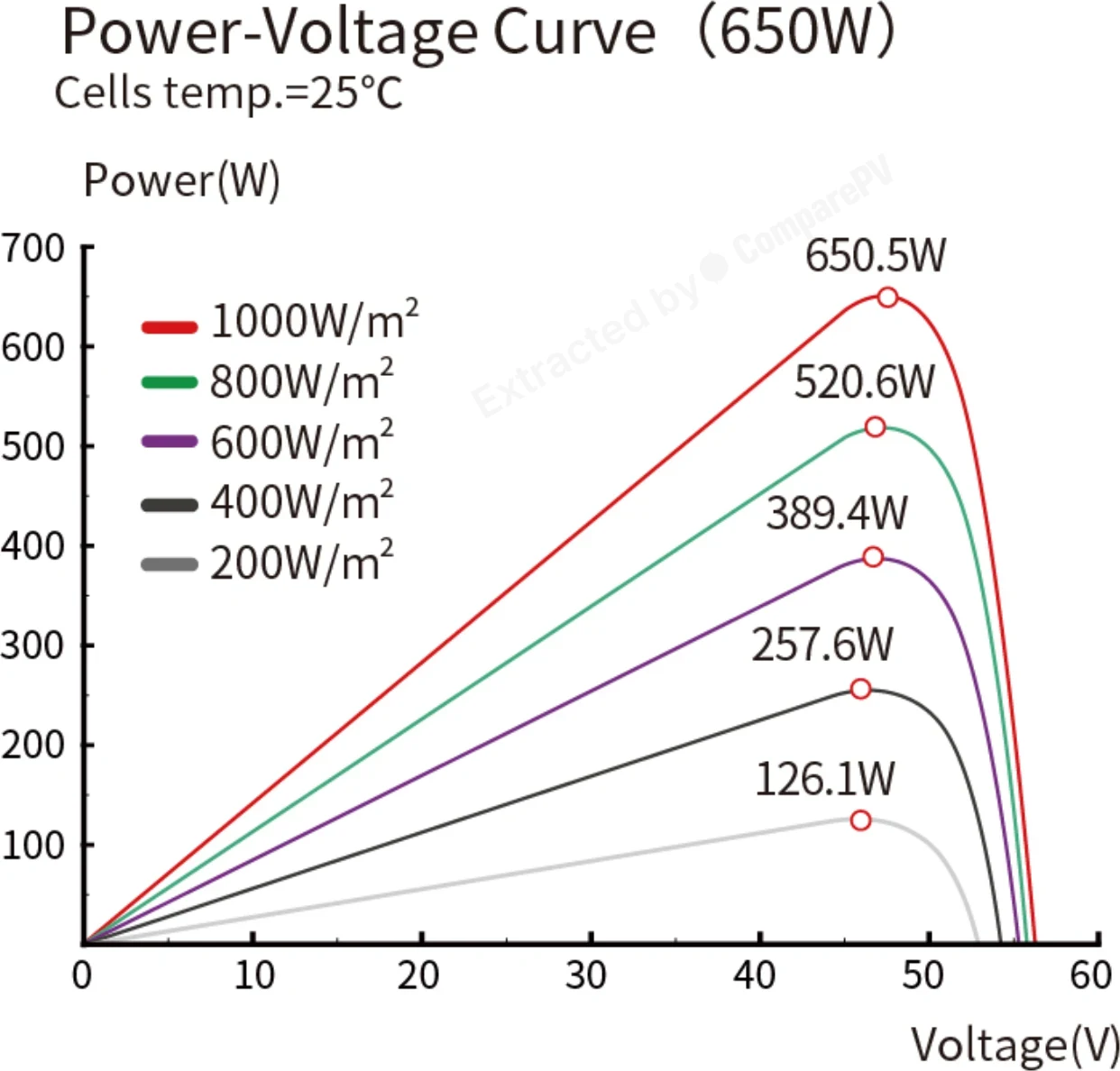
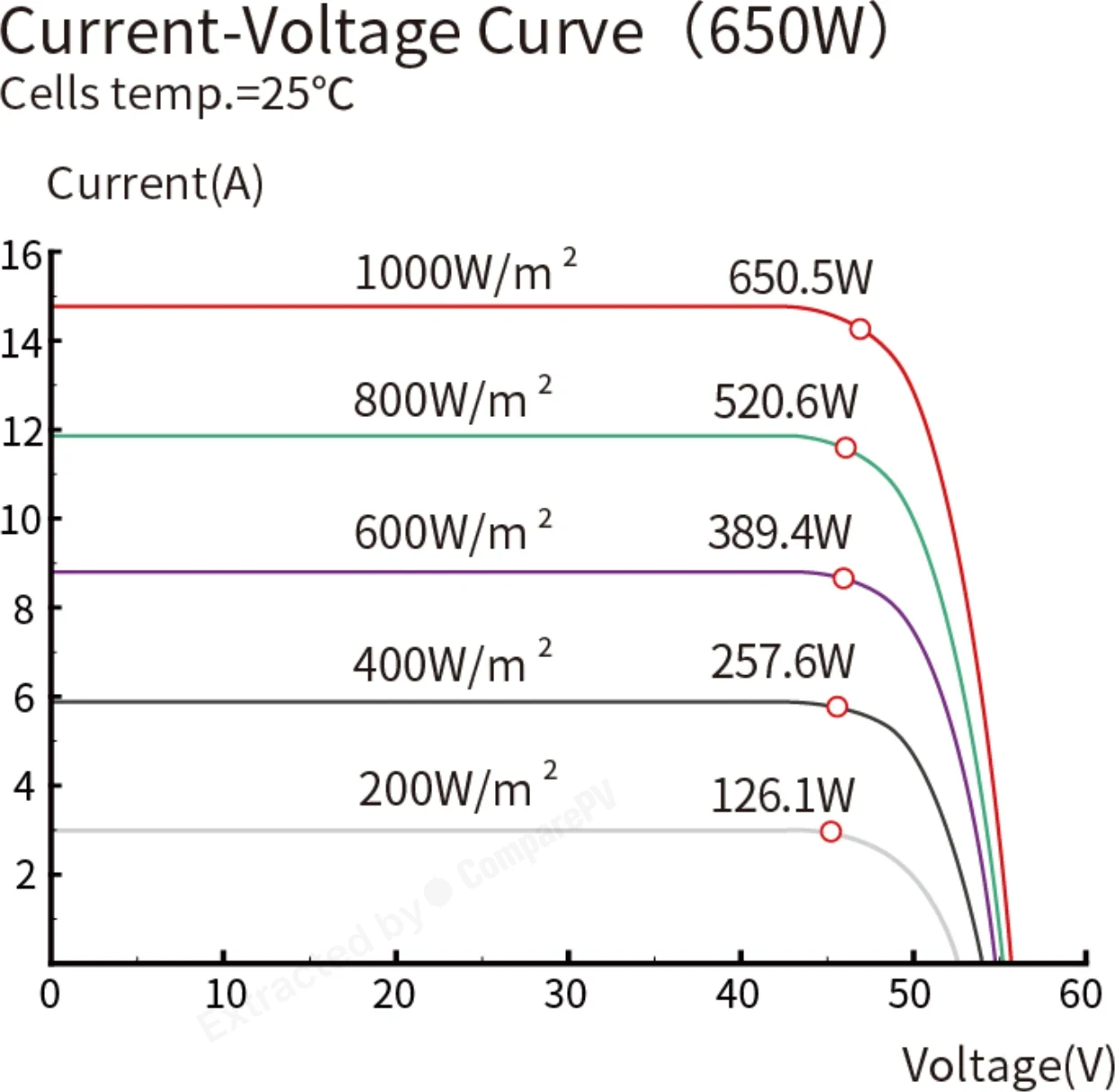
Measured curves published by BYD in this model's datasheet. A chart carrying a wattage was measured on that variant alone - only the ones that describe 650 Wp appear here. The rest cover the whole series.

Simulations

Live - change any input
Lifetime output & value
30 years at 1200 kWh/kWp/year and €0.50 per kWh
Power in year 30
-
Lifetime energy
-
Energy value
-
With bifacial gain
-

Degradation from this panel's own datasheet figures. No inverter, soiling or shading losses.

Heat losses
-0.300 %/°C against a segment median of -0.290
-
Bifacial gain
Rear gain over light concrete: -
-

Model: bifaciality × albedo × 0.6 view factor. A first-order estimate, not a yield simulation.

Alternatives

All BYD panels
Filter these
Size
Panel Power Eff. Temp. Weight Difference
BYD NLBK-39-650 650 W 23.25% -0.300 34.0 kg You are here
AIKO-A650-MAE72Mw 650 W 25.20% -0.260 27.0 kg Cooler, lighter, +1.9 pp
AIKO-A680-MDE72Mw 680 W 25.20% -0.260 29.0 kg Cooler, lighter, +1.9 pp
AIKO-A675-MDE72Mw 675 W 25.00% -0.260 29.0 kg Cooler, lighter, +1.8 pp
AIKO-A645-MAE72Mw 645 W 25.00% -0.260 27.0 kg Cooler, lighter, +1.8 pp
AIKO-A700-MAE78Dw 700 W 25.00% -0.260 34.5 kg +50 W, cooler, +1.8 pp
AIKO-A695-MAE78Dw 695 W 24.90% -0.260 34.5 kg +45 W, cooler, +1.6 pp
AIKO-G670-MCH72Mw 670 W 24.80% -0.260 28.2 kg Cooler, lighter, +1.6 pp
NLBK-39 625 625 W 22.35% -0.300 34.0 kg -25 W, -0.9 pp
NLBK-39 630 630 W 22.54% -0.300 34.0 kg -20 W, -0.7 pp
NLBK-39 635 635 W 22.72% -0.300 34.0 kg -15 W, -0.5 pp
NLBK-39 640 640 W 22.90% -0.300 34.0 kg -10 W, -0.4 pp
NLBK-39 645 645 W 23.07% -0.300 34.0 kg Very close match
LR7-72HVHF-670M 670 W 24.80% -0.260 28.5 kg Cooler, lighter, +1.6 pp
JKM650-670N-66QL6-BDV (670W class) 670 W 24.80% -0.260 32.5 kg +20 W, cooler, +1.6 pp

Found 616 panels of the same or similar size to this one, within ±10 mm. See them here Found 616 panels of the same or similar size to this one, within ±25 mm. See them here Found 616 panels of the same or similar size to this one, within ±50 mm. See them here Found 1813 panels of the same or similar size to this one, within ±100 mm. See them here

Common questions

6 answered
What is the TOPCon technology used in BYD AURO N NLBK-39 panels and why should you choose it?
TOPCon (Tunnel Oxide Passivated Contact) is an N-type silicon cell technology that eliminates Light-Induced Degradation (LID). In practice, this means that BYD AURO N NLBK-39 panels maintain their rated efficiency of up to 23.25% from day one of operation, rather than losing several percent of power output as older P-type cells do. For the investor, this translates into genuinely higher energy production throughout the entire service life of the system.
What warranty applies to the BYD AURO N NLBK-39 series?
The manufacturer offers a 12-year product warranty covering material and workmanship defects, along with a 30-year linear power output warranty. The latter guarantees that over three decades the panel will deliver its rated power in a gradual, predictable manner — rather than expiring after 10–15 years as budget alternatives often do. Such an extended warranty horizon is made possible by the inherent durability of N-type cells and the dual-glass construction of the module.
Do the bifacial BYD AURO N NLBK-39 panels deliver a real energy gain under Polish conditions?
Yes, provided the system is correctly installed. The bifaciality factor of the NLBK-39 series exceeds 80%, which — when a light-colored surface such as gravel or a white geomembrane is used, or when ground-mounted with sufficient clearance — can increase energy yield by 5–15%. In Poland, this effect is most pronounced during summer months and on days when snow on the ground reflects irradiance onto the rear side of the module.
How do BYD AURO N NLBK-39 panels perform during heat waves, and does high temperature affect their power output?
The NLBK-39 series features a low temperature coefficient of power of -0.30%/°C. This means that for every degree above 25°C, the panel loses only 0.30% of its rated power. Conventional P-type modules typically lose 0.35–0.40%/°C. At a cell temperature of 65°C, the difference already amounts to several percent of actual output — which during Polish heat waves in July and August translates into noticeably higher daily energy yields.
Is the 650 W BYD AURO N NLBK-39 series suitable for installation on a private home?
The NLBK-39 series, with a peak power of 650 W and large physical dimensions, is designed primarily for commercial solar farms and large-scale industrial installations, where minimizing the levelized cost of energy (LCOE) and maximizing power density are the key objectives. For a typical single-family home, smaller modules in the 400–450 W range are a better fit, as they are easier to accommodate on a roof section and are compatible with standard residential inverters.
Is BYD a reliable solar panel manufacturer, and where does the AURO N NLBK-39 series come from?
BYD (Build Your Dreams) is a Chinese corporation headquartered in Shenzhen and classified as a Tier 1 manufacturer by the independent agency Bloomberg NEF, confirming its financial stability and ability to honor warranties for decades. The company is a global leader in both photovoltaic cell and module production as well as battery manufacturing. Tier 1 status is particularly important when selecting modules backed by a 30-year power output warranty, as it minimizes the risk that the manufacturer will no longer exist at the time of a potential warranty claim.
Add to compare