BYD NLBK-39 650

NLBK-39 650

650 Wp TOPCon Bifacial 80%
ComparePV verdict

Solid all-round for its segment

Rank 1,648 of 14,005
Compare panels Datasheet PDF
Power (Wp)
650
Weak · bottom 13%
Efficiency (%)
23.25
Typical · median 22.40%
Density (Wp/m²)
232.5
Typical · median 223.7
Temp (%/°C)
-0.300
Typical · median -0.290
Weight (kg)
34.0
Typical · median 34.6 kg
Warranty (yrs)
30
Typical · median 30 yrs

The BYD AURON NLBK-39 (625-650W) series is designed to maximize energy yield from the same roof or ground area, especially in situations where every square meter counts. These modules are based on N-type TOPCon cells, which are known for their stable performance over long periods and excellent initial degradation resistance - ensuring that the installation maintains high productivity for longer.

In practice, you gain more energy not only in full sunlight. High efficiency in low-light conditions allows for effective operation in typical Polish weather - under cloudy skies, fog, and during transitional periods. Furthermore, the use of SMBB (multi-busbar architecture) reduces losses and improves power generation, which is also beneficial in partially shaded conditions.

This series also features a bifacial design, making it suitable for ground-mounted installations, bright roofs, and anywhere where the ground reflects light. The series targets investors who want to reduce energy costs over time, rather than just achieve a good result during installation.

Ranking

249 panels in the segment TOPCon 650-700 W
Metric This panel Median Position in segment Overall rank
Module efficiency 23.25% 22.40% Typical 1,239
Power density 232.5 223.7 Typical 1,222
Temperature coefficient -0.300 -0.290 Typical 6,093
Weight per kWp 52.3 53.2 Typical 5,769
Performance warranty 30 yrs 30 yrs Typical 21
Colour key Strong - top 25% Typical - middle 50% Weak - bottom 25%

Signals from the data

5 positive · 1 caution
Best for

Commercial, utility-scale and shaded-installations.

What owners get
Zero LID and Low Annual Degradation

N-type TOPCon cells exhibit zero light-induced degradation (LID), and annual power loss from year 2 onward is ≤0.55% — BYD guarantees retention of more than 84.8% of rated power after 25 years. By comparison, typical P-type PERC modules degrade at 0.55–0.70%/year while also suffering LID of 1–2% in the first year.

30-Year Linear Power Warranty

The manufacturer offers a 30-year linear power warranty, 5 years longer than the standard 25-year warranties offered by most Tier-1 manufacturers in the 625–650 W class. The product warranty stands at 12 years, which is typical for the premium segment.

Favorable Temperature Coefficient

The temperature coefficient of Pmax is -0.30%/°C, a clear improvement over the -0.34–0.35%/°C of P-type PERC modules. At a cell temperature of 65°C — a typical summer day in Poland — this difference translates to approximately 1.5–2% higher energy yield compared to older technology.

Bifacial Design — Additional Yield from the Rear Side

The bifacial construction enables 5–30% additional energy harvest from the module's rear surface, depending on ground albedo (gravel, light-colored concrete, snow). This is especially advantageous in ground-mounted systems and flat-roof installations with light-colored membranes, where albedo exceeds 0.2.

BYD — Bankable Tier-1 Manufacturer

BYD is listed among BNEF's Tier-1 bankable manufacturers, which significantly facilitates financing for commercial projects and utility-scale PV plants and reinforces confidence in the long-term warranty. The company has been in operation since 1995 and maintains a strong financial position as a global leader in batteries and EVs.

Trade-offs
Lower Efficiency Than Jinko Tiger Neo

The maximum module efficiency of the NLBK-39 is 23.25%, while direct competitor Jinko Solar Tiger Neo 66HL4M-BDX achieves 24.06% (+0.81 pp) in the same 650 W power class. On a 20-module installation, this difference amounts to approximately 100–130 Wp less total capacity for the same roof area.

Notes from the database
  • 23.2% module efficiency - 0.9pp better than the TOPCon 650-700W median of 22.4%
  • At 232.5 W/m² power density, this panel generates 8.8 W/m² more per unit area than TOPCon 650-700W median (223.7 W/m²)
  • At -0.30%/°C, hot weather performance is typical for TOPCon 650-700W panels
  • Bifacial design (80% factor) captures reflected light - adds 4-12% yield on ground-mount or white roof
  • #1239 for efficiency, #6093 for temperature performance out of 14005 panels

Specifications

Open datasheet PDF
Nominal power (Pmax) 650 Wp Nameplate at 1000 W/m², 25 °C
Module efficiency 23.25 % Typical Segment median 22.40%
Vmpp · Impp 46.51 V · 13.98 A Operating point at max power
Voc · Isc 55.49 V · 14.63 A Sizes the string length
Max system voltage 1500 V Longer strings than 1000 V modules
Dimensions 2465×1134×30 mm · 2.80 m² of roof
Weight 34.0 kg Typical Typical · median 34.6 kg
Cells 156 · TOPCon Monocrystalline
Bifaciality 80 % Rear output as a share of front
Coefficient Pmax -0.300 %/°C Typical median -0.290 of its segment
Coefficient Voc · Isc -0.250 · 0.046 %/°C
NOCT 45 °C At 800 W/m², 20 °C ambient
Product warranty 12 years Hardware defects only
Performance warranty 30 years Typical median 30 yrs · median 30 yrs
End-of-warranty output 87.4 % Equals 568 W guaranteed
Degradation 0.40 % Per year after the first

Datasheet charts

Open datasheet PDF

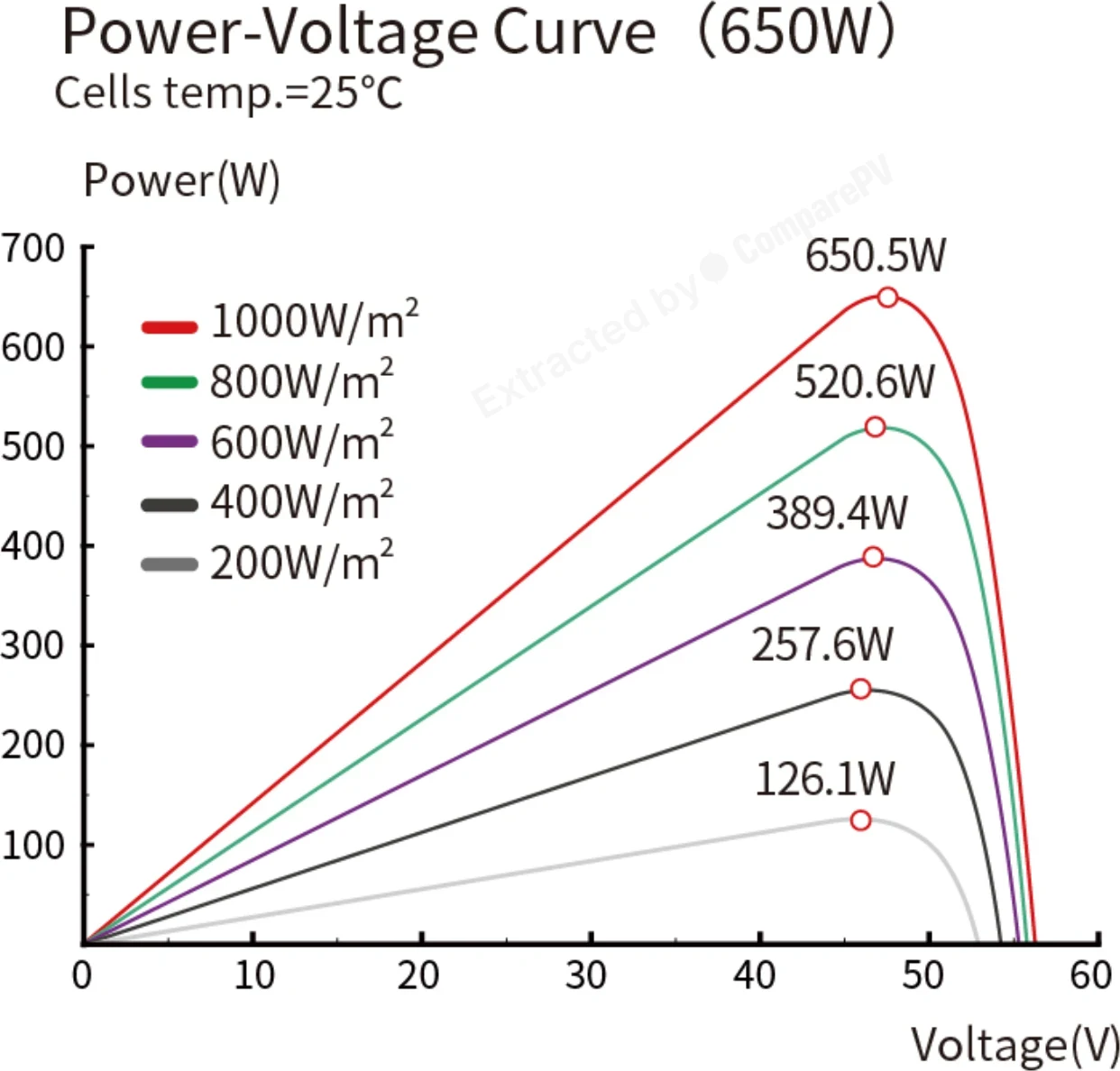
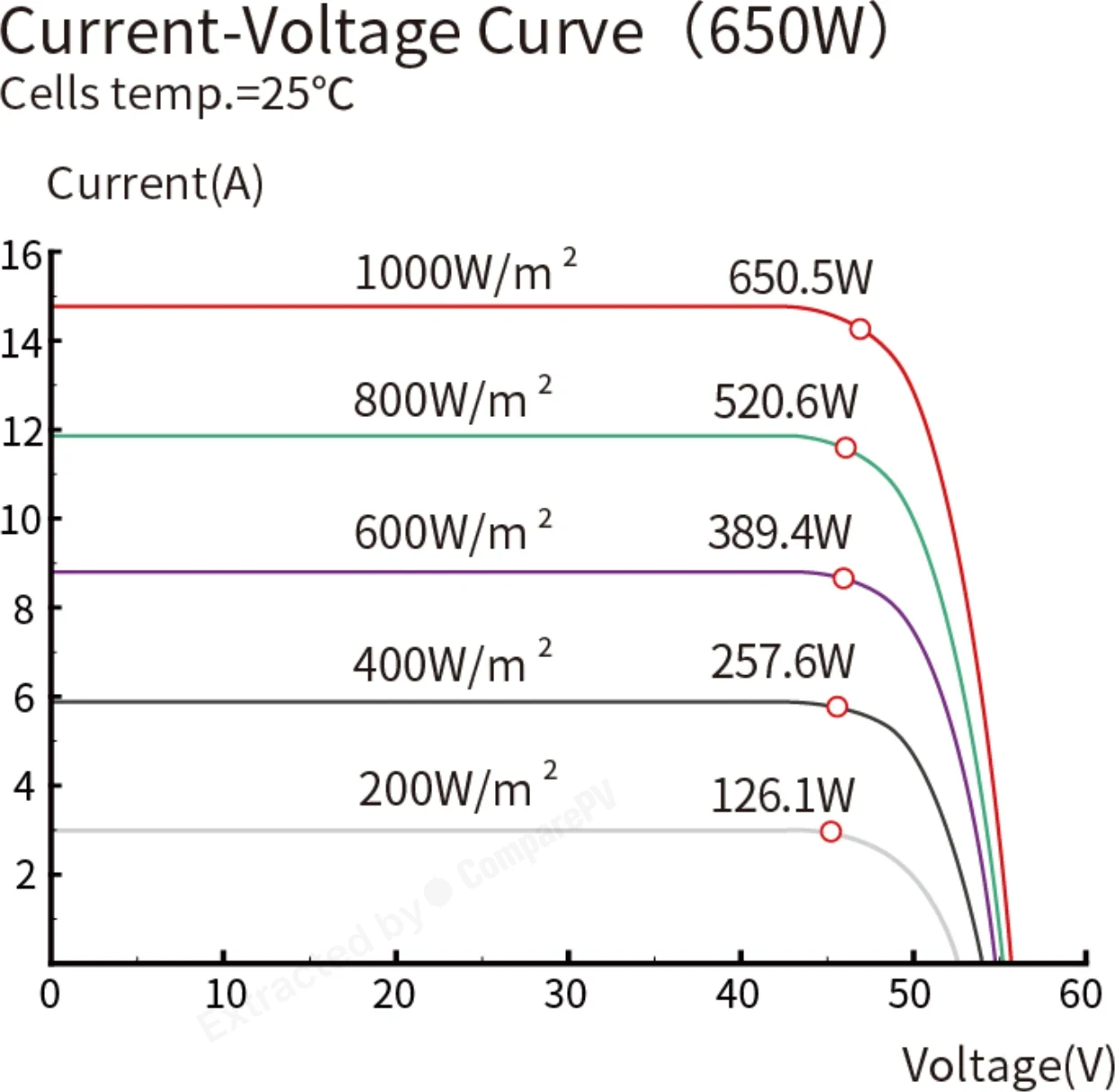
Measured curves published by BYD in this model's datasheet. A chart carrying a wattage was measured on that variant alone - only the ones that describe 650 Wp appear here. The rest cover the whole series.

Simulations

Live - change any input
Lifetime output & value
30 years at 1200 kWh/kWp/year and €0.50 per kWh
Power in year 30
-
Lifetime energy
-
Energy value
-
With bifacial gain
-

Degradation from this panel's own datasheet figures. No inverter, soiling or shading losses.

Heat losses
-0.300 %/°C against a segment median of -0.290
-
Bifacial gain
Rear gain over light concrete: -
-

Model: bifaciality × albedo × 0.6 view factor. A first-order estimate, not a yield simulation.

Alternatives

All BYD panels
Filter these
Size
Panel Power Eff. Temp. Weight Difference
BYD NLBK-39 650 650 W 23.25% -0.300 34.0 kg You are here
AIKO-A650-MAE72Mw 650 W 25.20% -0.260 27.0 kg Cooler, lighter, +1.9 pp
AIKO-A680-MDE72Mw 680 W 25.20% -0.260 29.0 kg Cooler, lighter, +1.9 pp
AIKO-A675-MDE72Mw 675 W 25.00% -0.260 29.0 kg Cooler, lighter, +1.8 pp
AIKO-A645-MAE72Mw 645 W 25.00% -0.260 27.0 kg Cooler, lighter, +1.8 pp
AIKO-A700-MAE78Dw 700 W 25.00% -0.260 34.5 kg +50 W, cooler, +1.8 pp
AIKO-A695-MAE78Dw 695 W 24.90% -0.260 34.5 kg +45 W, cooler, +1.6 pp
AIKO-G670-MCH72Mw 670 W 24.80% -0.260 28.2 kg Cooler, lighter, +1.6 pp
NLBK-39 625 625 W 22.35% -0.300 34.0 kg -25 W, -0.9 pp
NLBK-39 630 630 W 22.54% -0.300 34.0 kg -20 W, -0.7 pp
NLBK-39 635 635 W 22.72% -0.300 34.0 kg -15 W, -0.5 pp
NLBK-39 640 640 W 22.90% -0.300 34.0 kg -10 W, -0.4 pp
NLBK-39 645 645 W 23.07% -0.300 34.0 kg Very close match
LR7-72HVHF-670M 670 W 24.80% -0.260 28.5 kg Cooler, lighter, +1.6 pp
JKM650-670N-66QL6-BDV (670W class) 670 W 24.80% -0.260 32.5 kg +20 W, cooler, +1.6 pp

Found 616 panels of the same or similar size to this one, within ±10 mm. See them here Found 616 panels of the same or similar size to this one, within ±25 mm. See them here Found 616 panels of the same or similar size to this one, within ±50 mm. See them here Found 1813 panels of the same or similar size to this one, within ±100 mm. See them here

Common questions

6 answered
What is the efficiency of the BYD AURON NLBK-39 panels, and is it a competitive result?
The BYD AURON NLBK-39 series achieves a module efficiency of 23.25%, placing it among the top-performing panels available for both residential prosumer and commercial installations. This high efficiency means that more energy is harvested per square meter of roof or ground space compared to older technologies such as PERC. N-type TOPCon cell technology is the primary driver behind this result.
Do the BYD AURON NLBK-39 650W panels perform well under overcast skies and in Polish winter conditions?
Yes. N-type TOPCon cells exhibit superior temperature resistance and excellent low-irradiance performance compared to PERC technology. For the NLBK-39 series, the power temperature coefficient is only -0.30%/°C, which limits output losses on hot days. Under typical Polish conditions — including cloud cover, fog, and short winter days — these modules operate more efficiently than previous-generation panels.
What warranty does BYD provide for the AURON NLBK-39 series?
BYD offers a 12-year product warranty covering material and workmanship defects, along with a 30-year linear power output warranty. This means the manufacturer guarantees that power output will remain above a defined threshold for three decades — one of the most extensive warranty commitments available on the market. An additional advantage is the characteristically low initial degradation of N-type TOPCon cells.
Is the BYD AURON NLBK-39 series suitable for ground-mounted installations, and what benefit does its bifaciality provide?
Yes, the NLBK-39 series is a bifacial module featuring glass on both sides, making ground-mounted installations its natural operating environment. The rear side of the panel captures light reflected from the ground surface — such as light gravel, a bright membrane, or snow — generating an additional 5–32% of energy relative to the front side alone. The brighter and more reflective the ground albedo, the greater the real-world energy gain.
Is BYD a reliable panel manufacturer, and does the AURON NLBK-39 series come from an established supplier?
BYD (Build Your Dreams) is a Chinese conglomerate ranked as a Tier 1 manufacturer according to industry benchmarks, indicating financial stability and verified production capacity. The company is one of the world's largest producers of PV cells and modules, and its products hold IEC and MCS certifications. The AURON NLBK-39 series is an active, non-discontinued product line within the manufacturer's current portfolio.
What is SMBB in the BYD AURON NLBK-39 panels, and why does it matter for partial shading performance?
SMBB (Super Multi Busbar) is a cell interconnection architecture that uses a very high number of thin busbars instead of a few wide ones. This shortens the electron path to the busbar, reduces internal resistance, and minimizes losses associated with microcracks. In practice, an SMBB module handles partial shading — from chimneys, skylights, or trees, for example — more effectively, maintaining higher output than panels built with conventional busbar architecture.
Add to compare