Middle of its segment, needs the roof space
The ODA-120MHD photovoltaic panel series introduces a new level of quality to prosumer and commercial installations, utilizing advanced N-type TOPCon cell technology. Thanks to the bifacial double glass design, these modules not only generate energy from direct solar radiation but also effectively utilize reflected light reaching the back of the panel. This solves the problem of limited installation space, allowing for higher power generation from the same roof or ground area. The use of half-cut technology minimizes energy losses resulting from shading and reduces the risk of hot-spots, which directly translates into the fire safety of the entire installation. The ODA-120MHD stands out from the competition with its exceptional resistance to potential-induced degradation (PID) and light-induced degradation (LID), guaranteeing stable energy yields for decades. This solution is dedicated to investors seeking maximum durability in harsh weather conditions, such as strong winds or snow loads. By choosing this series, the user receives a product that combines an innovative crystalline structure with an aesthetic finish, making the panels blend perfectly with modern architecture while providing the lowest levelized cost of energy (LCOE).
Ranking
Signals from the data
Commercial, utility-scale and shaded-installations.
Roofs where every square metre has to count, tight roof space and weight-limited structures.
Bottom 16% of the TOPCon 600-650 W segment, against a median of 227.7.
Bottom 16% of the TOPCon 600-650 W segment, against a median of 22.80%.
Bottom 20% of the TOPCon 600-650 W segment, against a median of 53.1.
N-type cells exhibit a lower LID and PID degradation rate compared to PERC technology, and the double-glass design allows for an additional 5-25% of energy to be generated from reflected light (albedo), which directly increases the annual energy yield without increasing the installation area.
The series includes 12 variants ranging from 440 to 640 Wp, providing installers of both prosumer and commercial systems with exceptional flexibility in adapting the module to installation conditions and network requirements, without the need to change suppliers.
The manufacturer offers a 30-year performance warranty, which is the standard for premium products in this segment – comparable REC Alpha Pro M Series and Jinko Eagle G7B also offer 30 years of warranty, but many cheaper competitors limit their warranties to 25 years.
Dividing the solar cells in half reduces current losses by approximately 50% in partially shaded areas and lowers the risk of hot-spot formation, which is crucial for installations on roofs with complex geometries or in environments with frequent shading (trees, chimneys).
The maximum efficiency of 22.62% is comparable to the REC Alpha Pro M Series (22.5%) and only about 1.1% lower than the leading products in the segment (Jinko Eagle G7B, Powitt Solar – 23.69%). This translates to a difference of approximately 0.5–1 m² in the required surface area for a typical 10 kWp prosumer installation.
The ODA-120MHD series was available from 2021 to 2023 and is now discontinued. This means limited availability of new modules for expanding the installation, difficulty in accessing certified service technicians, and a lack of ongoing technical support from the manufacturer – all of which pose a significant risk for 25-30-year investments.
AUSTA ENERGY is not listed on Bloomberg NEF's Tier-1 bankability list, which makes it difficult to secure project financing and may be disqualifying in commercial tenders or solar farm bids that require confirmation of bankability from insurers.
The company, founded in 2015 (approximately 11 years of market presence), with its headquarters in India, has a significantly shorter operational history compared to its competitors (Jinko Solar – since 2006, REC Group – since 1996). This reduces the likelihood of accurately assessing its long-term ability to honor a 30-year power output warranty.
The maximum efficiency of 22.62% is 1.07 percentage points lower than Jinko Eagle G7B and Powitt Solar (23.69%). For installations with limited roof space (e.g., 40 m²), this difference translates to a real reduction of approximately 400-500 Wp per square meter in peak power compared to the most efficient available alternatives.
The warranty for the product is 15 years, while the REC Alpha Pro M Series offers a 25-year product warranty (frame + backsheet). For the premium N-type bifacial segment, 15 years is below market expectations and could influence an investor's decision when comparing the total cost of ownership (TCO).
- Module efficiency of 22.3% is 0.5pp below average for TOPCon 600-650W panels (median: 22.8%)
- At 222.6 W/m², this panel generates 5.1 W/m² less per unit area than TOPCon 600-650W median (227.7 W/m²)
- Temperature coefficient of -0.29%/°C matches the TOPCon 600-650W median
- Weight of 34.5 kg is 1.8 kg above TOPCon 600-650W median (32.7 kg) - verify structural support
- Bifaciality factor of 80% can add 4-12% extra yield with reflective mounting surface
Specifications
Datasheet charts
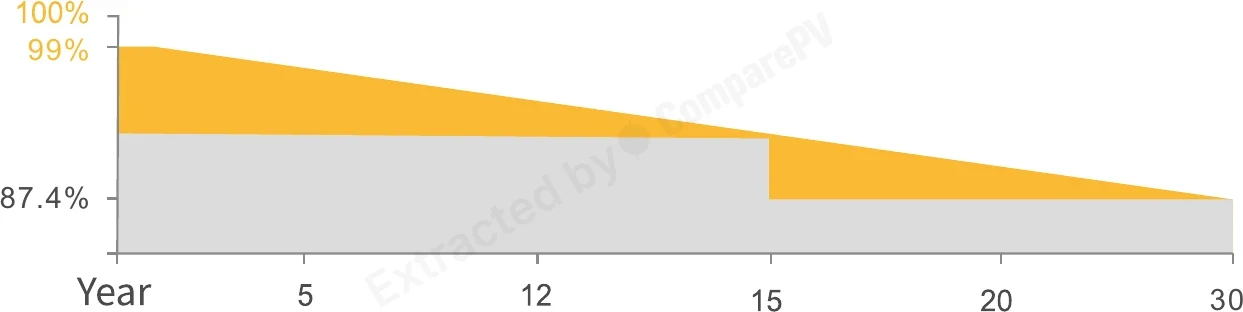
Measured curves published by AUSTA ENERGY in this model's datasheet. A chart carrying a wattage was measured on that variant alone - only the ones that describe 630 Wp appear here. The rest cover the whole series.
Simulations
Degradation from this panel's own datasheet figures. No inverter, soiling or shading losses.
Model: bifaciality × albedo × 0.6 view factor. A first-order estimate, not a yield simulation.




Found 497 panels of the same or similar size to this one, within ±10 mm. See them here Found 502 panels of the same or similar size to this one, within ±25 mm. See them here Found 502 panels of the same or similar size to this one, within ±50 mm. See them here Found 506 panels of the same or similar size to this one, within ±100 mm. See them here