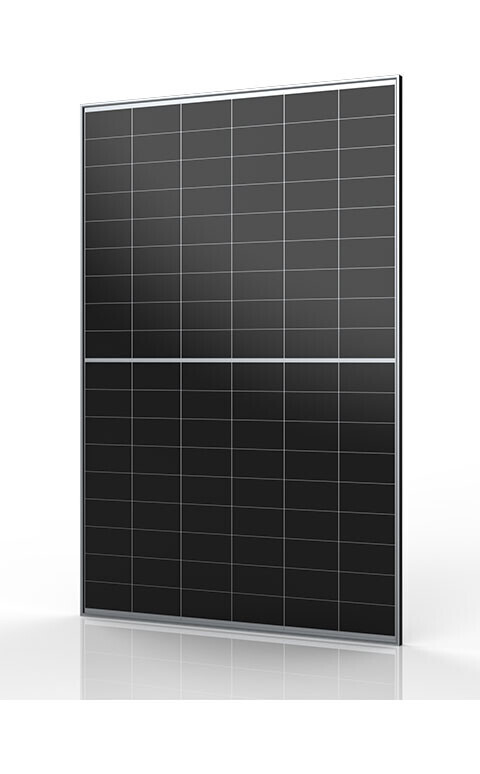
Middle of its segment, heavy for its output
AIKO Stellar 1N+ (AIKO-G-MCH72Dw) are dual-glass modules designed for maximum yield from the same surface area - with no compromises on longevity. Their key feature is the N-type ABC (All Back Contact) technology, which eliminates front busbars and utilizes light more effectively, translating to higher performance in real-world conditions, especially under weaker sunlight and in installations with limited mounting space. The glass-glass construction supports long-term operational stability, reduces the risk of degradation, and enhances resistance to environmental factors - crucial for solar farms, industrial rooftops, and projects near coastlines or agricultural areas. From an investor’s perspective, low degradation and long warranties are also important, as they facilitate energy production forecasting over time. The Stellar 1N+ modules also feature better performance at elevated temperatures, helping maintain yields during summer periods. This is a series for commercial and utility applications, where LCOE, reliability, and high power density matter.
Ranking
Signals from the data
Commercial, utility-scale and hot-climate.
Weight-limited structures.
Bottom 13% of the Back Contact 600-650 W segment, against a median of 50.4.
The temperature coefficient of power, -0.26%/°C, is better than that of typical TOPCon modules from competitors (LONGi Hi-MO 9: -0.27%/°C, Canadian Solar TOPBiHiKu6: -0.29%/°C). On a hot day at 70°C, an ABC module loses approximately 11.8% of its power, while a TOPCon module loses approximately 12.6% – this difference translates into a significantly higher summer yield in utility installations.
AIKO guarantees ≤1% per year from year 1 and ≤0.35%/year from year 2, which results in ≥88.85% performance after 30 years. Comparable TOPCon modules (Sunpro SPDG, Canadian Solar TOPBiHiKu6) typically declare ≤0.40%/year, ending at ~84.8% – this difference of approximately 4% over the entire period significantly improves LCOE.
The glass-on-glass construction has a fire resistance rating of A (required on many industrial roofs and in utility buildings), and can withstand a snow load of 5400 Pa and wind loads of 2400 Pa. This eliminates PID (polyvinyl chloride degradation) and moisture as factors that can degrade the system, which is critical in coastal and agricultural installations.
AIKO is listed on the BNEF Tier 1 PV Module Manufacturers Q1 2026 list, which requires documented financing from independent commercial banks for ≥6 projects >10 MW within 24 months. This is a necessary condition for projects requiring project finance and due diligence from institutional investors.
The G660 variant achieves a module efficiency of 24.4%, matching the highest-performing competitors (LONGi Hi-MO 9: 24.4%, Canadian Solar TOPBiHiKu6: 24.4%), while also offering a lower Tcoeff and slower degradation rate. A power density of 660 Wp per 2382×1134 mm surface directly reduces BOS (Balance of System) costs and installation costs per MW of installed power.
The dual-blade design increases the module weight to approximately 33.5 kg, compared to the ~28–30 kg for single-blade versions of competing TOPCon products. This may require a load-bearing capacity assessment and potential reinforcement of the existing roof structure during retrofits of commercial buildings – adding to the project cost.
- Efficiency of 23.5% matches the Back Contact 600-650W median
- Power density of 235.1 W/m² matches the Back Contact 600-650W median
- Temperature coefficient of -0.26%/°C matches the Back Contact 600-650W median
- At 33.5 kg, this panel is 1.2 kg heavier than the Back Contact 600-650W median (32.3 kg) - more demanding for installation crews
- Bifacial design (70% factor) captures reflected light - adds 4-10% yield on ground-mount or white roof
Specifications
Datasheet charts
Measured curves published by AIKO in this model's datasheet. A chart carrying a wattage was measured on that variant alone - only the ones that describe 635 Wp appear here. The rest cover the whole series.

Simulations
Degradation from this panel's own datasheet figures. No inverter, soiling or shading losses.
Model: bifaciality × albedo × 0.6 view factor. A first-order estimate, not a yield simulation.



Found 1119 panels of the same or similar size to this one, within ±10 mm. See them here Found 1125 panels of the same or similar size to this one, within ±25 mm. See them here Found 1236 panels of the same or similar size to this one, within ±50 mm. See them here Found 1917 panels of the same or similar size to this one, within ±100 mm. See them here