
Buying
How to choose panels for a small roof or a balcony
On a small roof or balcony, module size sets how many whole modules fit. A worked example with catalogue formats, efficiency bands and Polish shop prices.
In short: On a small roof, choose the module format before the efficiency. Only whole modules count, so the way a module's length and width divide your roof sets how many fit, and efficiency can only work on that count. On our 4.5 by 3.5 m example roof, 2382 x 1134 mm modules fit 3 for 1.88 kWp, and the larger 2384 x 1303 mm ones fit 2 for 1.40 kWp.
Efficiency and watts per square metre are one question
With little space, the obvious move is to buy the most efficient module you can find. Efficiency matters. On a roof that takes a handful of modules, though, it isn't the first thing to settle.
There seem to be three ways to get more power onto a small area: a more efficient module, a module with more watts per square metre, or a module whose size happens to fit. The first two are the same thing. Rated power is measured at standard test conditions, with 1000 W/m² of light on the module, so watts per square metre is module efficiency times ten. A 22 % module puts 220 W on every square metre it covers.
So the real choice is between efficiency and format, meaning the module's outer length and width.
The example roof
Most of the catalogue's 14,005 modules share a handful of formats, because manufacturers build around a few cell sizes and cell counts. The article on module sizes shows the clusters. I took the five most common formats and, for each, the median rated power and the power of the most efficient tenth (the 90th percentile).
The roof is 4.5 m along the eaves and 3.5 m up the slope, with 0.3 m kept free on every side and 0.02 m between rows. These are the roof-fit selector's defaults, and they leave a usable area of 3.9 m by 2.9 m. Modules go in a plain grid, all portrait or all landscape, whichever fits more.
Counting the modules that fit
Doing the count once by hand shows where modules get lost. Per orientation you need two numbers: how many fit across the 3.9 m width, and how many rows fit up the 2.9 m slope. Every row but the last needs the 0.02 m gap after it, which is why 0.02 m is added on both sides of the row calculation.
1762 x 1134 mm: four in landscape
In landscape each module takes 1.762 m of the width: 3.9 / 1.762 = 2.2, so two per row. Each row takes 1.134 m plus the gap: (2.9 + 0.02) / (1.134 + 0.02) = 2.5, so two rows. Four modules.
Portrait fits three across (3.9 / 1.134 = 3.4) but only one row up the slope, because (2.9 + 0.02) / (1.762 + 0.02) = 1.6. Three modules, so landscape wins.
2384 x 1303 mm: two, whichever way you turn it
In portrait, 3.9 / 1.303 = 2.99. Three side by side would need 3.909 m, 9 mm more than the roof has, so it's two per row. Up the slope only one row fits: (2.9 + 0.02) / (2.384 + 0.02) = 1.2.
Landscape is no better: one per row (3.9 / 2.384 = 1.6) and two rows ((2.9 + 0.02) / (1.303 + 0.02) = 2.2). Two modules either way.
2382 x 1134 mm: three in portrait
Long but narrow. In portrait, 3.9 / 1.134 = 3.4, so three fit across, and one row fits up the slope. Three modules.
The figure below runs the same count on the same roof. Change the size or the margin, add a chimney and move it, and watch which modules survive.
How many modules fit a small roof
Set the roof, the margin and the module size, turn the modules, add a chimney and drag it, and watch the grid fill the roof to scale.
How this is computed
The count is the roof-fit selector's own rule: modules in a plain grid, all portrait or all landscape, edge to edge in a row (clamp gaps of a few millimetres are ignored), rows up the slope separated by the row gap, and the edge margin kept free on all four sides. Portrait means the module's length runs up the slope. Modules in a row = floor(usable width / module width across), rows = floor((usable height + gap) / (module height + gap)).
The grid is drawn centred across the roof and starting at the eaves margin. A module that overlaps the chimney is dropped and the rest stay where they are; the figure does not rearrange the grid around it, which a planner sometimes can by shifting a row. Draw the chimney with the clearance your installer needs around it.
Total power is the module count times the rated power, and the share of the roof covered is the modules' area over the whole roof. The recommendation tries each of the five common sizes in both orientations on the same roof and chimney and keeps the most kWp. It ignores fire setbacks beyond the margin, mixed orientations, roof shape other than a rectangle and the mounting system's own spacing rules.
Illustrative model, not a measurement.
Format against efficiency on the example roof
The first table describes the modules: how common each format is in the catalogue and the median rated power of a module in it.
| Format (mm) | Modules in catalogue | Median power (W) |
|---|---|---|
| 1722 x 1134 | 1,609 | 420 |
| 1762 x 1134 | 1,347 | 450 |
| 2278 x 1134 | 2,234 | 565 |
| 2382 x 1134 | 1,086 | 625 |
| 2384 x 1303 | 1,367 | 700 |
The second puts each format on the roof. "Fit" is the count from the arithmetic above; the kWp columns are the roof's total with median modules and with modules from the most efficient tenth. Read across a row to see what efficiency adds within one format, and down the rows to see what the count does.
| Format (mm) | Fit | kWp at median power | kWp, top tenth |
|---|---|---|---|
| 1722 x 1134 | 4 | 1.68 | 1.76 |
| 1762 x 1134 | 4 | 1.80 | 1.86 |
| 2278 x 1134 | 3 | 1.70 | 1.78 |
| 2382 x 1134 | 3 | 1.88 | 1.97 |
| 2384 x 1303 | 2 | 1.40 | 1.45 |
The count multiplies everything else. One module more or less moves the total by a whole module's power, while a better module of the same format moves it by the gap between the last two columns. Set those two against each other in the table. The largest module fits the fewest here, so its extra watts per module have to cover a missing module before it can lead.
What a step up in efficiency costs
With the format fixed, a more efficient module of the same size is the only lever left, so it helps to know whether it costs more per watt. The table shows the median price per watt of matched single modules in Polish shops, before VAT, in euro. Poland is the one market in our offer data with enough matched offers in every band.
| Efficiency | Offers | Shops | Median EUR/W |
|---|---|---|---|
| under 21.5 % | 38 | 12 | 0.201 |
| 21.5 to 23.5 % | 254 | 28 | 0.141 |
| 23.5 % and up | 59 | 13 | 0.150 |
Market medians mix cheap shops with dear ones, so the cleaner test is inside one shop. Of the 13 Polish shops that list matched modules in both upper bands, 11 have a higher median price per watt for the more efficient ones. The median same-shop difference is 6 %.
The lowest band isn't part of that test. Its median compares different modules in different shops, so don't read it as the price of lower efficiency.
What this means when you buy
Choose the format first
The count of whole modules depends only on how the module's length and width divide your usable area. Efficiency has nothing to do with it.
Measure the roof and take off the edge clearance your mounting system and local rules need. Then run the roof-fit selector: it tries every module size in the catalogue on your dimensions and ranks them by kWp. Compare efficiency only within the format that wins. How much power the roof should hold in the first place follows from your consumption and your site; the article on how many panels a household needs sets out that calculation.
Measure to the centimetre
In the example, the largest format missed a third module across the roof by 9 mm. Ask your installer whether their edge clearance is a fixed requirement or a default that can be tightened. On a small roof, a few centimetres of margin can decide a whole module.
Then compare efficiency on price
Whether the step up in efficiency is worth it for you is a price comparison between two specific modules of your chosen format. The panel comparison calculator runs it with your own prices.
Use the power tolerance as the tie-breaker
With three or four modules, every watt per module shows up in the total. A positive-only power tolerance is a small but real difference between two modules of the same rated power, and I'd use it to settle a tie.
Balcony solar: a small roof with stricter rules
A balcony adds legal limits to the geometry. In Germany, the Renewable Energy Sources Act (EEG 2023, section 8(5a)) gives plug-in solar devices a simplified connection when they total up to 2 kW of installed module power and up to 800 VA of inverter power, behind the household's meter. Other countries set different limits, or none, so check the rules where you live.
How many modules the 2 kW allows depends on each module's power. At the median power of the 1722 x 1134 mm format, 4 modules fit within it; at the median of the 2384 x 1303 mm format, 2. The 800 VA limit is a separate cap on what the inverter feeds into the house at any moment, whatever the modules could produce.
A railing fixes one dimension. Unless it's taller than the module is long, the module hangs with its long side along the rail, and the railing's length alone decides how many fit.
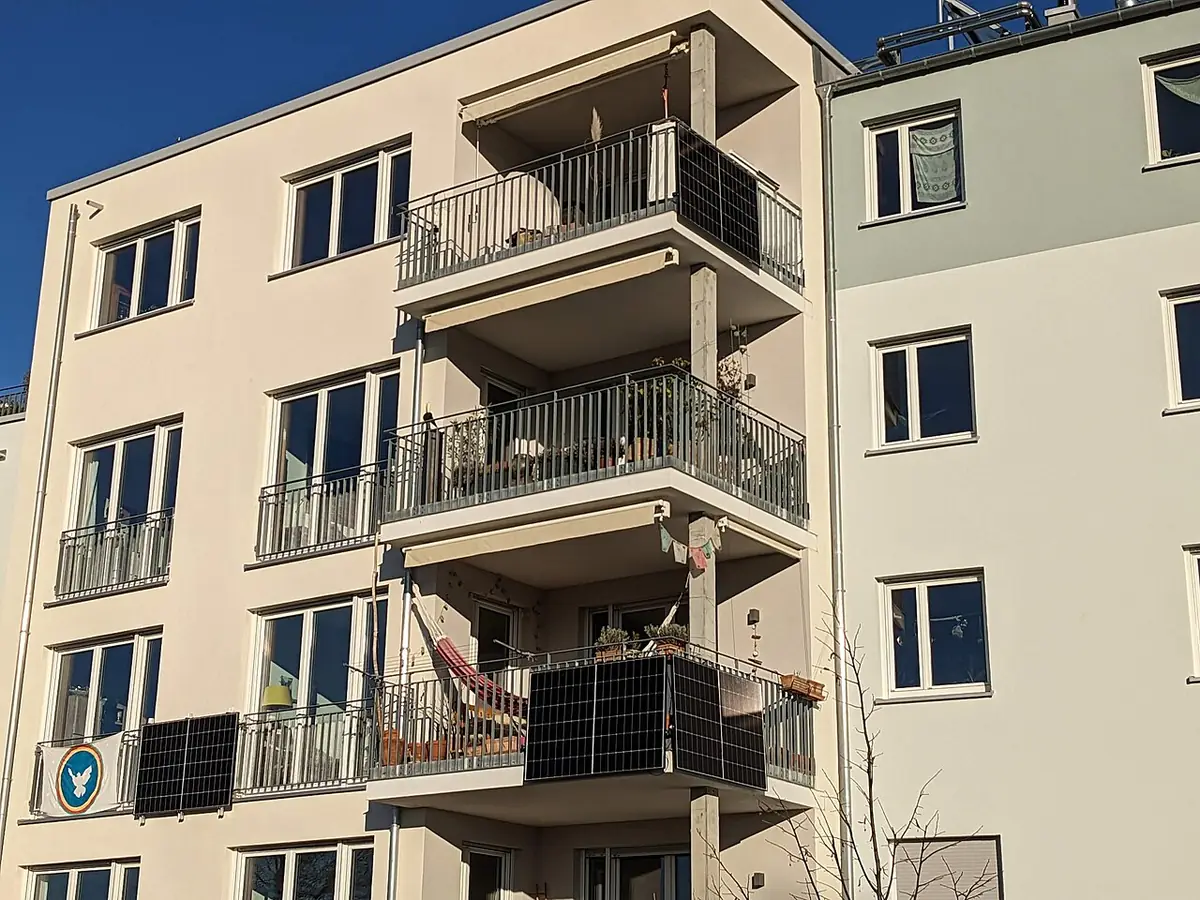

Flat on the rail or tilted out
A module hung flat against the railing stands vertical. At European latitudes a vertical module catches less sun over a year than one tilted back toward the sky, so brackets that angle it outward usually recover some of that loss.
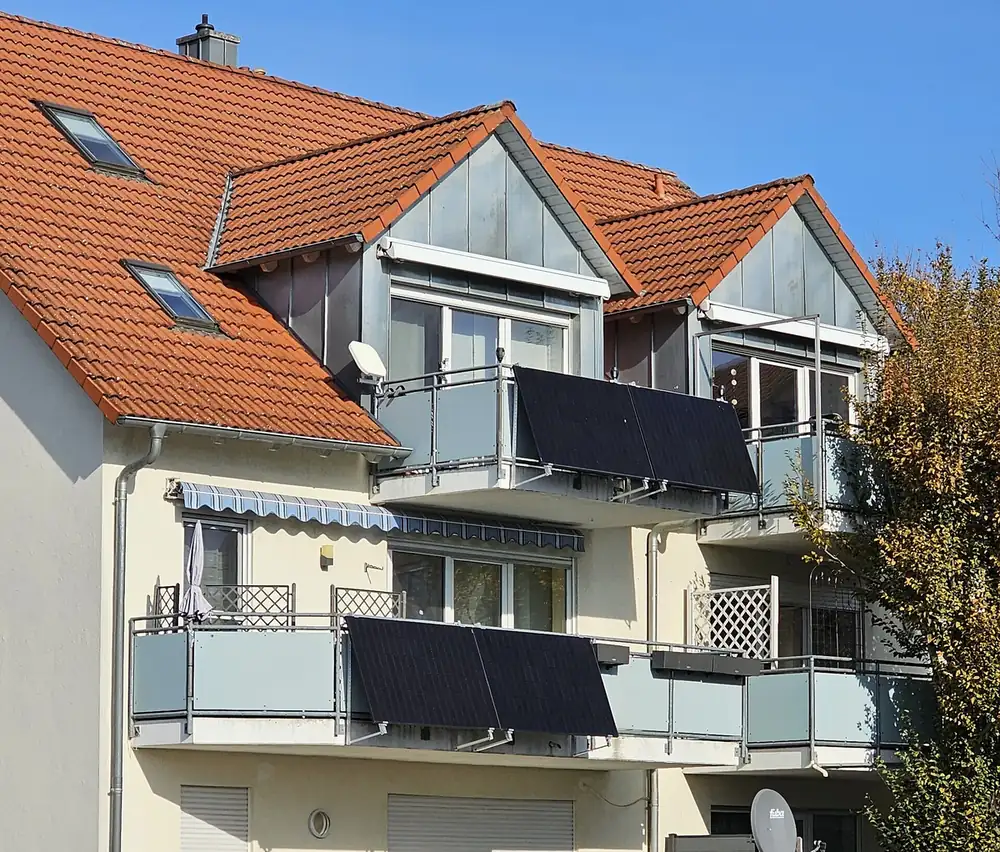

The price is that a tilted module stands off the railing and the wind can get behind it. Either way, a balcony module hangs on a structure that wasn't designed for it, and wind acts on area. Check the mechanical load rating and the mounting before the watts.
Example modules and live prices
When this was written, the format with the most kWp on the example roof at median power was 2382 x 1134 mm. Below is the module in that format with the most shop offers at the time, with its five cheapest live offers. Each price is printed as the shop shows it, with or without VAT.
Cheapest current offers for Jinko Solar JKM620N-66HL4M-BDV, prices read 9 Oct 2026.
| Shop | Market | Price | Availability |
|---|---|---|---|
| PV Zenit | Poland | 406.00 zł incl. VAT | In stock |
| Panele-Sloneczne.com | Poland | 336.00 zł net | In stock |
| Eco System Projekt | Poland | 435.00 zł incl. VAT | In stock |
| PVhurt | Poland | 451.27 zł incl. VAT | In stock |
| TIM SA | Poland | 500.73 zł incl. VAT | In stock |
Each price is the figure the shop printed, on its own side of VAT.
For comparison, the catalogue's modules with the most power per square metre, whatever their format, picked by the rule in the caption:
Top 3 by power per square metre, one module per datasheet, among 12,655 modules of 300 W or more with a stated cell technology and a stated size, as of the last catalogue sync.
Scorecard for this module: open its page on ComparePV.
Scorecard for this module: open its page on ComparePV.
Scorecard for this module: open its page on ComparePV.
Limits of this example
It's one roof. A different roof can change the order of the formats completely; what carries over is the method, and the roof-fit selector does the same arithmetic for your dimensions.
The grid is plain: one orientation, no chimneys, vents or windows, no fire setbacks beyond the uniform margin. Real obstacles and setbacks split the free area into smaller patches, and each patch becomes its own small-roof problem. The count also ignores the clamp gap, a centimetre or two, that a mounting system leaves between neighbouring modules in a row, so a real installation would miss that third module by more than 9 mm.
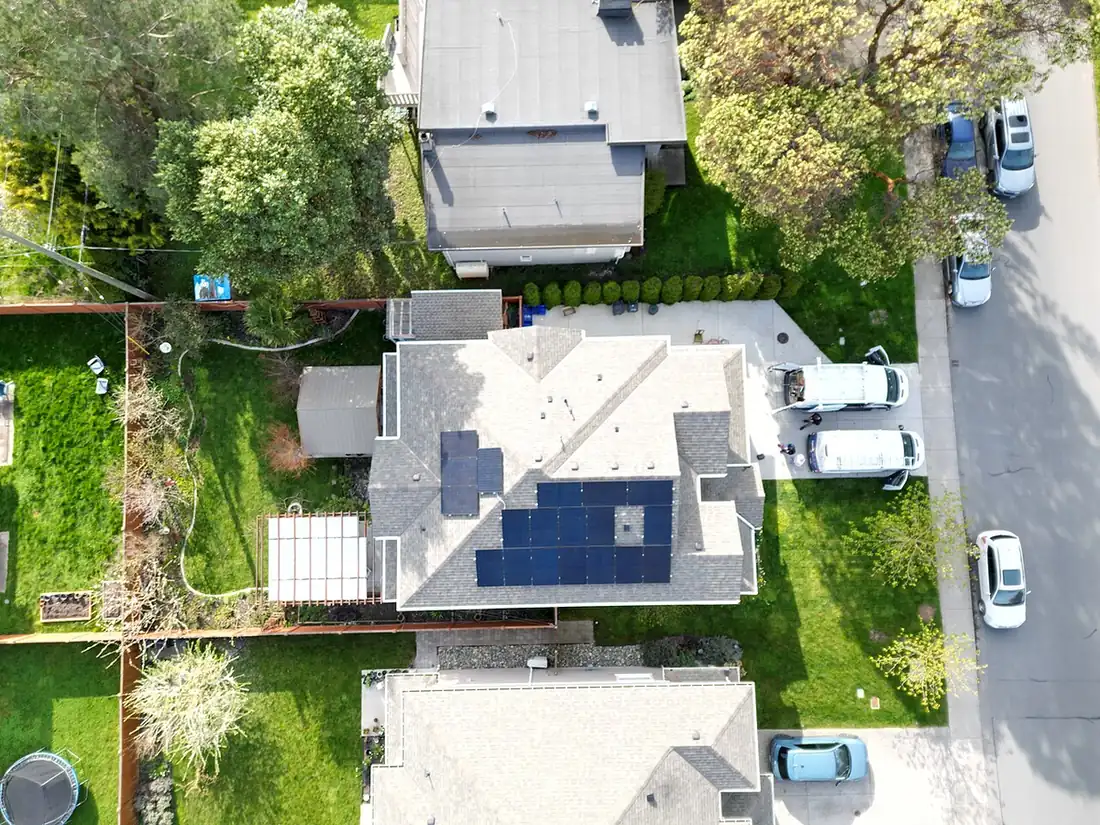

An installer can sometimes fit one more module by mixing orientations, which the plain grid doesn't try.
The catalogue figures are what the datasheets state, at standard test conditions rather than on a roof; the comparison holds because every module in the tables is rated the same way. The prices cover one market and matched offers only, and they move daily. The exact counting rules for every figure are under "Figures and denominators" below.
Figures and denominators
How the figures above were computed. Every figure is recomputed from the catalogue and the live shop offers when the page is served, and each one counts only the modules or offers that publish the value.
The catalogue figures cover every listable module, 14,005 of them, as each manufacturer's datasheet states it, without the rows that restate one module at an assumed rear-side gain. A format is an outer length and width, frame included, matched within a millimetre. The five formats in the table are the most common ones in the catalogue.
The example roof is 4.5 m along the eaves and 3.5 m up the slope, with 0.3 m kept free on every side and 0.02 m between rows, the roof-fit selector's own defaults. The count for each format is the selector's rule: modules in a plain grid, portrait or landscape, whichever fits more. The kWp figure is that count times the format's median rated power, or its 90th percentile power for the most efficient tenth.
The price figures are live shop offers in Poland, the one market with enough offers in every efficiency band, for single modules of 400 to 800 W that our matcher links to a catalogue module, so the efficiency is the catalogue's. Prices are before VAT, in euro at the day's ECB reference rate. The same-shop comparison takes each Polish shop's median price per watt for modules of 23.5 % efficiency and up against its median for 21.5 to 23.5 %, for the shops that list both.
All 6 figures on this page and what each counts
| Figure | Value | Computed over |
|---|---|---|
| Modules in the catalogue | 14,005 | 14,005 modules |
| Polish shops listing matched modules of both 21.5 to 23.5 % and 23.5 % and up | 13 | 13 shops |
| Of those, shops whose 23.5 % and up median price per watt is higher | 11 | 13 shops |
| Same shop, 23.5 % and up against 21.5 to 23.5 %, price per watt difference, median | 6 % | 13 shops |
| Modules 1722 x 1134 mm: modules within 2 kW at the median power | 4 | 1,609 modules |
| Modules 2384 x 1303 mm: modules within 2 kW at the median power | 2 | 1,367 modules |