
Specifications
How big are modern solar panels
Length, width, weight, watts per square metre and per kilogram for every module in our catalogue, and what the common formats mean for roofs and lifting.
In short: the median module in our catalogue is 2,094 mm long, covers 2.22 m² and weighs 26.5 kg, and 66 % of modules are 1134 mm wide. A bigger frame carries more watts and more kilograms; across the catalogue the median is 18.8 W/kg. Watts per square metre are set mostly by the cells, and the size of the frame changes them far less than it changes the watts.
A module's size often decides whether it fits your roof before its power does. So the question that matters when you buy is whether a bigger module puts more power on the same roof, or is just a heavier way to carry the same watts.
Where the figures come from
Every number here is what a manufacturer's datasheet states; none of it is our own measurement. Of 14,005 modules, 13,990 state a usable length and width and 13,987 state a weight. The filters, and why each is there, are under "Figures and denominators" below the article.
Two derived figures do most of the work. Power per square metre is rated power divided by area; rated power is measured at standard test conditions, with 1000 W/m² of light on the module, so this is module efficiency in percent times ten. Power per kilogram is rated power divided by weight.
Module sizes come in a few standard formats
Manufacturers build around a small number of cell sizes and cell counts, so the same outer dimensions turn up across brands.
Width is set by the cell size
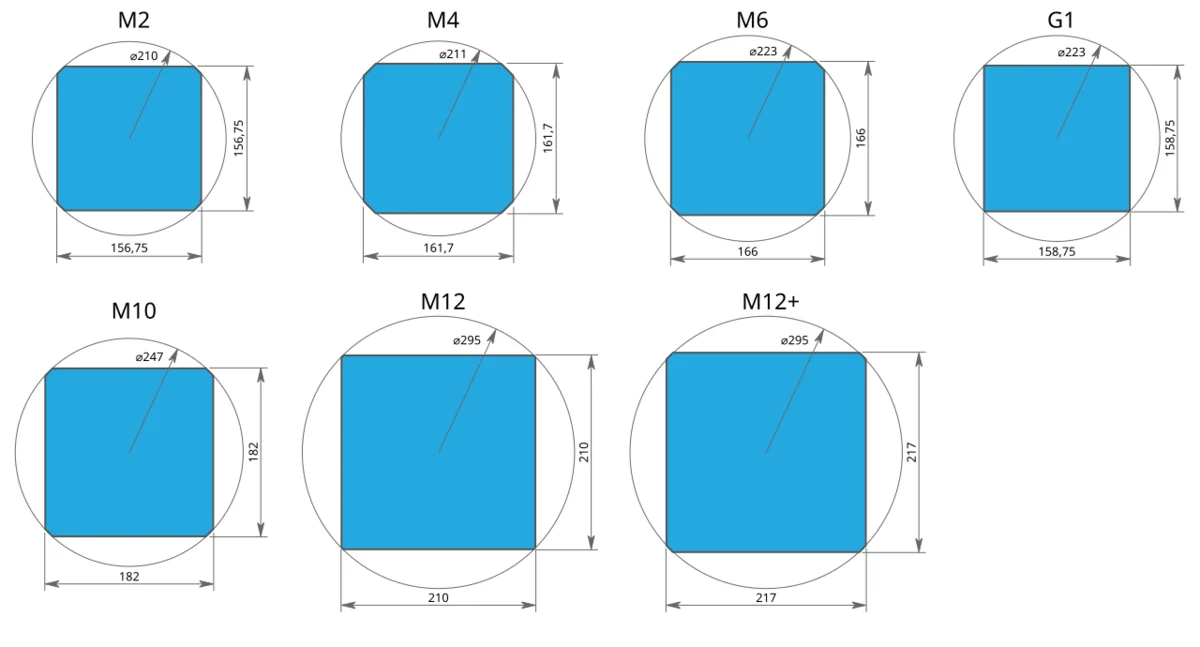
66 % of the modules are 1134 mm wide, give or take a millimetre, and another 14 % are 1303 mm wide.
A module is usually six cells across, so its width is six cell edges plus the gaps and the frame. With 182 mm cells that comes to about 1134 mm; with 210 mm cells, about 1303 mm. Older modules built on smaller cells were narrower, which is a large part of why modules have grown.

Length follows the cell count
Length depends on how many cells sit in each column. The median module is 2,094 mm long, with the 10th percentile at 1,722 mm and the 90th at 2,384 mm.
Area follows from the two: a median of 2.22 m², with the 10th percentile at 1.94 m² and the 90th at 3.10 m². In the chart, tall bars mark where the common formats sit; the low bars between them collect the rarer sizes.
The numbers behind the chart
| Module area (m²) | Modules |
|---|---|
| <1.8 | 854 |
| 1.8-2.0 | 4,143 |
| 2.0-2.2 | 1,473 |
| 2.2-2.4 | 1,140 |
| 2.4-2.6 | 2,528 |
| 2.6-2.8 | 1,928 |
| 2.8-3.0 | 505 |
| 3.0-3.2 | 1,400 |
| 3.2+ | 19 |
What a bigger frame adds: watts and kilograms
Four area classes show what a bigger frame buys you. Power and weight per module are the columns you'd expect to rise with area. The last column tells you whether the extra kilograms come with matching watts.
| Area | Modules | Power (W) | Weight (kg) | W/kg |
|---|---|---|---|---|
| under 2.0 m² | 4,997 | 415 | 21.3 | 18.8 |
| 2.0 to 2.4 m² | 2,613 | 480 | 25.0 | 18.9 |
| 2.4 to 2.8 m² | 4,456 | 585 | 31.5 | 18.9 |
| 2.8 m² and up | 1,924 | 675 | 37.3 | 18.7 |
Power, weight and W/kg are class medians. Across the whole catalogue the median is 18.8 W/kg, with the 10th percentile at 16.4 W/kg and the 90th at 21.3 W/kg. Hold the class medians against that band. If they sit close together inside it, size isn't moving the figure: a larger module is a larger piece of the same glass, cells and frame.
The figure below stands each class's typical module next to things you already know the size of.
Module sizes to scale, next to a person and a door
Pick a size class and see its typical module stood on end beside a person, a door and a balcony railing, drawn to the same scale.
How this is computed
Each class is the catalogue's modules in one area band (under 2.0 m², 2.0 to 2.4 m², 2.4 to 2.8 m², 2.8 m² and up). The module drawn is the median length by the median width of that class, which is close to the class's common format but is not necessarily a module someone makes; power and weight are the class medians too, each over the modules that state it.
The reference objects are fixed sizes chosen to read at a glance: a person 1.75 m tall, a door 2.0 m tall and 0.9 m wide, a balcony railing 1.0 m high. Everything sits on the same ground line at one scale; zoom narrows the view towards the module without changing that scale between objects.
"One person can lift" is an assumption, not a rule: it uses 25 kg, the UK Health and Safety Executive's guideline filter for a man lifting close to the body, and divides the weight by it for the number of people. The filter assumes a load that is easy to grip; a module two metres long is not, and wind on a module carried upright is its own hazard, so treat the figure as the least help you need.
Illustrative model, not a measurement.
Watts per square metre come from the cells
Power per square metre is efficiency in other units, so the cells set it. The catalogue median is 218 W/m², with the 10th percentile at 196 W/m² and the 90th at 232 W/m². A small module with efficient cells puts more power on each square metre than a large one with weaker cells.
Bifacial build and weight per square metre
Weight for a given area depends on how the module is built. The catalogue allows one split: modules listed as bifacial have a median of 12.2 kg/m², modules not listed as bifacial 10.8 kg/m². The difference between the two is what that build adds or saves per square metre, on paper.
What the size means when you buy
Roof fit depends on length and width
A roof takes a whole number of modules in each direction, so two modules of the same power can fill it differently. Among modules that share one of the two common widths, only length differs, and length decides the fit together with the edge clearances your mounting system needs.
Obstacles make it worse. A chimney, a vent or a roof window takes out a block of the plane, and a longer module can lose more of the roof around it than a shorter one.
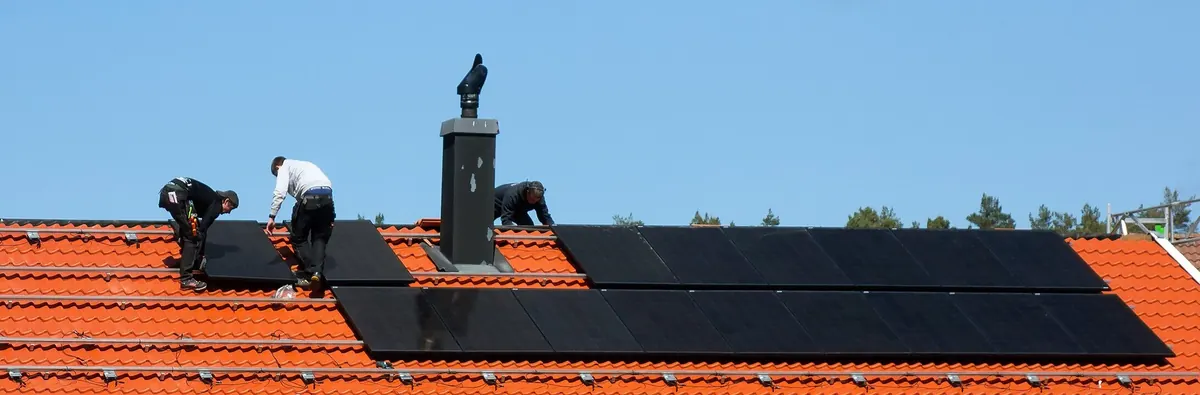

The figure below lays the common formats onto one example roof to scale. Switch the chimney on and drag it.
How many modules fit a small roof
Set the roof, the margin and the module size, turn the modules, add a chimney and drag it, and watch the grid fill the roof to scale.
How this is computed
The count is the roof-fit selector's own rule: modules in a plain grid, all portrait or all landscape, edge to edge in a row (clamp gaps of a few millimetres are ignored), rows up the slope separated by the row gap, and the edge margin kept free on all four sides. Portrait means the module's length runs up the slope. Modules in a row = floor(usable width / module width across), rows = floor((usable height + gap) / (module height + gap)).
The grid is drawn centred across the roof and starting at the eaves margin. A module that overlaps the chimney is dropped and the rest stay where they are; the figure does not rearrange the grid around it, which a planner sometimes can by shifting a row. Draw the chimney with the clearance your installer needs around it.
Total power is the module count times the rated power, and the share of the roof covered is the modules' area over the whole roof. The recommendation tries each of the five common sizes in both orientations on the same roof and chimney and keeps the most kWp. It ignores fire setbacks beyond the margin, mixed orientations, roof shape other than a rectangle and the mounting system's own spacing rules.
Illustrative model, not a measurement.
For your own roof, the roof-fit selector takes the dimensions and works through every module size in the catalogue, so you can see which format gives the most kilowatts.
When the roof is already full
Size alone doesn't put more power on the same area. On a full roof, the way to more power is a more efficient module.
A bigger module helps only when its length divides your roof better and leaves less unused space at the edges, which is what the selector checks. The article on small roofs and balconies works one such roof through in full.
Lifting, handling and the total weight
55 % of the modules that state a weight are heavier than 25 kg. That line comes from lifting guidance.
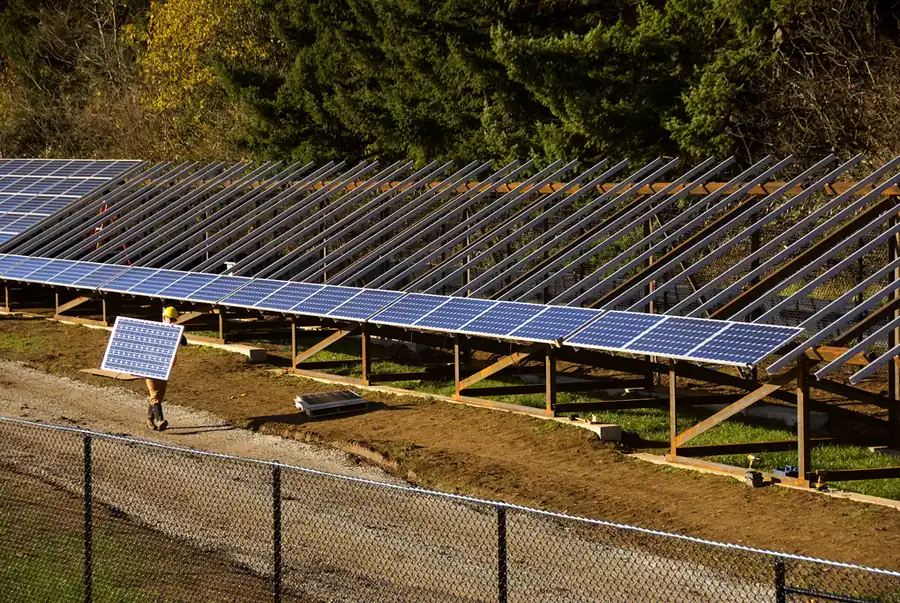
The UK Health and Safety Executive's guideline filter gives 25 kg for men lifting close to the body between knuckle and elbow height, and 16 kg for women. It says plainly that these are not safe limits, only a screen below which the risk is low. It also assumes a load you can grip easily with both hands. A module two metres long isn't that, so for the larger classes the filter is more generous than the module's shape allows. Plan on two people per large module.
.jpg)
For the roof as a whole, W/kg is the figure that counts. Where the class medians in the table above sit close together, a roof of large modules weighs about what a roof of small ones does for the same power. Mounting rails, clamps and any ballast come on top of the module weight.
Fewer, larger modules do mean fewer pieces per kilowatt to lift and clamp, and fewer connectors. That saves installation time.
Wind and snow loads act on area
Load ratings are given in pascals, a force per square metre, so a bigger module with the same rating passes more total force to each clamp. For the largest formats, read the mechanical load ratings together with the clamping zones in the installation manual. The rating only holds when the module is clamped where the manual says.
Example modules
These two were picked when this was written as the modules with the most shop offers in the smallest and the largest area class, ties broken by name. From the smallest class:
Scorecard for this module: open its page on ComparePV.
From the largest class:
Scorecard for this module: open its page on ComparePV.
If your roof is the limit, compare watts per square metre. The top modules by that figure, picked by the rule in the caption:
Top 3 by power per square metre, one module per datasheet, among 12,655 modules of 300 W or more with a stated cell technology and a stated size, as of the last catalogue sync.
Scorecard for this module: open its page on ComparePV.
Scorecard for this module: open its page on ComparePV.
Scorecard for this module: open its page on ComparePV.
The cards show four headline figures; each module's size and weight are on its page.
What these figures can't tell you
Dimensions and weights are nominal datasheet values, and a real module can differ slightly. A datasheet with a typo in one dimension lands in the wrong class until someone corrects it.
The shares count modules, not datasheets. A format offered in twenty power steps counts twenty times, so the shares describe the choice you see in the catalogue rather than how many distinct frames exist.
The lifting guideline is one country's screening tool for workplaces. It isn't a rule for a homeowner, and not a legal weight limit even in the UK. Rules for lifting and work at height differ by country, and an installer works to the local ones.
Figures and denominators
How the figures above were computed. Every figure is recomputed from the catalogue and the live shop offers when the page is served, and each one counts only the modules or offers that publish the value.
The pool is every listable module in our catalogue, 14,005 of them, as each manufacturer's datasheet states it. One datasheet usually covers a whole power ladder of the same frame, so most formats appear once per power step; the figures count modules, not datasheets.
Length and width are the outer dimensions printed on the datasheet, frame included. A module counts for the size figures when its length is between 500 and 3000 mm and its width between 300 and 1500 mm; outside that range a dimension is in centimetres or inches, not a module. Area is length times width. Weight counts between 1 and 100 kg, for the same reason.
Power per square metre is rated power at standard test conditions divided by area. Because those conditions put 1000 W of light on each square metre, this figure is module efficiency in percent multiplied by ten, written in the unit a roof is measured in. Power per kilogram is rated power divided by weight.
The size classes split the modules by area: under 2.0 m², 2.0 to 2.4 m², 2.4 to 2.8 m², and 2.8 m² and up. The edges fall between the common formats, so no format is cut in two. All medians and percentiles are continuous percentiles over the modules that state the figure.
All 21 figures on this page and what each counts
| Figure | Value | Computed over |
|---|---|---|
| Module length, median | 2,094 mm | 13,990 modules |
| Module area, median | 2.22 m² | 13,990 modules |
| Module weight, median | 26.5 kg | 13,987 modules |
| Share of modules 1134 mm wide (within 1 mm) | 66 % | 13,990 modules |
| Rated power per kilogram, median | 18.8 W/kg | 13,987 modules |
| Modules in the catalogue | 14,005 | 14,005 modules |
| Modules stating length and width | 13,990 | 14,005 modules |
| Modules stating a weight | 13,987 | 14,005 modules |
| Share of modules 1303 mm wide (within 1 mm) | 14 % | 13,990 modules |
| Module length, 10th percentile | 1,722 mm | 13,990 modules |
| Module length, 90th percentile | 2,384 mm | 13,990 modules |
| Module area, 10th percentile | 1.94 m² | 13,990 modules |
| Module area, 90th percentile | 3.10 m² | 13,990 modules |
| Rated power per kilogram, 10th percentile | 16.4 W/kg | 13,987 modules |
| Rated power per kilogram, 90th percentile | 21.3 W/kg | 13,987 modules |
| Rated power per square metre, median | 218 W/m² | 13,990 modules |
| Rated power per square metre, 10th percentile | 196 W/m² | 13,990 modules |
| Rated power per square metre, 90th percentile | 232 W/m² | 13,990 modules |
| Bifacial modules: weight per square metre, median | 12.2 kg/m² | 7,735 modules |
| Monofacial modules: weight per square metre, median | 10.8 kg/m² | 6,145 modules |
| Share of modules heavier than 25 kg | 55 % | 13,987 modules |