Yingli YL635CF60 f/2

Yingli YL635CF60 f/2

635 Wp TOPCon Bifacial 80%
ComparePV verdict

Middle of its segment, modest efficiency

Rank 2,694 of 14,129
Compare panels Datasheet PDF
Power (Wp)
635
Strong · top 16%
Efficiency (%)
22.40
Weak · bottom 23%
Density (Wp/m²)
224.4
Typical · median 227.7
Temp (%/°C)
-0.290
Typical · median -0.290
Weight (kg)
34.6
Weak · 1.8 kg above median
Warranty (yrs)
30
Typical · median 30 yrs

The Yingli PANDA 3.0 Plus 1 series are modules based on N-type TOPCon cells, designed for high energy yield in real-world operating conditions. The key advantage is excellent performance under low-light conditions - panels start generating earlier and maintain production for longer throughout the day, helping improve self-consumption and yield stability in Poland, especially during autumn and winter. The applied cell architecture supports lower long-term degradation, ensuring the installation remains economically viable for longer and making its return on investment easier to plan.

Bifacial variants allow for utilizing reflected light from the ground, translating to additional yield from the rear side without complicating the design. This is a series for investors seeking premium quality in residential homes, commercial rooftops, and ground-mounted installations, where maximizing yield from available space and predictable performance over a long horizon matters.

Ranking

1,085 panels in the segment TOPCon 600-650 W
Metric This panel Median Position in segment Overall rank
Module efficiency 22.40% 22.80% Weak · bottom 23% 4,834
Power density 224.4 227.7 Typical 4,794
Temperature coefficient -0.290 -0.290 Typical 2,220
Weight per kWp 54.5 53.1 Weak · bottom 23% 8,913
Performance warranty 30 yrs 30 yrs Typical 21
Colour key Strong - top 25% Typical - middle 50% Weak - bottom 25%

Signals from the data

0 positive · 2 caution
Best for

Residential, commercial and utility-scale.

Not ideal for

Tight roof space and weight-limited structures.

Watch-outs
22.40% module efficiency

Bottom 23% of the TOPCon 600-650 W segment, against a median of 22.80%.

54.5 kg per kWp

Bottom 23% of the TOPCon 600-650 W segment, against a median of 53.1.

Notes from the database
  • Efficiency of 22.4% matches the TOPCon 600-650W median
  • At 224.4 W/m², this panel generates 3.3 W/m² less per unit area than TOPCon 600-650W median (227.7 W/m²)
  • Temperature coefficient of -0.29%/°C matches the TOPCon 600-650W median
  • Weight of 34.6 kg is 1.8 kg above TOPCon 600-650W median (32.8 kg) - verify structural support
  • 80% bifaciality enables rear-side power generation, boosting yield by 4-12% on reflective surfaces

Specifications

Open datasheet PDF
Nominal power (Pmax) 635 Wp Nameplate at 1000 W/m², 25 °C
Module efficiency 22.40 % Weak Segment median 22.80%
Vmpp · Impp 36.86 V · 17.23 A Operating point at max power
Voc · Isc 43.73 V · 18.26 A Sizes the string length
Max system voltage 1500 V Longer strings than 1000 V modules
Dimensions 2172×1303×33 mm · 2.83 m² of roof
Weight 34.6 kg Weak Weak · 1.8 kg above median
Cells 120 · TOPCon Monocrystalline
Bifaciality 80 % Rear output as a share of front
Coefficient Pmax -0.290 %/°C Typical median -0.290 of its segment
Coefficient Voc · Isc -0.240 · 0.042 %/°C
NOCT 42 °C At 800 W/m², 20 °C ambient
Product warranty 12 years Hardware defects only
Performance warranty 30 years Typical median 30 yrs · median 30 yrs
End-of-warranty output 87.4 % Equals 555 W guaranteed
Degradation 1.00 → 0.40 % First year, then annual

Datasheet charts

Open datasheet PDF

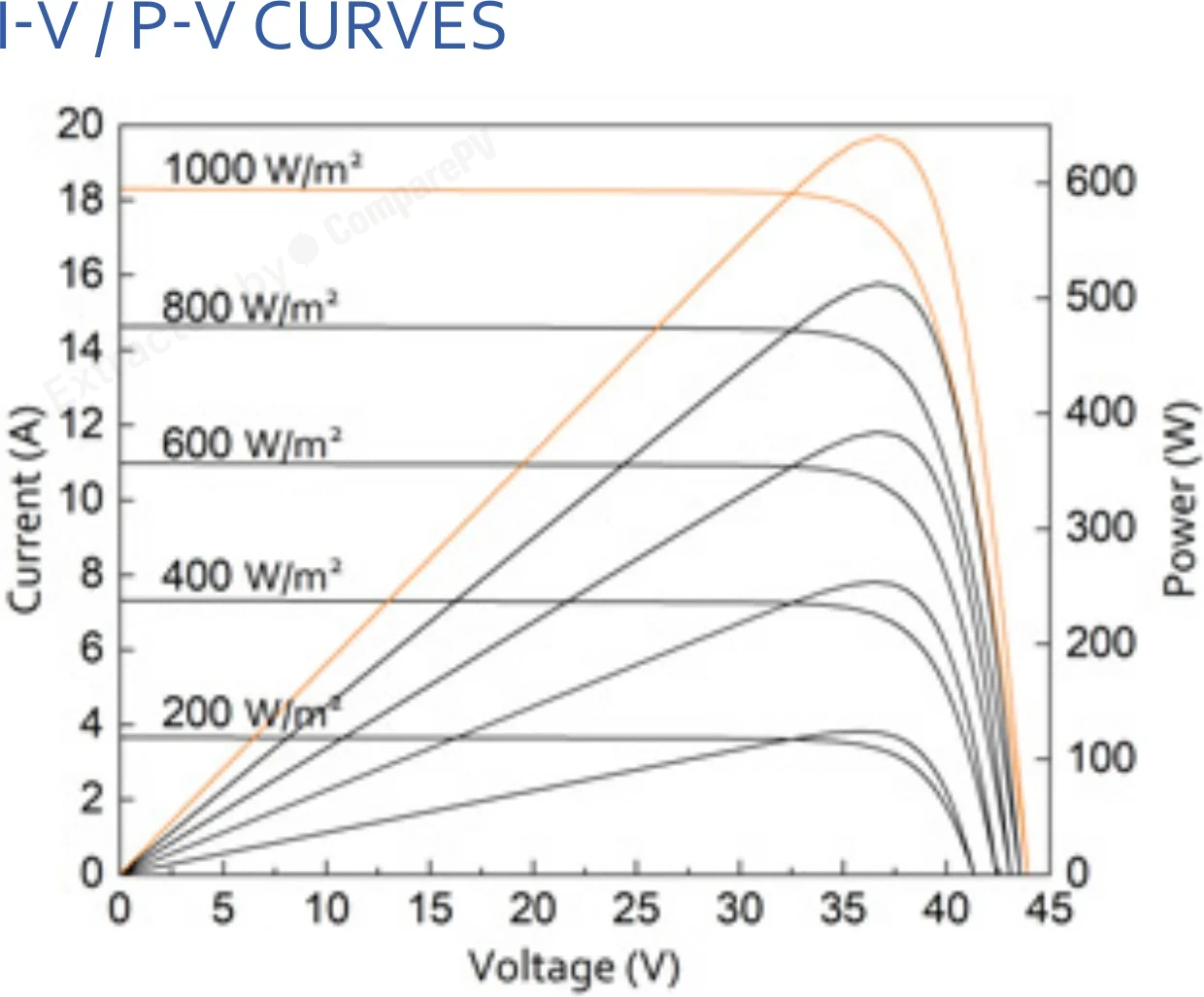
Measured curves published by Yingli in this model's datasheet. A chart carrying a wattage was measured on that variant alone - only the ones that describe 635 Wp appear here. The rest cover the whole series.
Simulations

Live - change any input
Lifetime output & value
30 years at 1200 kWh/kWp/year and €0.50 per kWh
Power in year 30
-
Lifetime energy
-
Energy value
-
With bifacial gain
-

Degradation from this panel's own datasheet figures. No inverter, soiling or shading losses.

Heat losses
-0.290 %/°C against a segment median of -0.290
-
Bifacial gain
Rear gain over light concrete: -
-

Model: bifaciality × albedo × 0.6 view factor. A first-order estimate, not a yield simulation.

Filter these
Size
Panel Power Eff. Temp. Weight Difference
Yingli YL635CF60 f/2 635 W 22.40% -0.290 34.6 kg You are here
AIKO-A650-MAE72Mw 650 W 25.20% -0.260 27.0 kg Cooler, lighter, +2.8 pp
AIKO-A680-MDE72Mw 680 W 25.20% -0.260 29.0 kg +45 W, lighter, +2.8 pp
AIKO-A675-MDE72Mw 675 W 25.00% -0.260 29.0 kg +40 W, lighter, +2.6 pp
AIKO-A645-MAE72Mw 645 W 25.00% -0.260 27.0 kg Cooler, lighter, +2.6 pp
WST-675BKX72-A2 675 W 25.00% -0.260 32.1 kg +40 W, cooler, +2.6 pp
AIKO-G670-MCH72Mw 670 W 24.80% -0.260 28.2 kg +35 W, lighter, +2.4 pp
LR7-72HVHF-670M 670 W 24.80% -0.260 28.5 kg +35 W, lighter, +2.4 pp
YL580DF60f/2 580 W 20.50% -0.340 35.1 kg -55 W, hotter, -1.9 pp
YL585DF60f/2 585 W 20.70% -0.340 35.1 kg -50 W, hotter, -1.7 pp
YL590DF60f/2 590 W 20.80% -0.340 35.1 kg -45 W, hotter, -1.6 pp
YL595D-41f 1/2 / YL595D-41f 1500V 1/2 595 W 21.00% -0.340 31.0 kg Hotter, -1.4 pp, -5 yr warranty
YL600DF60f/2 600 W 21.20% -0.340 35.1 kg -35 W, hotter, -1.2 pp
GKA210N120 680 W 24.03% -0.340 28.0 kg Hotter, lighter, +1.6 pp
GKA210N120-675 675 W 23.85% -0.340 28.0 kg Hotter, lighter, +1.5 pp
QN-670HJT-01 670 W 23.70% -0.240 35.5 kg +35 W, cooler, +1.3 pp
GKA210N120-670 670 W 23.67% -0.340 28.0 kg Hotter, lighter, +1.3 pp

Found 497 panels of the same or similar size to this one, within ±10 mm. See them here Found 502 panels of the same or similar size to this one, within ±25 mm. See them here Found 502 panels of the same or similar size to this one, within ±50 mm. See them here Found 502 panels of the same or similar size to this one, within ±100 mm. See them here

About the PANDA 3.0 Plus 1 series

6 answered

These answers cover the whole series. Where a figure differs, the specification above is this module's own.

What is the power output of Yingli PANDA 3.0 Plus 1 solar panels?
The PANDA 3.0 Plus 1 series reaches a maximum power output of up to 735 Wp. This high performance results from N-type TOPCon cells, which make better use of the panel surface and generate more energy from the same installation footprint compared to older PERC technology.
How do the N-type TOPCon cells in the PANDA 3.0 Plus 1 series differ from standard PERC panels?
TOPCon cells include an additional passivation layer that reduces electrical losses and improves performance under weak or diffuse light. In practice, this means an earlier production start in the morning, longer output after sunset, and higher yield in autumn and winter compared to conventional PERC modules.
Are the bifacial variants of the PANDA 3.0 Plus 1 series worth it for a residential rooftop?
Bifacial panels generate extra energy from light reflected off the ground, but the effect is greatest on bright, open surfaces such as ground-mount installations or light-colored rooftops. On a typical sloped residential roof, the gain is usually modest, so bifacial variants are best suited to ground-mount or east-west installations.
What warranty comes with Yingli PANDA 3.0 Plus 1 panels?
The manufacturer provides a 12-year product warranty and a 30-year power performance warranty. This means the panel is covered not only against material and manufacturing defects but also against a guaranteed power output level over a very long horizon, making it easier to plan the investment's payback period.
Is Yingli a Tier 1 manufacturer, and where are PANDA 3.0 Plus 1 panels made?
Yingli is a Chinese manufacturer classified as Tier 1, reflecting long-term financial and production stability confirmed by independent industry rankings. This classification lowers investor risk by increasing the likelihood the manufacturer will remain in business throughout the full warranty period.
What type of installations is the PANDA 3.0 Plus 1 series best suited for?
The series works well on residential rooftops, commercial roofs, and large ground-mount installations. The high per-module output of up to 735 Wp allows more energy to be generated from fewer panels, which is especially valuable when roof space is limited or when maximizing yield from available land is a priority.
Add to compare