
VSUN690N-132BMH-DG

690 Wp TOPCon Bifacial 80%
ComparePV verdict

Middle of its segment, heavy for its output

Rank 1,555 of 14,005
Compare panels Datasheet PDF
Power (Wp)
690
Strong · top 21%
Efficiency (%)
22.21
Typical · median 22.40%
Density (Wp/m²)
222.1
Typical · median 223.7
Temp (%/°C)
-0.300
Typical · median -0.290
Weight (kg)
38.5
Weak · 3.9 kg above median
Warranty (yrs)
30
Typical · median 30 yrs

The VSUN N-132BMH-DG series represents the latest generation of modules utilizing N-type TOPCon cell technology. Thanks to this architecture, the panels are characterized by almost zero light-induced degradation (LID), which translates into significantly higher efficiency over a long service life. A key differentiator is the Bifacial Dual Glass design, which, through the use of tempered glass on both sides, not only increases mechanical strength and resistance to extreme weather conditions but also allows for additional energy recovery from radiation reflected from the ground. This solution effectively eliminates the problem of micro-cracks and backsheet aging, which is a common issue with standard competitive products. These modules are an optimal choice for investors developing photovoltaic farms and large-scale commercial installations, where the priority is maximizing yields per square meter while simultaneously reducing the LCOE. This series performs excellently even at a low sun angle, offering a better temperature coefficient compared to traditional P-type cells. Choosing the VSUN N-132BMH-DG ensures Class A fire safety and energy stability that outclasses solutions based on older silicon technologies.

Ranking

249 panels in the segment TOPCon 650-700 W
Metric This panel Median Position in segment Overall rank
Module efficiency 22.21% 22.40% Typical 5,754
Power density 222.1 223.7 Typical 5,734
Temperature coefficient -0.300 -0.290 Typical 6,093
Weight per kWp 55.8 53.2 Weak · bottom 24% 10,180
Performance warranty 30 yrs 30 yrs Typical 21
Colour key Strong - top 25% Typical - middle 50% Weak - bottom 25%

Signals from the data

0 positive · 1 caution
Best for

Utility-scale and commercial.

Not ideal for

Weight-limited structures.

Watch-outs
55.8 kg per kWp

Bottom 24% of the TOPCon 650-700 W segment, against a median of 53.2.

Notes from the database
  • Efficiency of 22.2% matches the TOPCon 650-700W median
  • Power density of 222.1 W/m² matches the TOPCon 650-700W median
  • Temperature coefficient of -0.30%/°C matches the TOPCon 650-700W median
  • At 38.5 kg (3.9 kg above TOPCon 650-700W median of 34.6 kg), requires checking roof load capacity
  • Bifaciality factor of 80% can add 4-12% extra yield with reflective mounting surface

Specifications

Open datasheet PDF
Nominal power (Pmax) 690 Wp Nameplate at 1000 W/m², 25 °C
Module efficiency 22.21 % Typical Segment median 22.40%
Vmpp · Impp 40.10 V · 17.23 A Operating point at max power
Voc · Isc 47.90 V · 18.25 A Sizes the string length
Max system voltage 1500 V Longer strings than 1000 V modules
Dimensions 2384×1303×35 mm · 3.11 m² of roof
Weight 38.5 kg Weak Weak · 3.9 kg above median
Cells 132 · TOPCon Monocrystalline
Bifaciality 80 % Rear output as a share of front
Coefficient Pmax -0.300 %/°C Typical median -0.290 of its segment
Coefficient Voc · Isc -0.250 · 0.040 %/°C
NOCT 45 °C At 800 W/m², 20 °C ambient
Product warranty 12 years Hardware defects only
Performance warranty 30 years Typical median 30 yrs · median 30 yrs
End-of-warranty output 87.4 % Equals 603 W guaranteed
Degradation 1.00 → 0.40 % First year, then annual

Datasheet charts

Open datasheet PDF

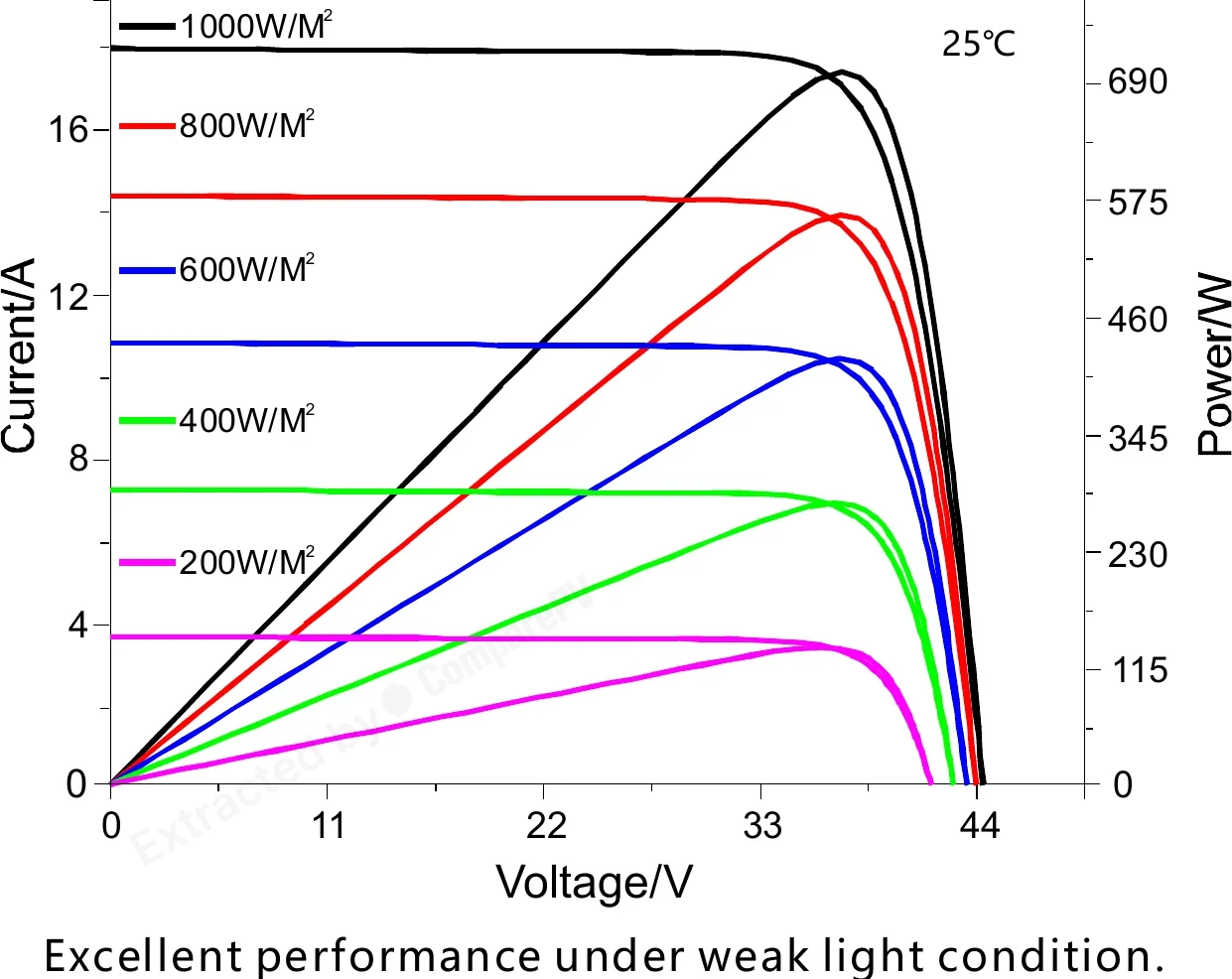
Measured curves published by VSUN in this model's datasheet. A chart carrying a wattage was measured on that variant alone - only the ones that describe 690 Wp appear here. The rest cover the whole series.
Simulations

Live - change any input
Lifetime output & value
30 years at 1200 kWh/kWp/year and €0.50 per kWh
Power in year 30
-
Lifetime energy
-
Energy value
-
With bifacial gain
-

Degradation from this panel's own datasheet figures. No inverter, soiling or shading losses.

Heat losses
-0.300 %/°C against a segment median of -0.290
-
Bifacial gain
Rear gain over light concrete: -
-

Model: bifaciality × albedo × 0.6 view factor. A first-order estimate, not a yield simulation.

Filter these
Size
Panel Power Eff. Temp. Weight Difference
VSUN VSUN690N-132BMH-DG 690 W 22.21% -0.300 38.5 kg You are here
AIKO-A650-MAE72Mw 650 W 25.20% -0.260 27.0 kg -40 W, lighter, +3.0 pp
AIKO-A680-MDE72Mw 680 W 25.20% -0.260 29.0 kg Cooler, lighter, +3.0 pp
AIKO-A675-MDE72Mw 675 W 25.00% -0.260 29.0 kg Cooler, lighter, +2.8 pp
AIKO-A645-MAE72Mw 645 W 25.00% -0.260 27.0 kg -45 W, lighter, +2.8 pp
AIKO-A700-MAE78Dw 700 W 25.00% -0.260 34.5 kg Cooler, lighter, +2.8 pp
AIKO-A695-MAE78Dw 695 W 24.90% -0.260 34.5 kg Cooler, lighter, +2.7 pp
AIKO-G670-MCH72Mw 670 W 24.80% -0.260 28.2 kg Cooler, lighter, +2.6 pp
CSUN645-132M 645 W 20.76% -0.350 34.5 kg Hotter, -1.4 pp, -5 yr warranty
VSUN655-132BMH-DG 655 W 21.09% -0.340 38.5 kg -35 W, hotter, -1.1 pp
VSUN660-132BMH-DG 660 W 21.25% -0.340 38.5 kg -30 W, hotter, -1.0 pp
VSUN665-132BMH-DG 665 W 21.41% -0.340 38.5 kg -25 W, hotter, -0.8 pp
VSUN670-132BMH-DG 670 W 21.57% -0.340 38.5 kg -20 W, hotter, -0.6 pp
VSUN685N-132BMH-DG 685 W 22.05% -0.300 38.5 kg Very close match
AIKO-A805-GRH78Dw 805 W 25.10% -0.260 39.8 kg +115 W, cooler, +2.9 pp
AIKO-A800-GRH78Dw 800 W 24.90% -0.260 39.8 kg +110 W, cooler, +2.7 pp
AIKO-A795-GRH78Dw 795 W 24.80% -0.260 39.8 kg +105 W, cooler, +2.6 pp

Found 1390 panels of the same or similar size to this one, within ±10 mm. See them here Found 1400 panels of the same or similar size to this one, within ±25 mm. See them here Found 1400 panels of the same or similar size to this one, within ±50 mm. See them here Found 1432 panels of the same or similar size to this one, within ±100 mm. See them here

Common questions

6 answered
What is the N-type TOPCon technology used in the VSUN N-132BMH-DG series, and how does it differ from P-type?
TOPCon (Tunnel Oxide Passivated Contact) is an N-type cell technology where an additional passivating oxide layer reduces carrier recombination. In practice this means higher efficiency (22.05-22.53%), near-zero LID degradation, and better performance at high temperatures compared to classic P-type PERC cells. Modules in this series reach up to 700 Wp with 132 cells, making them one of the higher-power constructions available for commercial-scale projects.
How much extra energy does the Bifacial Dual Glass construction of the VSUN N-132BMH-DG series generate?
Thanks to the double-sided design with tempered glass on both sides, the module captures light reflected from the ground surface. Depending on terrain albedo (e.g., light gravel, white roofing) and mounting height, this typically adds 5-15% extra annual energy yield compared to a monofacial panel of the same rated power. Dual glass also improves mechanical durability and eliminates the backsheet degradation risk common in cheaper single-sided panels.
What warranty does the manufacturer offer on the VSUN N-132BMH-DG series?
VSUN provides a 12-year product warranty and a 30-year linear power warranty, guaranteeing around 87.4% of initial output remains after 30 years of operation. This is a standard benchmark for modern N-type modules and stems directly from the low light-induced degradation characteristic of TOPCon technology.
How does the VSUN N-132BMH-DG series perform in high summer temperatures?
The series has a power temperature coefficient of -0.3%/°C, better (less negative) than the typical -0.35% to -0.40%/°C found in P-type cells. This means a smaller output drop on hot days and when modules heat up on a roof or ground-mount structure, resulting in higher energy production during summer months, especially in large-scale installations exposed to prolonged sunlight.
Are VSUN N-132BMH-DG panels suitable for mounting on a residential sloped roof?
This is not the ideal choice for a typical sloped roof. The module measures 2384x1303x35 mm and weighs around 38.5 kg, significantly more than standard residential panels, making rooftop handling and single-person installation difficult. The series is designed for solar farms and large commercial installations, where maximizing power output per square meter and lowering LCOE take priority over ease of installation on a small roof area.
Is VSUN a Tier 1 manufacturer, and where is the company based?
VSUN is not listed as a Tier 1 manufacturer under the BloombergNEF classification, meaning a shorter track record of bank-financed projects compared to top-tier players like Jinko or Trina. The company is headquartered in Germany, which simplifies warranty service and support for the European market. This is worth considering for large bank-financed commercial projects, though it does not affect the module's technical performance.
Add to compare