THC G12-66 Bifacial

740 Wp TOPCon Bifacial 85%
ComparePV verdict

Space saver, no clear weak spot

Rank 130 of 14,005
Compare panels Datasheet PDF
Power (Wp)
740
Strong · top 2%
Efficiency (%)
23.80
Strong · top 3%
Density (Wp/m²)
238.2
Strong · top 2%
Temp (%/°C)
-0.280
Strong · top 11%
Weight (kg)
37.0
Strong · 1.0 kg below median
Warranty (yrs)
30
Typical · median 30 yrs

The Tongwei TNC and THC panel series is a technological breakthrough based on N-type cells that redefines efficiency standards in modern photovoltaics. The use of advanced TOPCon and HJT structures allows for achieving parameters unavailable to older technologies, which directly translates to a greater amount of energy harvested from the same roof area. TNC models stand out with minimal annual degradation, providing investors with long-term security and financial stability throughout the entire service life. In turn, the THC line, based on heterojunction technology, offers an excellent temperature coefficient, thanks to which the modules operate extremely efficiently even during extreme summer heat. These products effectively solve the problem of limited installation space, delivering more power from every square meter of the installation. The manufacturer's unique vertical integration guarantees the highest quality of silicon, which distinguishes these series from the competition in terms of durability and purity of components. The TNC and THC series is the optimal choice for business and residential projects where the priority is maximizing energy yields while reducing operating costs. This is a solution for those looking for future technology ready to work in the demanding Polish climate.

Ranking

420 panels in the segment TOPCon 700-750 W
Metric This panel Median Position in segment Overall rank
Module efficiency 23.80% 23.00% Strong · top 3% 433
Power density 238.2 230.2 Strong · top 2% 431
Temperature coefficient -0.280 -0.290 Strong · top 11% 1,309
Weight per kWp 50.0 52.9 Strong · top 17% 3,317
Performance warranty 30 yrs 30 yrs Typical 21
Colour key Strong - top 25% Typical - middle 50% Weak - bottom 25%

Signals from the data

3 positive · 0 caution
Best for

Commercial, utility-scale and hot-climate.

Strengths
238.2 watts per square metre

Top 2% of the TOPCon 700-750 W segment, against a median of 230.2. Ranked 431st in the whole database.

23.80% module efficiency

Top 3% of the TOPCon 700-750 W segment, against a median of 23.00%. Ranked 433rd in the whole database.

-0.280 %/°C temperature coefficient

Top 11% of the TOPCon 700-750 W segment, against a median of -0.290.

Notes from the database
  • 23.8% module efficiency - 0.8pp better than the TOPCon 700-750W median of 23.0%
  • Power density of 238.2 W/m² packs 8.0 W/m² more into the same footprint vs TOPCon 700-750W median (230.2 W/m²)
  • Temperature coefficient of -0.28%/°C matches the TOPCon 700-750W median
  • At 37.0 kg, weight matches the TOPCon 700-750W median
  • Bifacial design (85% factor) captures reflected light - adds 4-13% yield on ground-mount or white roof

Specifications

Open datasheet PDF
Nominal power (Pmax) 740 Wp Nameplate at 1000 W/m², 25 °C
Module efficiency 23.80 % Strong Segment median 23.00%
Vmpp · Impp 42.32 V · 17.49 A Operating point at max power
Voc · Isc 50.62 V · 18.47 A Sizes the string length
Dimensions 2384×1303×33 mm · 3.11 m² of roof
Weight 37.0 kg Strong Strong · 1.0 kg below median
Cells 132 · TOPCon Monocrystalline
Bifaciality 85 % Rear output as a share of front
Coefficient Pmax -0.280 %/°C Strong top 11% of its segment
Coefficient Voc · Isc -0.220 · 0.040 %/°C
NOCT 45 °C At 800 W/m², 20 °C ambient
Product warranty 15 years Hardware defects only
Performance warranty 30 years Typical median 30 yrs · median 30 yrs

Datasheet charts

Open datasheet PDF

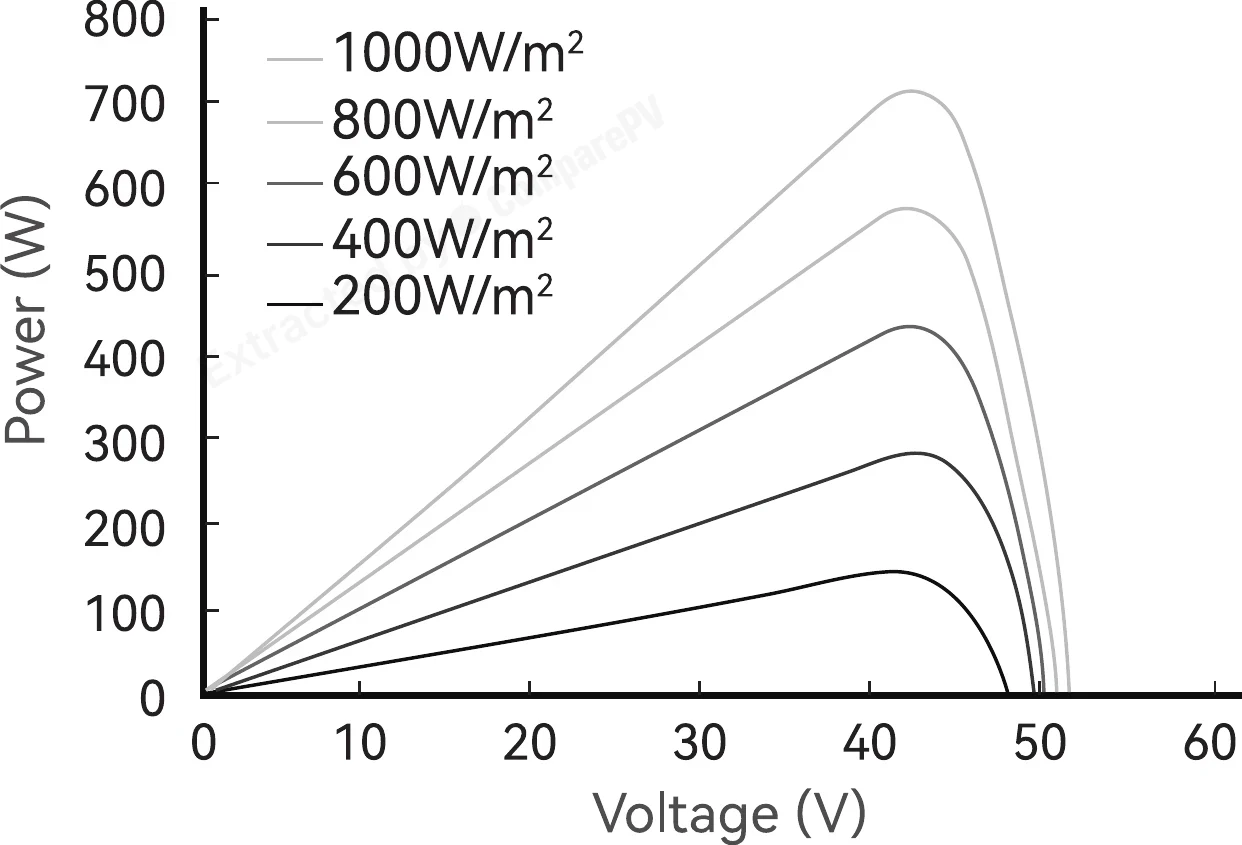
Measured curves published by Tongwei in this model's datasheet. A chart carrying a wattage was measured on that variant alone - only the ones that describe 740 Wp appear here. The rest cover the whole series.

Simulations

Live - change any input
Lifetime output & value
30 years at 1200 kWh/kWp/year and €0.50 per kWh
Power in year 30
-
Lifetime energy
-
Energy value
-
With bifacial gain
-

Degradation from this panel's own datasheet figures. No inverter, soiling or shading losses.

Heat losses
-0.280 %/°C against a segment median of -0.290
-
Bifacial gain
Rear gain over light concrete: -
-

Model: bifaciality × albedo × 0.6 view factor. A first-order estimate, not a yield simulation.

Filter these
Size
Panel Power Eff. Temp. Weight Difference
Tongwei THC G12-66 Bifacial 740 W 23.80% -0.280 37.0 kg You are here
AIKO-A700-MAE78Dw 700 W 25.00% -0.260 34.5 kg -40 W, lighter, +1.2 pp
AIKO-A695-MAE78Dw 695 W 24.90% -0.260 34.5 kg -45 W, lighter, +1.1 pp
AIKO-A690-MAE78Dw 690 W 24.70% -0.260 34.5 kg -50 W, lighter, +0.9 pp
AIKO-A790-GRH78Dw 790 W 24.60% -0.260 39.8 kg +50 W, heavier, +0.8 pp
TSM-NEG21C.20Q-760 760 W 24.50% -0.260 38.3 kg +20 W, cooler, +0.7 pp
AIKO-A785-GRH78Dw 785 W 24.40% -0.260 39.8 kg +45 W, heavier, +0.6 pp
GK-4-78HGBD-780M 780 W 24.30% -0.260 38.7 kg +40 W, cooler, +0.5 pp
AIKO-A780-GRH78Dw 780 W 24.30% -0.260 39.8 kg +40 W, heavier, +0.5 pp
JT755SLk(B) 755 W 24.30% -0.240 36.4 kg +15 W, cooler, +0.5 pp
TSM-NEG21C.20Q-755 755 W 24.30% -0.260 38.3 kg +15 W, cooler, +0.5 pp
TWMPF-66HD655 655 W 21.10% -0.330 37.9 kg -85 W, hotter, -2.7 pp
TWMPF-66HD660 660 W 21.20% -0.330 37.9 kg -80 W, hotter, -2.6 pp
TWMPF-66HD665 665 W 21.40% -0.330 37.9 kg -75 W, hotter, -2.4 pp
TWMPF-66HD670 670 W 21.60% -0.330 37.9 kg -70 W, hotter, -2.2 pp
TWMPF-66HD675 675 W 21.70% -0.330 37.9 kg -65 W, hotter, -2.1 pp
TWMNF-66HD700XX 700 W 22.50% -0.280 37.9 kg -40 W, -1.3 pp
AIKO-A805-GRH78Dw 805 W 25.10% -0.260 39.8 kg +65 W, heavier, +1.3 pp

Found 1390 panels of the same or similar size to this one, within ±10 mm. See them here Found 1400 panels of the same or similar size to this one, within ±25 mm. See them here Found 1400 panels of the same or similar size to this one, within ±50 mm. See them here Found 1432 panels of the same or similar size to this one, within ±100 mm. See them here

Common questions

6 answered
What is the difference between Tongwei's TNC and THC panel series?
The TNC series uses N-type TOPCon cells, delivering high efficiency and minimal annual degradation, ideal for projects focused on stable, long-term energy yield. The THC series is based on heterojunction (HJT) technology, offering a better temperature coefficient so modules lose less power during hot weather. The choice depends on installation climate and investment priorities.
What is the maximum power output of Tongwei TNC and THC panels?
The most powerful variants in both series reach up to 740 Wp, placing them among the top-tier bifacial N-type modules currently available. Higher wattage per panel reduces the number of modules needed to reach a target system size, lowering mounting structure and installation labor costs.
Are Tongwei TNC/THC panels bifacial, and is it worth it?
Yes, both series feature bifacial construction, allowing panels to generate additional energy from light reflected off the ground or roof surface. This typically boosts overall energy yield, especially with bright surfaces or elevated ground-mount installations. The bifacial gain is less pronounced on standard dark-roof residential installations.
What warranty comes with Tongwei TNC and THC series panels?
The manufacturer offers a 15-year product warranty and a 30-year linear power warranty, among the longest currently available in the PV market. This warranty structure gives investors confidence in long-term durability and predictable energy output over the entire lifespan of the installation.
Is Tongwei a reliable, established solar panel manufacturer?
Tongwei is a Tier 1 manufacturer headquartered in China with full vertical integration, from polysilicon production through to finished modules. This supply chain control ensures consistent, high-quality silicon and stable production output, which matters for larger commercial and industrial-scale projects.
Do Tongwei TOPCon panels perform well in hot summer conditions?
Yes, the TOPCon and HJT cells used in the TNC and THC series have a favorable temperature coefficient, limiting power loss at high module operating temperatures compared to older technologies like PERC. This matters especially in summer, when rooftop panel temperatures can significantly exceed ambient air temperature.
Add to compare