Middle of its segment, weak in heat
The Aurora Pro series redefines energy efficiency standards through the use of advanced N-type TOPCon silicon cells, which almost completely eliminate the negative phenomena of initial degradation. Thanks to the implementation of innovative SMBB (Super Multi Busbar) technology, these modules are characterized by a shortened electron flow path and lower resistive losses, which significantly increases the overall efficiency of the installation. This solution is primarily dedicated to owners of buildings with complex roof architecture, where maximizing yields from a small mounting area is key. Aurora Pro panels solve the common problem of performance drops on heavily cloudy days, offering excellent low-light characteristics, which in the Polish climate zone guarantees real gains outside the summer peak. They are distinguished from the competition by an exceptionally low temperature coefficient, ensuring that the system operates stably even during extreme heat waves. The robust frame construction and tempered glass provide above-average load resistance to snow and wind, making this series a safe choice for years to come. Aurora Pro is a synonym for reliability for prosumers and businesses that expect state-of-the-art technologies supporting a fast return on investment and minimal operating costs of the entire photovoltaic system.
Ranking
Signals from the data
Residential, commercial, utility-scale and hot-climate.
Hot climates.
Bottom 8% of the TOPCon 700-750 W segment, against a median of -0.290. Ranked 8,005th in the whole database.
- At 23.2% efficiency, this panel is on par with typical TOPCon 700-750W modules
- At 231.8 W/m² power density, roof space requirements are typical for TOPCon 700-750W panels
- Temperature coefficient of -0.31%/°C is 0.02pp worse than TOPCon 700-750W median (-0.29%/°C) - higher losses in summer heat
- Ranked #1424 out of 14005 panels for efficiency in the database
Specifications
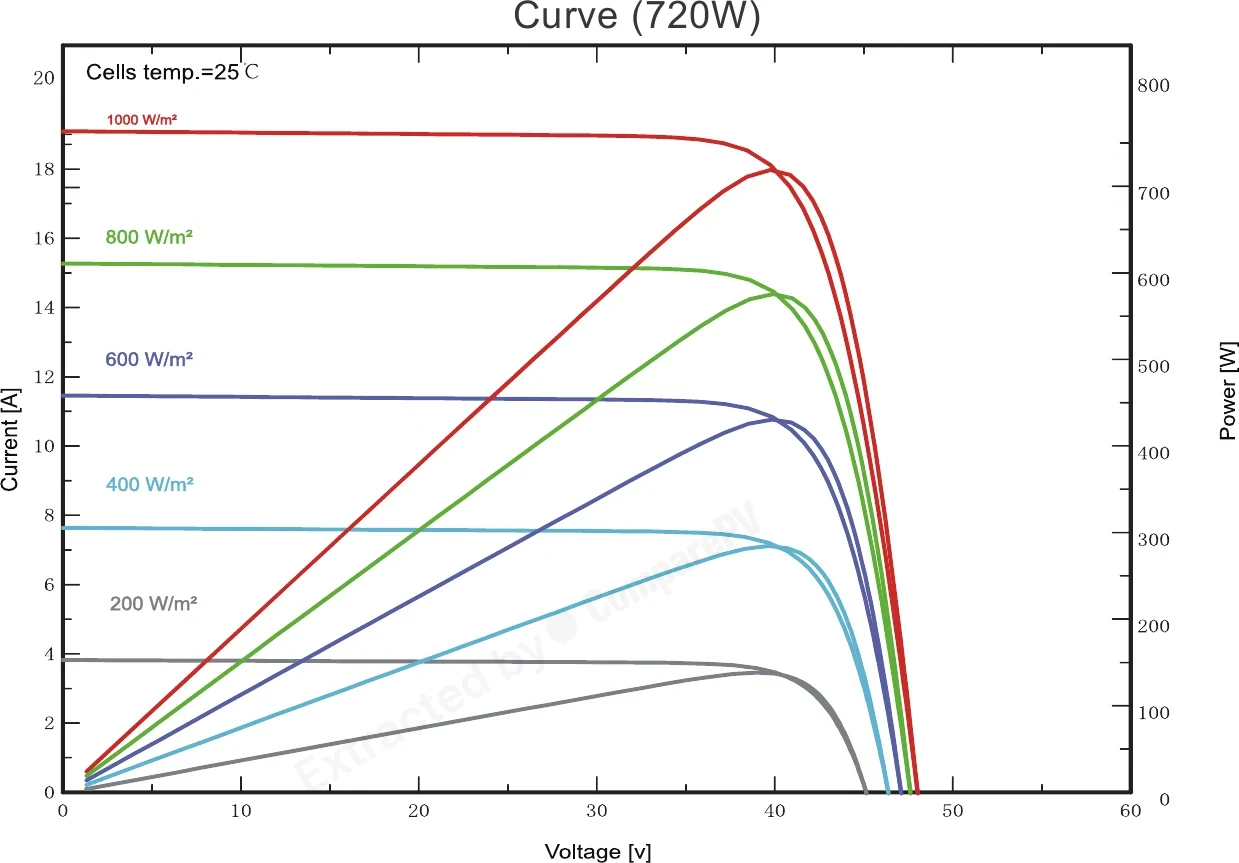
Datasheet charts
Measured curves published by Runda Solar in this model's datasheet. A chart carrying a wattage was measured on that variant alone - only the ones that describe 720 Wp appear here. The rest cover the whole series.
Simulations
Degradation from this panel's own datasheet figures. No inverter, soiling or shading losses.
Model: bifaciality × albedo × 0.6 view factor. A first-order estimate, not a yield simulation.
Alternatives




Found 1390 panels of the same or similar size to this one, within ±10 mm. See them here Found 1400 panels of the same or similar size to this one, within ±25 mm. See them here Found 1400 panels of the same or similar size to this one, within ±50 mm. See them here Found 1432 panels of the same or similar size to this one, within ±100 mm. See them here