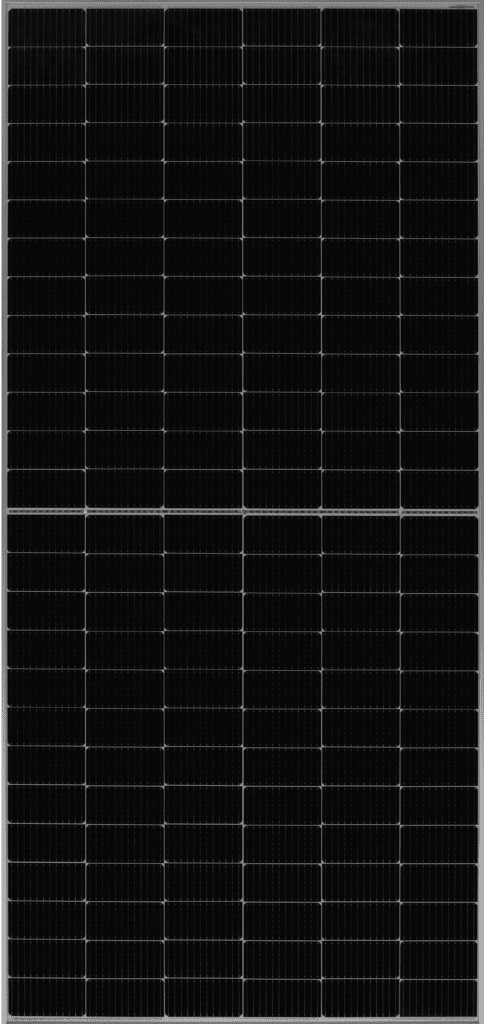
Q-Cells Q.PEAK DUO XL-G11S.3 / BFG 600

Q.PEAK DUO XL-G11S.3 / BFG 600

600 Wp PERC Bifacial 70%
ComparePV verdict

Middle of its segment, heavy for its output

Rank 4,980 of 14,005
Compare panels Datasheet PDF
Power (Wp)
600
Weak · bottom 16%
Efficiency (%)
21.50
Typical · median 21.38%
Density (Wp/m²)
214.9
Typical · median 213.8
Temp (%/°C)
-0.340
Typical · median -0.340
Weight (kg)
34.9
Weak · bottom 25%
Warranty (yrs)
30
Typical · median 30 yrs

The Q-Cells Q.PEAK DUO XL-G11S series are bifacial modules in a double glass configuration, designed for commercial installations and PV farms where maximizing energy yield from the same surface area and predictable long-term production are key. Thanks to the double-sided construction, the panel can also utilize reflected light from the ground, effectively boosting energy production in ground-mounted systems and trackers, thereby reducing the cost of producing 1 kWh.

Against the backdrop of numerous competitive modules, it stands out with the Q.ANTUM DUO technology featuring a modern cell connection method and half-cell format, which minimizes losses and improves performance under partial shading. In practice, this addresses typical issues in large installations - uneven irradiance, operation under poorer light conditions, and yield drops at high temperatures.

Another advantage is the weather-resistant structure and load-bearing capacity, as well as the long warranty package, which is important for investors, developers, and companies expecting stable project parameters for years to come.

Ranking

217 panels in the segment PERC 600-650 W
Metric This panel Median Position in segment Overall rank
Module efficiency 21.50% 21.38% Typical 7,958
Power density 214.9 213.8 Typical 8,031
Temperature coefficient -0.340 -0.340 Typical 8,778
Weight per kWp 58.2 55.7 Weak · bottom 25% 11,592
Performance warranty 30 yrs 30 yrs Typical 21
Colour key Strong - top 25% Typical - middle 50% Weak - bottom 25%

Signals from the data

5 positive · 4 caution
Best for

Commercial, utility-scale and shaded-installations.

Not ideal for

Weight-limited structures.

Watch-outs
58.2 kg per kWp

Bottom 25% of the PERC 600-650 W segment, against a median of 55.7.

What owners get
Double-glass bifacial construction

The glass-glass design combined with Q.ANTUM DUO technology captures light reflected off the ground, delivering up to 20% additional rear-side energy yield compared to conventional monofacial modules - especially relevant for ground-mount and tracker installations.

Tier-1 bankable manufacturer

Q-Cells is a South Korean manufacturer (Hanwha Group, founded 1999) with BNEF Tier-1 status, which directly matters for financing commercial and utility-scale projects, as banks and investors more readily accept the brand as loan collateral.

30-year power warranty at 84.95%

The manufacturer guarantees 93.95% power output after 10 years and 84.95% after 30 years, providing a predictable, near-linear degradation profile that is critical for investors planning a three-decade project payback.

Low -0.34%/°C temperature coefficient

The half-cut format in Q.ANTUM DUO technology reduces partial-shading losses, and a Pmax temperature coefficient of -0.34%/°C means smaller output drops in hot conditions than many conventional PERC modules in the same segment.

Assembled in the USA

Modules are assembled in the United States, which for US-based projects eases compliance with domestic content requirements and can reduce tariff exposure compared to modules imported from Asia.

Trade-offs
Production discontinued in 2025

The Q.PEAK DUO XL-G11S series has been discontinued (released 2022, end-of-production 2025), meaning limited availability of warranty service and spare parts, and added difficulty completing large, multi-year installations with a single module type.

PERC efficiency trails newer N-type models

The maximum efficiency of 21.7% is notably lower than the competing GCL SIROT Efficient NT10/72GDF (23.42% at the same 605 Wp power class, N-type technology), meaning lower yield per square meter of roof or ground area.

Module weight increases BoS costs

The double-glass construction weighs about 34.9 kg at 2462x1134 mm dimensions, notably heavier than lighter framed monoglass panels - this can raise racking and logistics costs on large-scale PV farms.

Notes from the database
  • Efficiency of 21.5% matches the PERC 600-650W median
  • At 214.9 W/m² power density, roof space requirements are typical for PERC 600-650W panels
  • Temperature coefficient of -0.34%/°C matches the PERC 600-650W median
  • 70% bifaciality enables rear-side power generation, boosting yield by 4-10% on reflective surfaces
  • Ranked #7958 out of 14005 panels for efficiency in the database

Specifications

Open datasheet PDF
Nominal power (Pmax) 600 Wp Nameplate at 1000 W/m², 25 °C
Module efficiency 21.50 % Typical Segment median 21.38%
Vmpp · Impp 45.30 V · 13.25 A Operating point at max power
Voc · Isc 53.66 V · 13.80 A Sizes the string length
Max system voltage 1500 V Longer strings than 1000 V modules
Dimensions 2462×1134×35 mm · 2.79 m² of roof
Weight 34.9 kg Weak Weak · bottom 25%
Cells 156 · PERC Monocrystalline
Bifaciality 70 % Rear output as a share of front
Coefficient Pmax -0.340 %/°C Typical median -0.340 of its segment
Coefficient Voc · Isc -0.270 · 0.040 %/°C
NOCT 42 °C At 800 W/m², 20 °C ambient
Product warranty 12 years Hardware defects only
Performance warranty 30 years Typical median 30 yrs · median 30 yrs
End-of-warranty output 85.0 % Equals 510 W guaranteed
Degradation 2.00 → 0.45 % First year, then annual

Simulations

Live - change any input
Lifetime output & value
30 years at 1200 kWh/kWp/year and €0.50 per kWh
Power in year 30
-
Lifetime energy
-
Energy value
-
With bifacial gain
-

Degradation from this panel's own datasheet figures. No inverter, soiling or shading losses.

Heat losses
-0.340 %/°C against a segment median of -0.340
-
Bifacial gain
Rear gain over light concrete: -
-

Model: bifaciality × albedo × 0.6 view factor. A first-order estimate, not a yield simulation.

Filter these
Size
Panel Power Eff. Temp. Weight Difference
Q-Cells Q.PEAK DUO XL-G11S.3 / BFG 600 600 W 21.50% -0.340 34.9 kg You are here
AIKO-A650-MAE72Mw 650 W 25.20% -0.260 27.0 kg Cooler, lighter, +3.7 pp
AIKO-A645-MAE72Mw 645 W 25.00% -0.260 27.0 kg Cooler, lighter, +3.5 pp
LR7-60HVH-560M 560 W 24.80% -0.260 25.0 kg Cooler, lighter, +3.3 pp
AIKO-A640-MAE72Mw 640 W 24.80% -0.260 27.0 kg Cooler, lighter, +3.3 pp
LR7-60HVH-555M 555 W 24.60% -0.260 25.0 kg Cooler, lighter, +3.1 pp
AIKO-A635-MAE72Mw 635 W 24.60% -0.260 27.0 kg Cooler, lighter, +3.1 pp
Q.PEAK DUO XL-G11S.3 / BFG 580 580 W 20.80% -0.340 34.9 kg -20 W, -0.7 pp
Q.PEAK DUO RSF XL-G11S.3 / BFG 585 585 W 21.00% -0.340 36.4 kg -15 W, heavier, -0.5 pp
Q.PEAK DUO RSF XL-G11S.3 / BFG 590 590 W 21.10% -0.340 36.4 kg -10 W, heavier, -0.4 pp
Q.PEAK DUO RSF XL-G11S.3 / BFG 595 595 W 21.30% -0.340 36.4 kg Heavier
Q.PEAK DUO XL-G11S.3 / BFG 605 605 W 21.70% -0.340 34.9 kg Very close match
AIKO-A680-MDE72Mw 680 W 25.20% -0.260 29.0 kg +80 W, cooler, +3.7 pp
AIKO-A675-MDE72Mw 675 W 25.00% -0.260 29.0 kg +75 W, cooler, +3.5 pp
AIKO-A700-MAE78Dw 700 W 25.00% -0.260 34.5 kg +100 W, cooler, +3.5 pp
AIKO-A695-MAE78Dw 695 W 24.90% -0.260 34.5 kg +95 W, cooler, +3.4 pp
AIKO-G670-MCH72Mw 670 W 24.80% -0.260 28.2 kg +70 W, cooler, +3.3 pp

Found 616 panels of the same or similar size to this one, within ±10 mm. See them here Found 616 panels of the same or similar size to this one, within ±25 mm. See them here Found 616 panels of the same or similar size to this one, within ±50 mm. See them here Found 1813 panels of the same or similar size to this one, within ±100 mm. See them here

Common questions

6 answered
Is the Q.PEAK DUO XL-G11S series still available for purchase?
The Q.PEAK DUO XL-G11S series has been discontinued — Q-Cells has replaced it with newer module generations. Availability at distributors may be limited to remaining stock. If you need Q-Cells panels with similar specs for a commercial project, ask your distributor about current equivalents from the Q.PEAK DUO or Q.TRON lineup.
What warranty does the Q.PEAK DUO XL-G11S series carry?
The Q.PEAK DUO XL-G11S series comes with a 12-year product warranty and a 30-year linear power warranty — after 30 years, the panel is guaranteed to retain at least 84.95% of its nominal power output. This is one of the longer warranty packages in the bifacial commercial module segment, an important factor for project financing and long-term yield forecasting.
What does Q.ANTUM DUO technology bring to the Q.PEAK DUO XL-G11S series?
Q.ANTUM DUO combines PERC cells in a half-cut format (156 cells) with an optimized multi-busbar layout. The half-cut design reduces resistive losses and improves shading tolerance, while PERC increases light absorption. The result is module efficiency up to 21.7% and better energy yield under low-irradiance and diffuse-light conditions.
Is the Q.PEAK DUO XL-G11S suitable for ground-mounted systems with single-axis trackers?
Yes, the XL-G11S series is purpose-built for utility-scale and commercial PV plants. The bifacial double-glass construction captures energy from both module sides — on a single-axis tracker or over a reflective ground surface, rear-side gain can add several percentage points of additional yield. The aluminum frame is rated for 5,400 Pa snow load and 3,750 Pa wind load.
How does high ambient temperature affect Q.PEAK DUO XL-G11S output?
The temperature coefficient for Pmax is -0.34%/°C. At a realistic summer module temperature of 65°C, power loss relative to STC conditions is approximately 8.5%. This is a moderate result for PERC-class cells — the double-glass rear side also aids heat dissipation compared with conventional back-sheet modules.
How heavy is the Q.PEAK DUO XL-G11S and does it work on an industrial rooftop?
The module weighs 34.9 kg with dimensions of 2,462×1,134×35 mm, delivering up to 605 Wp. This XL large-format panel is designed primarily for industrial rooftops and utility-scale PV plants where mechanical handling equipment is available. For rooftop use, the mounting structure must be engineered to support the additional weight of the double-glass construction.
Add to compare