Efficiency leader, no clear weak spot
The Jshine Solar Technology JS 380-400W 120M6 HJT DG series consists of modules based on the HJT technology, designed for high energy production even under less-than-ideal conditions. The use of a bifacial design allows for the utilization of not only direct sunlight, but also reflected light from the ground - which makes it possible to achieve higher energy yields on bright roofs, ground-mounted structures, or with appropriately chosen gravel. A key advantage of this series is its low temperature sensitivity, which ensures stable operation in hot weather, while many standard modules experience a more significant loss of power.
The double glass (DG) construction provides durability in demanding environments - where resistance to moisture and long-term laminate stability are crucial. This is a reasonable choice for residential and commercial installations, as well as PV farms, where predictable production and robust, modern technology are prioritized over compromises.
Ranking
Signals from the data
Residential, commercial and hot-climate.
Top 18% of the HJT 350-400 W segment, against a median of 20.90%.
Top 18% of the HJT 350-400 W segment, against a median of 209.3.
Top 21% of the HJT 350-400 W segment, against a median of -0.259.
HJT technology delivers a temperature coefficient of approximately -0.24%/°C, outperforming PERC (-0.35%/°C) and TOPCon (-0.30%/°C). In real-world conditions where module temperature exceeds 60°C in summer, HJT generates 5–7% more energy than an equivalent PERC panel at the same irradiance.
The highest-efficiency variant reaches 21.96% module efficiency, exceeding Meyer Burger White (21.7%), MWG Mono (19.32%), and significantly outpacing DMEGC GH400M10T-B48HST (15.48%). Within the listed peer comparables, this series ranks first by peak efficiency.
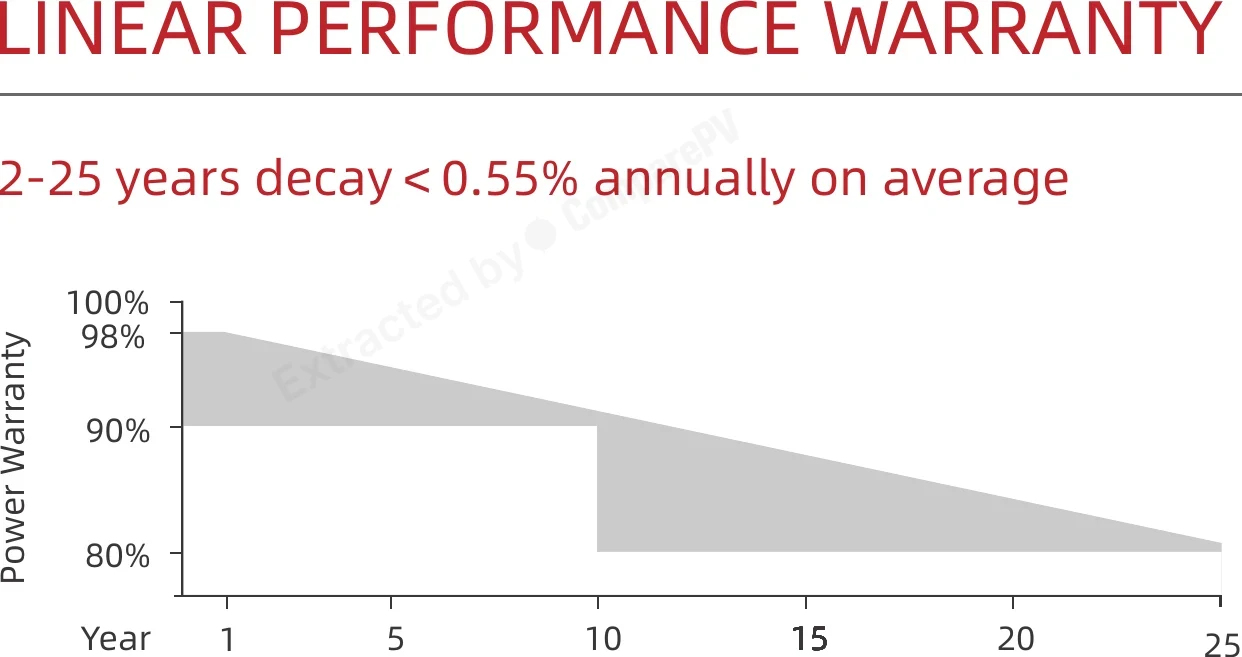
HJT cells built on N-type silicon are inherently immune to Light-Induced Degradation (LID). Typical annual degradation is ~0.25%, compared to 0.40–0.55% for PERC technology. Over a 30-year warranty period, this translates to roughly 5–9 percentage points more retained nameplate power versus PERC modules of the same nominal wattage.
A bifaciality factor of up to 95% enables 10–30% additional energy yield on high-albedo surfaces (concrete, light gravel, snow). The glass-glass construction eliminates moisture ingress and EVA delamination associated with backsheet designs — a critical advantage for ground-mounted systems and agrivoltaic applications in humid climates.
The manufacturer provides a 30-year warranty on both the product and power output — matching Meyer Burger White among the listed peers. This exceeds the 25-year power warranty standard common across mainstream Tier-1 manufacturers including MWG Mono.
Jshine Solar Technology does not appear on BloombergNEF's Tier 1 module manufacturer lists (verified across Q1 2025 – Q1 2026 publications). While Tier 1 status does not assess technical quality, it is a prerequisite for bankability in commercially financed utility-scale and C&I projects. Its absence may restrict access to project financing from international lenders.
As of 2025, HJT modules carry a 15–30% price premium over PERC and approximately 30–50% over TOPCon at equivalent nameplate wattage. For residential prosumer installations, particularly on dark rooftops where bifacial rear-side gain is negligible, the improved LCOE from higher efficiency may not fully offset the higher upfront BoS cost.
Replacing the backsheet with a rear glass pane adds an estimated 4–6 kg per module (typical glass-glass 380–400 W units weigh ~26–28 kg vs. ~20–22 kg for backsheet variants). Rooftop installations require load-bearing verification, and additional weight increases BoS costs for racking, transport, and handling.
- At 21.4% efficiency, this panel is 0.8pp above typical HJT 0-400W modules (median: 20.6%)
- Power density of 214.1 W/m² packs 7.7 W/m² more into the same footprint vs HJT 0-400W median (206.4 W/m²)
- Temperature coefficient of -0.24%/°C matches the HJT 0-400W median
- At 22.8 kg, this panel is 1.3 kg heavier than the HJT 0-400W median (21.5 kg) - more demanding for installation crews
- Bifacial design (85% factor) captures reflected light - adds 4-13% yield on ground-mount or white roof
Specifications
Datasheet charts
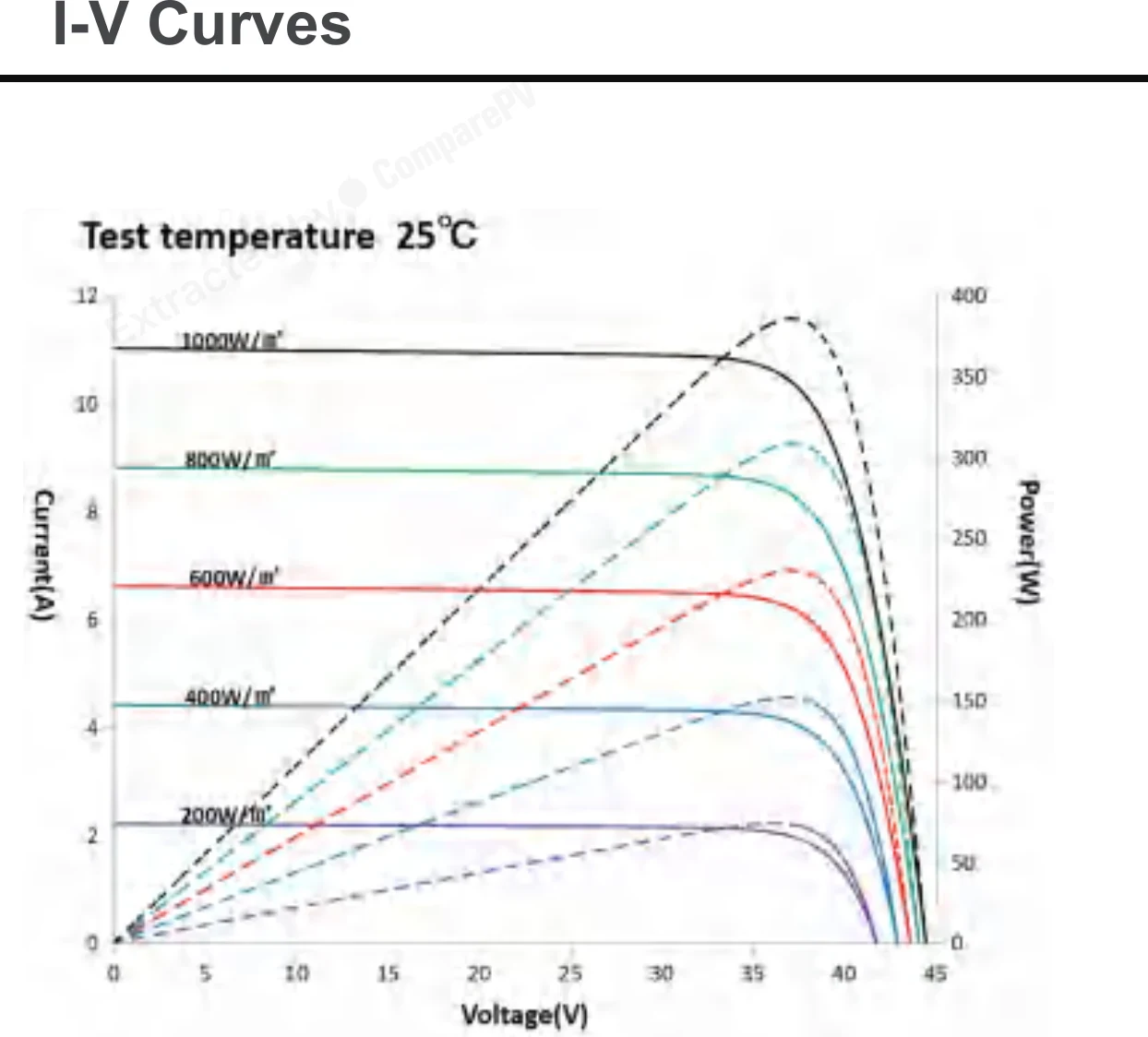
Measured curves published by Jshine Solar Technology in this model's datasheet. A chart carrying a wattage was measured on that variant alone - only the ones that describe 390 Wp appear here. The rest cover the whole series.
Simulations
Degradation from this panel's own datasheet figures. No inverter, soiling or shading losses.
Model: bifaciality × albedo × 0.6 view factor. A first-order estimate, not a yield simulation.
Alternatives






Found 210 panels of the same or similar size to this one, within ±10 mm. See them here Found 271 panels of the same or similar size to this one, within ±25 mm. See them here Found 332 panels of the same or similar size to this one, within ±50 mm. See them here Found 4151 panels of the same or similar size to this one, within ±100 mm. See them here