JS 380~400W 120M6 HJT DG (400W class)

400 Wp HJT Bifacial 85%
ComparePV verdict

Middle of its segment, heavy for its output

Rank 7,683 of 14,005
Compare panels Datasheet PDF
Power (Wp)
400
Weak · bottom 4%
Efficiency (%)
21.96
Typical · median 22.20%
Density (Wp/m²)
219.6
Typical · median 221.6
Temp (%/°C)
-0.240
Typical · median -0.240
Weight (kg)
22.8
Weak · bottom 15%
Warranty (yrs)
30
Typical · median 30 yrs

The Jshine Solar Technology JS 380-400W 120M6 HJT DG series consists of modules based on the HJT technology, designed for high energy production even under less-than-ideal conditions. The use of a bifacial design allows for the utilization of not only direct sunlight, but also reflected light from the ground - which makes it possible to achieve higher energy yields on bright roofs, ground-mounted structures, or with appropriately chosen gravel. A key advantage of this series is its low temperature sensitivity, which ensures stable operation in hot weather, while many standard modules experience a more significant loss of power.

The double glass (DG) construction provides durability in demanding environments - where resistance to moisture and long-term laminate stability are crucial. This is a reasonable choice for residential and commercial installations, as well as PV farms, where predictable production and robust, modern technology are prioritized over compromises.

Ranking

113 panels in the segment HJT 400-450 W
Metric This panel Median Position in segment Overall rank
Module efficiency 21.96% 22.20% Typical 6,741
Power density 219.6 221.6 Typical 6,698
Temperature coefficient -0.240 -0.240 Typical 13
Weight per kWp 57.0 52.4 Weak · bottom 15% 10,998
Performance warranty 30 yrs 30 yrs Typical 21
Colour key Strong - top 25% Typical - middle 50% Weak - bottom 25%

Signals from the data

5 positive · 4 caution
Best for

Residential, commercial and hot-climate.

Not ideal for

Weight-limited structures.

Watch-outs
57.0 kg per kWp

Bottom 15% of the HJT 400-450 W segment, against a median of 52.4.

What owners get
Best-in-class temperature coefficient

HJT technology delivers a temperature coefficient of approximately -0.24%/°C, outperforming PERC (-0.35%/°C) and TOPCon (-0.30%/°C). In real-world conditions where module temperature exceeds 60°C in summer, HJT generates 5–7% more energy than an equivalent PERC panel at the same irradiance.

Up to 21.96% efficiency — top of peer group

The highest-efficiency variant reaches 21.96% module efficiency, exceeding Meyer Burger White (21.7%), MWG Mono (19.32%), and significantly outpacing DMEGC GH400M10T-B48HST (15.48%). Within the listed peer comparables, this series ranks first by peak efficiency.

Low degradation — LID-free N-type cells

HJT cells built on N-type silicon are inherently immune to Light-Induced Degradation (LID). Typical annual degradation is ~0.25%, compared to 0.40–0.55% for PERC technology. Over a 30-year warranty period, this translates to roughly 5–9 percentage points more retained nameplate power versus PERC modules of the same nominal wattage.

Bifacial + double glass: higher yield and durability

A bifaciality factor of up to 95% enables 10–30% additional energy yield on high-albedo surfaces (concrete, light gravel, snow). The glass-glass construction eliminates moisture ingress and EVA delamination associated with backsheet designs — a critical advantage for ground-mounted systems and agrivoltaic applications in humid climates.

30-year product and power warranty

The manufacturer provides a 30-year warranty on both the product and power output — matching Meyer Burger White among the listed peers. This exceeds the 25-year power warranty standard common across mainstream Tier-1 manufacturers including MWG Mono.

Trade-offs
Not on BNEF Tier 1 list

Jshine Solar Technology does not appear on BloombergNEF's Tier 1 module manufacturer lists (verified across Q1 2025 – Q1 2026 publications). While Tier 1 status does not assess technical quality, it is a prerequisite for bankability in commercially financed utility-scale and C&I projects. Its absence may restrict access to project financing from international lenders.

HJT price premium over TOPCon and PERC

As of 2025, HJT modules carry a 15–30% price premium over PERC and approximately 30–50% over TOPCon at equivalent nameplate wattage. For residential prosumer installations, particularly on dark rooftops where bifacial rear-side gain is negligible, the improved LCOE from higher efficiency may not fully offset the higher upfront BoS cost.

Increased weight from double glass construction

Replacing the backsheet with a rear glass pane adds an estimated 4–6 kg per module (typical glass-glass 380–400 W units weigh ~26–28 kg vs. ~20–22 kg for backsheet variants). Rooftop installations require load-bearing verification, and additional weight increases BoS costs for racking, transport, and handling.

Notes from the database
  • Efficiency of 22.0% matches the HJT 400-450W median
  • At 219.6 W/m² power density, roof space requirements are typical for HJT 400-450W panels
  • At -0.24%/°C, hot weather performance is typical for HJT 400-450W panels
  • Bifaciality factor of 85% can add 4-13% extra yield with reflective mounting surface
  • Ranked #6741 out of 14005 panels for efficiency in the database

Specifications

Open datasheet PDF
Nominal power (Pmax) 400 Wp Nameplate at 1000 W/m², 25 °C
Module efficiency 21.96 % Typical Segment median 22.20%
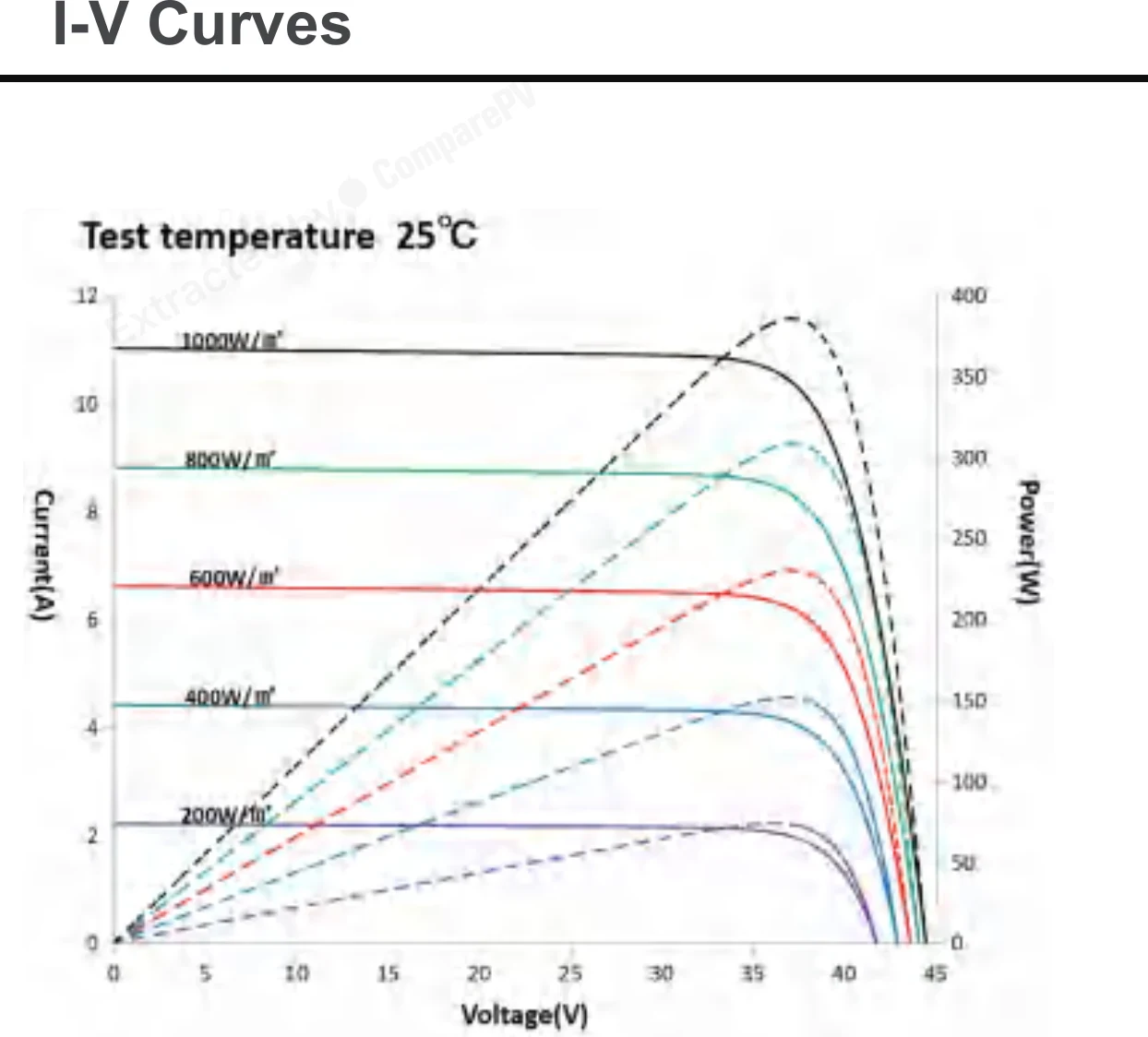
Vmpp · Impp 38.43 V · 10.41 A Operating point at max power
Voc · Isc 45.45 V · 11.13 A Sizes the string length
Max system voltage 1500 V Longer strings than 1000 V modules
Dimensions 1755×1038×30 mm · 1.82 m² of roof
Weight 22.8 kg Weak Weak · bottom 15%
Cells 120 · HJT Monocrystalline
Bifaciality 85 % Rear output as a share of front
Coefficient Pmax -0.240 %/°C Typical median -0.240 of its segment
Coefficient Voc · Isc -0.220 · 0.047 %/°C
NOCT 45 °C At 800 W/m², 20 °C ambient
Product warranty 30 years Hardware defects only
Performance warranty 30 years Typical median 30 yrs · median 30 yrs
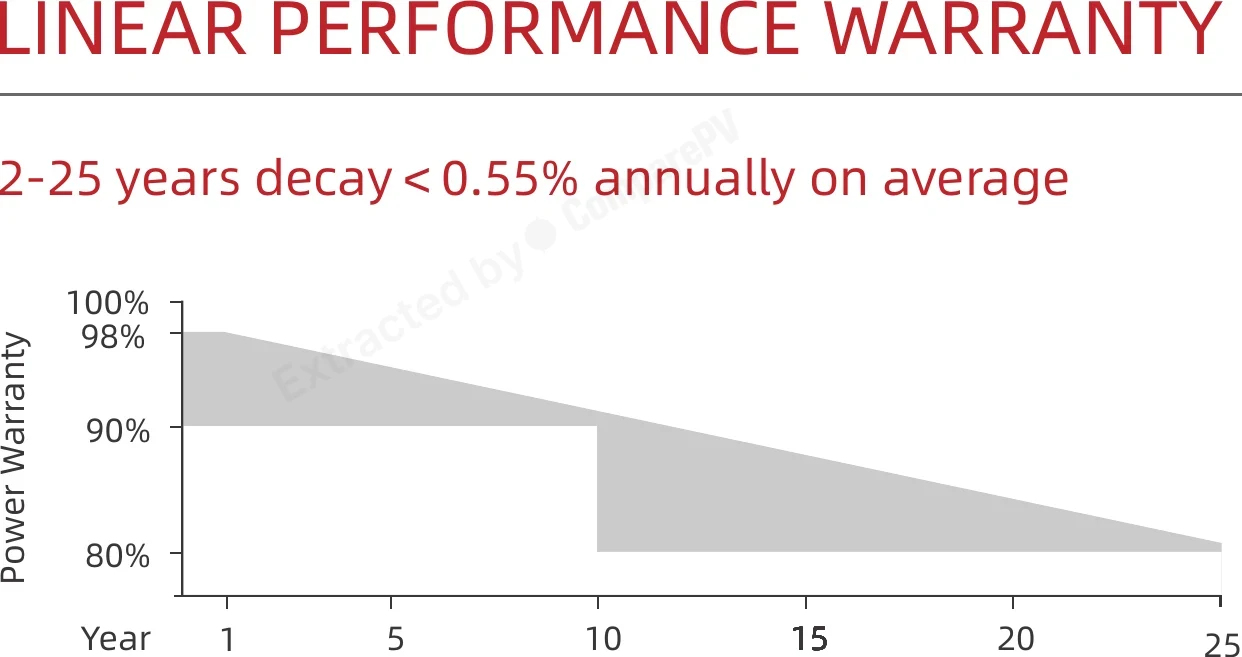
Degradation 2.00 → 0.55 % First year, then annual

Datasheet charts

Open datasheet PDF

Measured curves published by Jshine Solar Technology in this model's datasheet. A chart carrying a wattage was measured on that variant alone - only the ones that describe 400 Wp appear here. The rest cover the whole series.
Simulations

Live - change any input
Lifetime output & value
30 years at 1200 kWh/kWp/year and €0.50 per kWh
Power in year 30
-
Lifetime energy
-
Energy value
-
With bifacial gain
-

Degradation from this panel's own datasheet figures. No inverter, soiling or shading losses.

Heat losses
-0.240 %/°C against a segment median of -0.240
-
Bifacial gain
Rear gain over light concrete: -
-

Model: bifaciality × albedo × 0.6 view factor. A first-order estimate, not a yield simulation.

Filter these
Size
Panel Power Eff. Temp. Weight Difference
Jshine Solar Technology JS 380~400W 120M6 HJT DG (400W class) 400 W 21.96% -0.240 22.8 kg You are here
LX-440M/182-108+GG 440 W 23.07% -0.240 23.6 kg +40 W, +1.1 pp
JST-EDMH-(445-465)W-TD (450W class) 450 W 23.05% -0.300 20.5 kg +50 W, hotter, +1.1 pp
QNN182-HG450-54 450 W 23.04% -0.290 24.0 kg +50 W, hotter, +1.1 pp
HY440-N108BDD 450 W 23.04% -0.300 23.5 kg +50 W, hotter, +1.1 pp
NLBK-27-450 450 W 23.04% -0.300 22.9 kg +50 W, hotter, +1.1 pp
RS41-450NBG-E3 450 W 23.04% -0.290 24.5 kg +50 W, hotter, +1.1 pp
JS 380~400W 120M6 HJT DG (380W class) 380 W 20.86% -0.240 22.8 kg -20 W, -1.1 pp
JS 380~400W 120M6 HJT DG (385W class) 385 W 21.14% -0.240 22.8 kg -15 W, -0.8 pp
JS 380~400W 120M6 HJT DG (390W class) 390 W 21.41% -0.240 22.8 kg -10 W, -0.6 pp
JS 380~400W 120M6 HJT DG (395W class) 395 W 21.68% -0.240 22.8 kg -0.3 pp
LR7-54HJD-510M 510 W 25.00% -0.240 23.5 kg +110 W, +3.0 pp
AIKO-A495-MCE54Mw 495 W 24.80% -0.260 21.0 kg +95 W, hotter, +2.8 pp
LR7-54HJD-505M 505 W 24.70% -0.240 23.5 kg +105 W, +2.7 pp
AIKO-A490-MCE54Mw 490 W 24.50% -0.260 21.0 kg +90 W, hotter, +2.5 pp
LR7-54HJD-500M 500 W 24.50% -0.240 23.5 kg +100 W, +2.5 pp
CIPRO-TN9C54M-500W 500 W 24.50% -0.260 21.4 kg +100 W, hotter, +2.5 pp

Found 210 panels of the same or similar size to this one, within ±10 mm. See them here Found 271 panels of the same or similar size to this one, within ±25 mm. See them here Found 332 panels of the same or similar size to this one, within ±50 mm. See them here Found 4151 panels of the same or similar size to this one, within ±100 mm. See them here

Common questions

6 answered
What warranty does the Jshine Solar JS 380-400W HJT DG series offer?
The JS 380-400W HJT DG series comes with a 30-year product warranty and a 30-year power output warranty — among the longest coverage periods available in the residential and commercial PV market. The extended warranty is backed by the inherent durability of HJT cell technology and the double glass construction, both of which result in very low annual degradation rates.
Does the bifacial design of the Jshine HJT 400W DG make sense for ground-mounted systems with gravel?
Yes — the bifacial design captures reflected irradiance from the ground in addition to direct sunlight. On ground-mounted systems with high-albedo surfaces such as white gravel, a light membrane, or concrete, real-world energy yield can noticeably exceed the rated 400 Wp. The bifacial gain is maximized when the frame is elevated and the ground cover has an albedo above 0.3.
How does summer heat affect the output of Jshine JS HJT DG panels?
The series carries a temperature coefficient of Pmax of approximately -0.24%/°C — one of the lowest in the industry. Standard PERC modules typically reach -0.38%/°C. On a hot day when the module surface hits 60°C, this HJT series retains significantly more power than conventional monocrystalline panels, which translates to measurably higher annual energy yield in real-world conditions.
What does the DG designation mean in the Jshine JS 380-400W series and why does it matter for longevity?
DG stands for double glass — both the front and rear surfaces use tempered glass instead of a standard polymer backsheet. This construction provides superior resistance to moisture ingress, delamination, and long-term UV degradation, making it well-suited for demanding environments including coastal areas and flat commercial rooftops. The glass rear layer is also structurally required for proper bifacial light capture.
Are Jshine JS HJT 400W DG panels compatible with standard pitched roof mounting systems?
Yes — with dimensions of approximately 1755 × 1038 mm and a weight of around 22.8 kg, the panels fit standard rail-based roof mounting systems used across most residential and commercial installations. Note that the bifacial advantage is minimal on pitched roofs since the rear side faces the roof deck. Full bifacial gains are best realized on elevated ground-mounted frames with a reflective surface underneath.
How does HJT technology in the Jshine series compare to TOPCon and PERC?
HJT (heterojunction technology) bonds monocrystalline silicon with amorphous silicon layers, delivering a very low temperature coefficient and an inherently high bifacial factor of up to 95%. TOPCon uses tunnel oxide passivation on n-type silicon for competitive efficiency at a lower manufacturing cost. PERC is an older p-type architecture with higher temperature sensitivity. Of the three, HJT leads in thermal performance and bifaciality; TOPCon offers the best cost-to-efficiency ratio; PERC is the most established and affordable baseline technology.
Add to compare