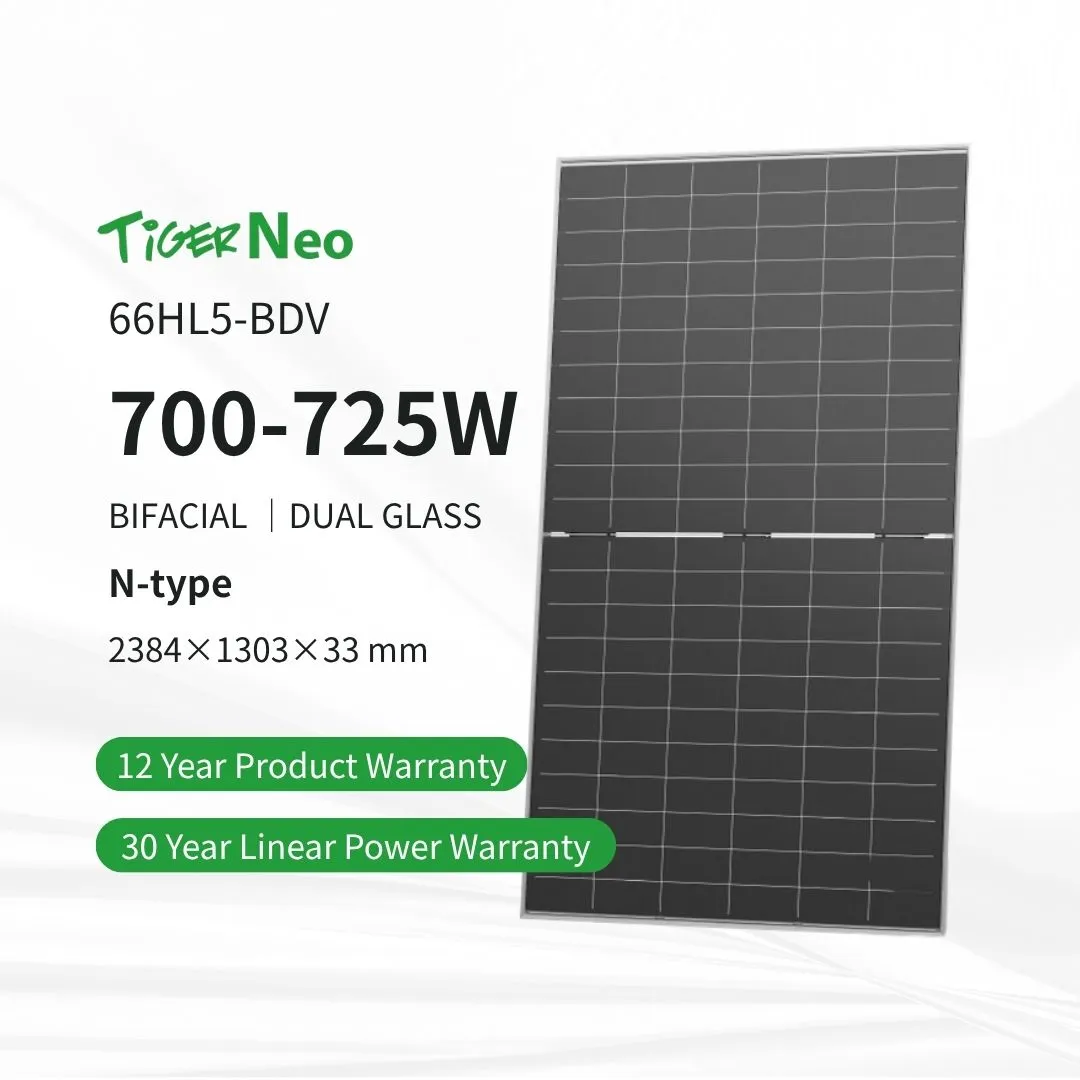
Jinko Solar JKM710-735N-66HL5-BDV-Z3-EU (710W bin)

JKM710-735N-66HL5-BDV-Z3-EU (710W bin)

710 Wp TOPCon Bifacial 80%
ComparePV verdict

Solid all-round for its segment

Rank 849 of 14,005
Compare panels Datasheet PDF
Power (Wp)
710
Typical for its class
Efficiency (%)
22.86
Typical · median 23.00%
Density (Wp/m²)
228.6
Typical · median 230.2
Temp (%/°C)
-0.290
Typical · median -0.290
Weight (kg)
37.5
Typical · median 38.0 kg
Warranty (yrs)
30
Typical · median 30 yrs

The Jinko Solar Tiger Neo 66HL5-BDV series was designed for installations where maximum yield from the same surface area is key. These are bifacial glass-glass modules, effectively utilizing direct, diffuse, and reflected light from the substrate - which helps significantly increase energy production in PV farms, flat rooftops, and elevated structure systems.

They stand out from the competition due to the combination of N-type TOPCon cells with solutions enhancing performance in challenging conditions: higher efficiency even under weaker sunlight, lower susceptibility to typical degradation mechanisms, and better predictability of yields over time. Additionally, SMBB technology supports current collection and minimizes shading losses, while the dual glass construction increases moisture and load resistance. In practice, the 66HL5-BDV series is the choice for investors seeking lower LCOE and more reliable module performance over the long term, especially in commercial and large-scale projects.

Ranking

420 panels in the segment TOPCon 700-750 W
Metric This panel Median Position in segment Overall rank
Module efficiency 22.86% 23.00% Typical 2,536
Power density 228.6 230.2 Typical 2,474
Temperature coefficient -0.290 -0.290 Typical 2,165
Weight per kWp 52.8 52.9 Typical 6,497
Performance warranty 30 yrs 30 yrs Typical 21
Colour key Strong - top 25% Typical - middle 50% Weak - bottom 25%

Signals from the data

5 positive · 1 caution
Best for

Utility-scale, commercial, shaded-installations and hot-climate.

What owners get
N-type TOPCon with low degradation

N-type TOPCon cells virtually eliminate LID and minimize LeTID, resulting in a maximum annual degradation of 0.4% compared to approximately 0.7% for older P-type PERC modules. Jinko guarantees ≥87.4% of nominal power after 30 years of operation.

Up to 23.66% efficiency — top of segment

Peak module efficiency of 23.66% places the series on par with the best peer comparables (BYD HALO HSBK-33: 23.66%, Yingli Panda 3.0 Plus: 23.7%), while maintaining a favorable temperature coefficient of -0.30%/°C — better than the typical -0.35% for PERC, translating to measurably higher summer energy yield.

30-year linear power warranty

The performance warranty spans 30 years with ≥87.4% power retention — exceeding the standard offered by many competitors (e.g., Trina Solar and JA Solar typically guarantee 25 years). For projects with a 20–25-year financing horizon, this lowers risk in LCOE analysis.

Bifacial glass-glass design with SMBB technology

The dual-glass construction with a high bifaciality factor enables additional energy harvest from ground-reflected irradiance, with an estimated output gain of 10–20% depending on site albedo and tilt angle. Super Multi Busbar (SMBB) technology reduces resistive losses and limits the impact of partial shading on overall module output.

Jinko Solar: BNEF #1 bankability 2025

Jinko Solar is the only PV module manufacturer rated bankable by 100% of respondents in the Bloomberg BNEF 2025 bankability survey — an achievement sustained for the 10th consecutive year. For projects requiring project finance, this reduces due diligence risk and simplifies obtaining insurance-backed warranties.

Trade-offs
Large format — installation constraints

The 66HL5-BDV modules in glass-glass configuration at 710–735 Wp reach approximately 35–40 kg (typical for G12/210 mm dual-glass large-format modules), requiring reinforced racking systems and increasing BoS costs. The series is designed exclusively for C&I and utility-scale installations — it is not practically suitable for typical residential rooftop installations with limited structural load capacity.

Notes from the database
  • At 22.9% efficiency, this panel is on par with typical TOPCon 700-750W modules
  • At 228.6 W/m² power density, roof space requirements are typical for TOPCon 700-750W panels
  • At -0.29%/°C, hot weather performance is typical for TOPCon 700-750W panels
  • 80% bifaciality enables rear-side power generation, boosting yield by 4-12% on reflective surfaces
  • Ranked #2536 out of 14005 panels for efficiency in the database

Specifications

Open datasheet PDF
Nominal power (Pmax) 710 Wp Nameplate at 1000 W/m², 25 °C
Module efficiency 22.86 % Typical Segment median 23.00%
Vmpp · Impp 40.65 V · 17.47 A Operating point at max power
Voc · Isc 48.73 V · 18.53 A Sizes the string length
Max system voltage 1500 V Longer strings than 1000 V modules
Dimensions 2384×1303×33 mm · 3.11 m² of roof
Weight 37.5 kg Typical Typical · median 38.0 kg
Cells 132 · TOPCon Monocrystalline
Bifaciality 80 % Rear output as a share of front
Coefficient Pmax -0.290 %/°C Typical median -0.290 of its segment
Coefficient Voc · Isc -0.250 · 0.045 %/°C
Product warranty 12 years Hardware defects only
Performance warranty 30 years Typical median 30 yrs · median 30 yrs
End-of-warranty output 87.4 % Equals 621 W guaranteed
Degradation 1.00 → 0.40 % First year, then annual

Simulations

Live - change any input
Lifetime output & value
30 years at 1200 kWh/kWp/year and €0.50 per kWh
Power in year 30
-
Lifetime energy
-
Energy value
-
With bifacial gain
-

Degradation from this panel's own datasheet figures. No inverter, soiling or shading losses.

Heat losses
-0.290 %/°C against a segment median of -0.290
-
Bifacial gain
Rear gain over light concrete: -
-

Model: bifaciality × albedo × 0.6 view factor. A first-order estimate, not a yield simulation.

Filter these
Size
Panel Power Eff. Temp. Weight Difference
Jinko Solar JKM710-735N-66HL5-BDV-Z3-EU (710W bin) 710 W 22.86% -0.290 37.5 kg You are here
AIKO-A680-MDE72Mw 680 W 25.20% -0.260 29.0 kg -30 W, lighter, +2.3 pp
AIKO-A675-MDE72Mw 675 W 25.00% -0.260 29.0 kg -35 W, lighter, +2.1 pp
AIKO-A700-MAE78Dw 700 W 25.00% -0.260 34.5 kg Cooler, lighter, +2.1 pp
AIKO-A695-MAE78Dw 695 W 24.90% -0.260 34.5 kg Cooler, lighter, +2.0 pp
AIKO-G670-MCH72Mw 670 W 24.80% -0.260 28.2 kg -40 W, lighter, +1.9 pp
LR7-72HVHF-670M 670 W 24.80% -0.260 28.5 kg -40 W, lighter, +1.9 pp
JKM650-670N-66QL6-BDV (670W class) 670 W 24.80% -0.260 32.5 kg -40 W, lighter, +1.9 pp
JS210MHC132-650 650 W 20.90% -0.340 34.0 kg -60 W, hotter, -2.0 pp
JS210MHC132-655 655 W 21.10% -0.340 34.0 kg -55 W, hotter, -1.8 pp
JS210MHC132-660 660 W 21.20% -0.340 34.0 kg -50 W, hotter, -1.7 pp
JS210MHC132-665 665 W 21.40% -0.340 34.0 kg Hotter, -1.5 pp, -5 yr warranty
JS210MHC132-670 670 W 21.60% -0.340 34.0 kg Hotter, -1.3 pp, -5 yr warranty
JKM710-735N-66HL5-BDV-Z3-EU (715W bin) 715 W 23.02% -0.290 37.5 kg Very close match
AIKO-A805-GRH78Dw 805 W 25.10% -0.260 39.8 kg +95 W, cooler, +2.2 pp
AIKO-A800-GRH78Dw 800 W 24.90% -0.260 39.8 kg +90 W, cooler, +2.0 pp
AIKO-A795-GRH78Dw 795 W 24.80% -0.260 39.8 kg +85 W, cooler, +1.9 pp

Found 1390 panels of the same or similar size to this one, within ±10 mm. See them here Found 1400 panels of the same or similar size to this one, within ±25 mm. See them here Found 1400 panels of the same or similar size to this one, within ±50 mm. See them here Found 1432 panels of the same or similar size to this one, within ±100 mm. See them here

Common questions

6 answered
What warranty does the Jinko Solar Tiger Neo 66HL5-BDV series come with?
Jinko Solar provides a 12-year product warranty covering manufacturing defects and a 30-year linear power output warranty. Annual degradation is capped at 0.4%, guaranteeing at least 87.4% of rated power after 30 years. As a Tier 1 manufacturer, Jinko Solar's warranty terms are broadly accepted for project finance and bankability assessments in commercial and utility-scale projects.
What does bifacial construction and dual glass mean for the 66HL5-BDV, and why does it matter?
A bifacial module generates power from both the front side (direct irradiance) and the rear side (ground-reflected albedo light). With light-colored surfaces beneath — concrete, sand, or white roof membranes — rear-side gains can add several percentage points to total annual yield. The glass-glass build replaces the standard polymer backsheet with a second glass layer, improving moisture resistance and long-term durability, which directly lowers the LCOE over the module's operating lifetime.
How do N-type TOPCon cells in the Tiger Neo 66HL5-BDV compare to older PERC modules?
TOPCon (Tunnel Oxide Passivating Contacts) technology uses a thin tunnel oxide layer that reduces carrier recombination, enabling higher module efficiency — up to 23.66% for the 66HL5-BDV — and significantly lower LID/LeTID degradation compared to PERC. N-type TOPCon cells also maintain better performance under low-irradiance conditions, and the low temperature coefficient of -0.29%/°C for Pmax means smaller output losses on hot days.
What is the peak power output of the Jinko Tiger Neo 66HL5-BDV, and what does that mean for a project?
The top model in the 66HL5-BDV series reaches 735 Wp with module efficiency up to 23.66%. For a 132-cell half-cut format, this is among the highest power outputs available in commercial utility modules. Higher wattage per panel reduces the number of modules needed for a given system capacity, cutting BoS costs — fewer mounting structures, cables, and installation labor hours per MW.
Is the Jinko Tiger Neo 66HL5-BDV a good fit for solar farms and flat commercial rooftops?
Yes, the 66HL5-BDV is specifically engineered for utility-scale and commercial rooftop applications. Bifacial gain is maximized on elevated racking with high-albedo surfaces below, as well as flat industrial roofs with white membranes. The module is rated for snow loads up to 5400 Pa and wind loads up to 2400 Pa, meeting the structural requirements for exposed large-scale installations.
What is SMBB technology in Jinko Tiger Neo 66HL5-BDV panels, and how does it handle shading?
SMBB (Super Multi Busbar) replaces a few wide busbars with many thin wires that collect current across the full cell surface. The shorter current path reduces resistive losses and improves tolerance to partial shading — a shadow over one cell area affects total output far less than with conventional busbar designs. Combined with the half-cut cell layout, SMBB makes the 66HL5-BDV particularly resilient in urban rooftop or industrial installations where some shading is unavoidable.
Add to compare