Huasun HSN-210R-B88DSN405

HSN-210R-B88DSN405

405 Wp HJT Bifacial 90%
ComparePV verdict

Middle of its segment, modest efficiency

Rank 13,176 of 14,005
Compare panels Datasheet PDF
Power (Wp)
405
Weak · bottom 10%
Efficiency (%)
15.00
Weak · bottom 6%
Density (Wp/m²)
149.9
Weak · bottom 6%
Temp (%/°C)
-0.240
Typical · median -0.240
Weight (kg)
32.0
Weak · 9.0 kg above median
Warranty (yrs)
30
Typical · median 30 yrs

The Huasun HSN-210R-B88 panel series utilizes advanced G12R rectangular HJT cells, representing a significant breakthrough in solar energy conversion efficiency on the Polish market. Thanks to the unique combination of crystalline and amorphous silicon advantages, these modules offer exceptional efficiency and excellent performance parameters even in diffused light. This is an ideal solution for investors seeking maximum yield from limited roof space, as heterojunction technology effectively minimizes energy losses. A key distinguishing feature of the series is the exceptionally low temperature coefficient, which ensures that the panels maintain high efficiency on hot days, outperforming standard TOPCon or PERC solutions. These products solve the problem of power loss over time, offering minimal linear degradation and complete resistance to the LID effect. The use of N-type technology with bifaciality allows for additional energy recovery from the rear side of the module, making them unbeatable in ground-mounted and flat-roof installations. By choosing Huasun HSN-210R-B88, the user receives a product with the highest power density, which combines technological innovation with an aesthetic finish, ensuring the highest standard of energy security for home and business over many years of operation.

Ranking

113 panels in the segment HJT 400-450 W
Metric This panel Median Position in segment Overall rank
Module efficiency 15.00% 22.20% Weak · bottom 6% 13,806
Power density 149.9 221.6 Weak · bottom 6% 13,791
Temperature coefficient -0.240 -0.240 Typical 13
Weight per kWp 79.0 52.4 Weak · bottom 9% 13,708
Performance warranty 30 yrs 30 yrs Typical 21
Colour key Strong - top 25% Typical - middle 50% Weak - bottom 25%

Signals from the data

5 positive · 6 caution
Not ideal for

Tight roof space, roofs where every square metre has to count and weight-limited structures.

Watch-outs
15.00% module efficiency

Bottom 6% of the HJT 400-450 W segment, against a median of 22.20%. Ranked 13,806th in the whole database.

149.9 watts per square metre

Bottom 6% of the HJT 400-450 W segment, against a median of 221.6. Ranked 13,791st in the whole database.

79.0 kg per kWp

Bottom 9% of the HJT 400-450 W segment, against a median of 52.4. Ranked 13,708th in the whole database.

What owners get
Best-in-class temperature coefficient

HJT N-type cells achieve a temperature coefficient of -0.24%/°C — the lowest among mass-market cell technologies. By comparison, TOPCon typically runs at -0.30%/°C and PERC at -0.35%/°C. At module operating temperatures of 60–70°C, this translates to a real-world daily yield advantage of approximately 2.5–4 percentage points over PERC-based installations under identical irradiance conditions.

Zero LID, ~0.25%/year degradation

The HJT heterojunction N-type structure eliminates Light Induced Degradation (LID), which can reduce PERC cell output by 1–3% within the first 100 operating hours. HJT annual degradation of ~0.25%/year (vs. 0.35–0.40%/year for TOPCon) means approximately 92–93% of nominal power is retained after 30 years — well above the typical TOPCon warranty floor of 84–86% at year 25.

Agrivoltaics: dual land use enabled

The HSN-210R-B88 is a dedicated agri-PV module with 32% light transmittance (confirmed by Huasun), allowing simultaneous power generation and crop cultivation or livestock grazing beneath the array. This is a unique niche: none of the three peer comparables (VDS, Sunket, Luxor) offer a certified agrivoltaic solution in the G12R 88-cell format.

30-year linear power warranty

Huasun provides a 30-year linear power warranty — five years longer than the 25-year standard offered by LONGi, JA Solar, and Jinko Solar. With HJT degradation at ~0.25%/year, the module retains >92% of nominal power at year 30, directly reducing LCOE over the full financing horizon of a project.

BNEF Tier 1 — bankability confirmed

Huasun achieved BNEF Tier 1 status in Q1 2023 — one of the fastest timelines ever recorded for an HJT-specialist manufacturer. This status is a prerequisite for project financing from most infrastructure banks and funds, eliminating lender-side bankability risk for institutional investors.

Trade-offs
Module efficiency 14.8–15.2% vs. 20.4–21.3% in peers

The semi-transparent construction (32% non-active light-transmitting area) reduces module efficiency to 14.8–15.2%, while comparable full-cell bifacial N-type peers achieve 20.4% (VDS VDS-S144/FNH), 21.0% (Sunket SKT410M10), and 21.33% (Luxor Eco Line N-type TOPCon). On the same roof or ground area, a standard module delivers approximately 35–40% more energy output. The HSN-210R-B88 series is justified only in agrivoltaic scenarios or where light transmittance is a mandatory design requirement.

15-year product warranty — below industry norm

The materials and workmanship warranty is 15 years, whereas the de-facto Tier-1 market standard is 25 years (LONGi, JA Solar, Jinko Solar, Trina Solar). A shorter product warranty increases the financial risk of mechanical defect replacement after year 15 and may be a disqualifying criterion for certain project insurers and EPC contractors.

Limited operational track record (est. 2020)

Huasun Energy has been operating for only 5 years, versus LONGi (est. 2006), JA Solar (est. 2005), and Jinko Solar (est. 2006), which each have 20+ years of documented warranty claim fulfillment and global service networks. BNEF Tier 1 status since Q1 2023 confirms bankability but does not substitute for a long-term warranty execution track record — a meaningful risk factor for projects with 25–30-year financing horizons.

Notes from the database
  • At 15.0% efficiency, this panel is 7.2pp below the HJT 400-450W median of 22.2%
  • 149.9 W/m² power density is 71.7 W/m² below HJT 400-450W median (221.6 W/m²) - requires larger installation area
  • At -0.24%/°C, hot weather performance is typical for HJT 400-450W panels
  • At 32.0 kg (9.0 kg above HJT 400-450W median of 23.0 kg), requires checking roof load capacity
  • 90% bifaciality enables rear-side power generation, boosting yield by 4-14% on reflective surfaces

Specifications

Open datasheet PDF
Nominal power (Pmax) 405 Wp Nameplate at 1000 W/m², 25 °C
Module efficiency 15.00 % Weak Segment median 22.20%
Vmpp · Impp 27.89 V · 14.53 A Operating point at max power
Voc · Isc 33.24 V · 15.23 A Sizes the string length
Max system voltage 1500 V Longer strings than 1000 V modules
Dimensions 2382×1134×30 mm · 2.70 m² of roof
Weight 32.0 kg Weak Weak · 9.0 kg above median
Cells 88 · HJT Monocrystalline
Bifaciality 90 % Rear output as a share of front
Coefficient Pmax -0.240 %/°C Typical median -0.240 of its segment
Coefficient Voc · Isc -0.220 · 0.040 %/°C
NOCT 44 °C At 800 W/m², 20 °C ambient
Product warranty 15 years Hardware defects only
Performance warranty 30 years Typical median 30 yrs · median 30 yrs
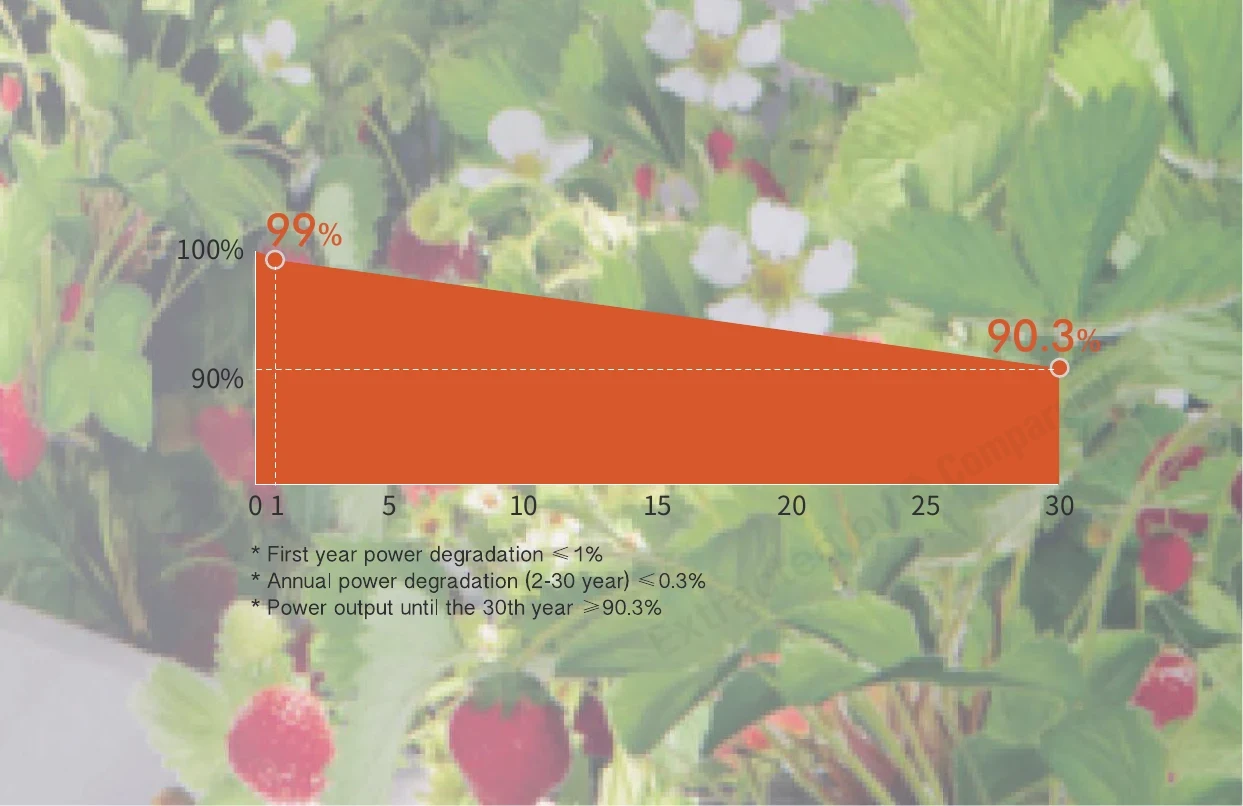
End-of-warranty output 90.3 % Equals 366 W guaranteed
Degradation 1.00 → 0.30 % First year, then annual

Datasheet charts

Open datasheet PDF

Measured curves published by Huasun in this model's datasheet. A chart carrying a wattage was measured on that variant alone - only the ones that describe 405 Wp appear here. The rest cover the whole series.
Simulations

Live - change any input
Lifetime output & value
30 years at 1200 kWh/kWp/year and €0.50 per kWh
Power in year 30
-
Lifetime energy
-
Energy value
-
With bifacial gain
-

Degradation from this panel's own datasheet figures. No inverter, soiling or shading losses.

Heat losses
-0.240 %/°C against a segment median of -0.240
-
Bifacial gain
Rear gain over light concrete: -
-

Model: bifaciality × albedo × 0.6 view factor. A first-order estimate, not a yield simulation.

Filter these
Size
Panel Power Eff. Temp. Weight Difference
Huasun HSN-210R-B88DSN405 405 W 15.00% -0.240 32.0 kg You are here
AIKO-455-MAH54Db 455 W 23.30% -0.260 24.0 kg +50 W, lighter, +8.3 pp
LR5-54HTH-455M 455 W 23.30% -0.290 20.8 kg +50 W, lighter, +8.3 pp
YL455CF54 e/2 455 W 23.30% -0.290 20.3 kg +50 W, lighter, +8.3 pp
ESM-455T 455 W 23.30% -0.310 21.0 kg Hotter, lighter, +8.3 pp
SE5-54HBC-455W 455 W 23.30% -0.290 20.8 kg +50 W, lighter, +8.3 pp
JST-EDMH-(445-465)W-TD (455W class) 455 W 23.30% -0.300 20.5 kg Hotter, lighter, +8.3 pp
LX-455M/182R-96+ GG 455 W 23.30% -0.260 23.5 kg +50 W, lighter, +8.3 pp
HSN-210R-B88DSN400 400 W 14.80% -0.240 32.0 kg Very close match
HSN-210R-B88DSN410 410 W 15.20% -0.240 32.0 kg Very close match
HSN-210R-B132DSU590 590 W 21.80% -0.240 35.3 kg +185 W, heavier, +6.8 pp
HSN-210R-B132DSU595 595 W 22.00% -0.240 35.3 kg +190 W, heavier, +7.0 pp
HSN-210R-B132DSU600 600 W 22.20% -0.240 35.3 kg +195 W, heavier, +7.2 pp
HSN-210R-B132DSU605 605 W 22.40% -0.240 35.3 kg +200 W, heavier, +7.4 pp
AIKO-A680-MDE72Mw 680 W 25.20% -0.260 29.0 kg +275 W, lighter, +10.2 pp
AIKO-A675-MDE72Mw 675 W 25.00% -0.260 29.0 kg +270 W, lighter, +10.0 pp
AIKO-A700-MAE78Dw 700 W 25.00% -0.260 34.5 kg +295 W, heavier, +10.0 pp

Found 1119 panels of the same or similar size to this one, within ±10 mm. See them here Found 1125 panels of the same or similar size to this one, within ±25 mm. See them here Found 1236 panels of the same or similar size to this one, within ±50 mm. See them here Found 1917 panels of the same or similar size to this one, within ±100 mm. See them here

Common questions

6 answered
What warranty does the Huasun HSN-210R-B88 come with and what does it cover?
The HSN-210R-B88 series includes a 15-year product warranty covering material and workmanship defects, plus a 30-year linear power output warranty. Huasun, rated Tier 1 by Bloomberg NEF, guarantees that power output will remain above 87% of nominal rating after 30 years. This is among the longest power warranties currently available and is especially attractive when calculating long-term return on investment.
Do Huasun HSN-210R-B88 HJT panels lose more efficiency in hot weather compared to TOPCon or PERC?
No, it is actually the opposite. The HJT technology used in the HSN-210R-B88 series delivers an exceptionally low temperature coefficient, typically around -0.24%/°C, versus roughly -0.30%/°C for TOPCon and -0.35%/°C for PERC. In practice, on a hot day when panel surface temperature reaches 70°C, HJT loses approximately 10–11% of output compared to 15–17% for PERC, resulting in meaningfully higher energy yield during summer months.
What does bifacial mean in the HSN-210R-B88 series and is it worth paying for?
Bifacial means the HSN-210R-B88 generates power from both the front and rear surfaces by capturing light reflected off the ground, a white roof membrane, or concrete. Rear-side gain typically ranges from 5 to 20% depending on the albedo of the surface below and the mounting angle. Ground-mount systems and flat roofs with light-colored membranes benefit most. On pitched residential roofs the gain is smaller but still measurable and adds up over a 25-year system life.
Are the Huasun HSN-210R-B88 panels susceptible to the LID effect, and how fast do they degrade?
The HSN-210R-B88 series is built on N-type HJT cells, which are completely immune to LID (Light Induced Degradation). Unlike older P-type PERC cells, there is no initial power drop after the first light exposure. Annual linear degradation is typically less than 0.4%, meaning the modules should retain more than 90% of their rated power after 25 years of operation, which is a key advantage in any long-term energy yield calculation.
How heavy is the Huasun HSN-210R-B88 module and can a standard roof structure support a full installation?
The G12R 88-cell format results in a compact module weighing approximately 21–23 kg, which is within the range of typical residential panels. Standard steel roof mounting systems are engineered for a load of at least 15 kg/m², and these modules fall well within that limit without requiring roof reinforcement. A structural assessment is still advisable for buildings older than 30 years or for installations larger than 10 kWp.
How do the G12R cells in the Huasun HSN-210R-B88 differ from standard G12 or M10 cells?
G12R cells are rectangular wafers (182×105 mm) cut from a full-size G12 wafer (210×210 mm). This format gives the HSN-210R-B88 higher power density and a better fit to the proportions of typical residential roofs compared to square G12 cells, while maintaining high operating currents. Compared to the widely used M10 format (182×182 mm), the G12R layout allows more efficient cell packing within the module and delivers higher module efficiency at a similar overall footprint.
Add to compare