
Light for its output, short guarantee
The First Solar Series 7 FT1 series redefines performance standards in photovoltaic farms, utilizing unique CdTe thin-film technology. Unlike traditional silicon modules, this solution offers significantly higher efficiency in real-world operating conditions, especially with limited sunlight and in high humidity. A key innovation is the optimized frame design, which eliminates the risk of mechanical stress and facilitates fast installation on large surfaces. These panels effectively solve the problem of power loss on hot days, as they are characterized by the lowest temperature coefficient on the market. By using a larger cell format, the FT1 series reduces structural BOS installation costs, making it an ideal choice for investors building commercial and industrial systems. The product also stands out from the competition through its exceptionally low carbon footprint and full recycling of end-of-life modules, aligning with rigorous sustainability requirements. This is an advanced tool for professionals seeking maximum energy yield from every square meter of land while maintaining the highest mechanical durability and parameter stability for decades.
Ranking
Signals from the data
Commercial, utility-scale and hot-climate.
Owners who want a long output guarantee.
Top 5% of the CdTe 440-640 W segment, against a median of 73.5. Ranked 13,298th in the whole database.
Top 11% of the CdTe 440-640 W segment, against a median of 18.60%.
Top 11% of the CdTe 440-640 W segment, against a median of 185.9.
Bottom 10% of the CdTe 440-640 W segment, against a median of 30 yrs. Ranked 9,798th in the whole database.
The Pmax temperature coefficient of the FT1 is -0.32%/°C (per the First Solar FT1 datasheet), compared to -0.40% to -0.45%/°C for standard mono-Si modules. At a module operating temperature of 70°C, this translates to approximately 4–6% higher energy yield relative to silicon — a critical advantage for utility-scale plants in continental climates during summer months.
The life-cycle carbon intensity of CdTe Series 7 technology is approximately 15.83 gCO2eq/kWh — up to 4× lower than c-Si modules produced from Chinese polysilicon. Series 7 was the first module on the market to achieve EPEAT Climate+ certification (threshold: ≤400 kg CO2e/kWp), satisfying ESG requirements and the eligibility criteria of green project bonds.
First Solar operates the only global end-of-life PV module recycling program, recovering 95% of materials — including glass, aluminum, steel, and the CdTe semiconductor. Annual recycling capacity stands at 88,000 metric tons (approximately 2.6 million modules per year). This eliminates end-of-life regulatory risk — a material consideration for infrastructure projects in the EU.
The optimized steel frame design allows mounting closer to the tracker rotation axis, enabling longer tracker rows and reducing the number of motors and dampeners required per MW. The manufacturer claims faster installation rates and lower BoS costs compared to Series 6 — a key competitive advantage on projects exceeding 50 MWp.
First Solar (founded 1999, HQ: USA) maintains Tier-1 BNEF status and full bankability for project finance. As of end-2024, nameplate manufacturing capacity stood at 9.4 GWdc/year, produced exclusively in the United States — reducing supply chain risk and exposure to Asian import tariffs, including AD/CVD duties.
The FT1's maximum module efficiency is 19.7%, while direct competitors in the 550 Wp segment achieve 21.28–21.3%: Goldi Solar GS10-B144-TF, IBC Solar 182M Half Cell, and S-Energy SL65-72BGJ. The ~1.6 percentage point gap requires approximately 8% more land area to deliver the same installed capacity — a tangible cost driver for projects with constrained or expensive sites.
The FT1 is a monofacial module (is_bifacial: false), whereas most modern mono-Si modules in the 550 Wp class offer bifacial gain of 10–20% depending on ground albedo. For ground-mounted systems over light-colored aggregate or snow-covered terrain, this results in a measurable energy yield deficit relative to bifacial competitors.
At 36.8 kg (±3.5 kg), the FT1 is significantly heavier than comparable mono-Si 550 Wp modules, which typically weigh 27–30 kg. This necessitates adapted HSE handling procedures, potentially mechanized installation aids, and heavier-duty mounting structures for certain ground-mount racking systems.
- At 19.3% efficiency, this panel is on par with typical CdTe 500-550W modules
- 193.1 W/m² power density - 5.4 W/m² more than CdTe 500-550W median (187.7 W/m²), more power per roof area
- Temperature coefficient of -0.32%/°C matches the CdTe 500-550W median
- At 36.8 kg, this panel is 2.9 kg lighter than CdTe 500-550W median (39.7 kg) - easier handling during installation
- Ranked #12799 out of 14005 panels for efficiency in the database
Specifications
Datasheet charts
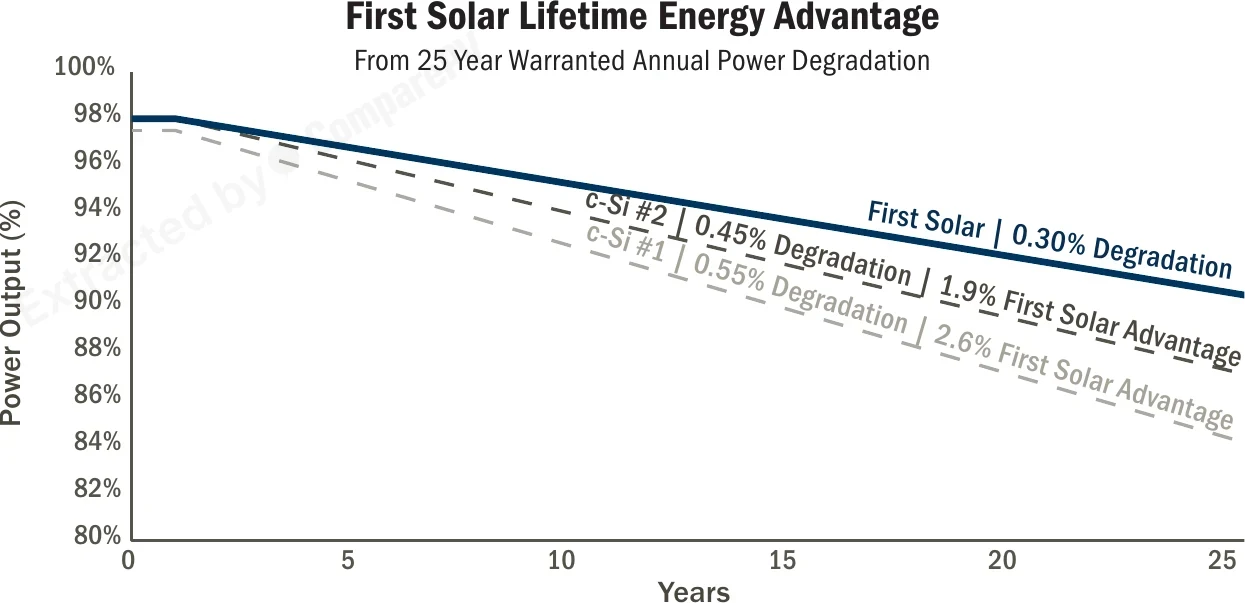
Measured curves published by First Solar in this model's datasheet. A chart carrying a wattage was measured on that variant alone - only the ones that describe 540 Wp appear here. The rest cover the whole series.
Simulations
Degradation from this panel's own datasheet figures. No inverter, soiling or shading losses.
Alternatives



Found 19 panels of the same or similar size to this one, within ±10 mm. See them here Found 19 panels of the same or similar size to this one, within ±25 mm. See them here Found 29 panels of the same or similar size to this one, within ±50 mm. See them here Found 4975 panels of the same or similar size to this one, within ±100 mm. See them here