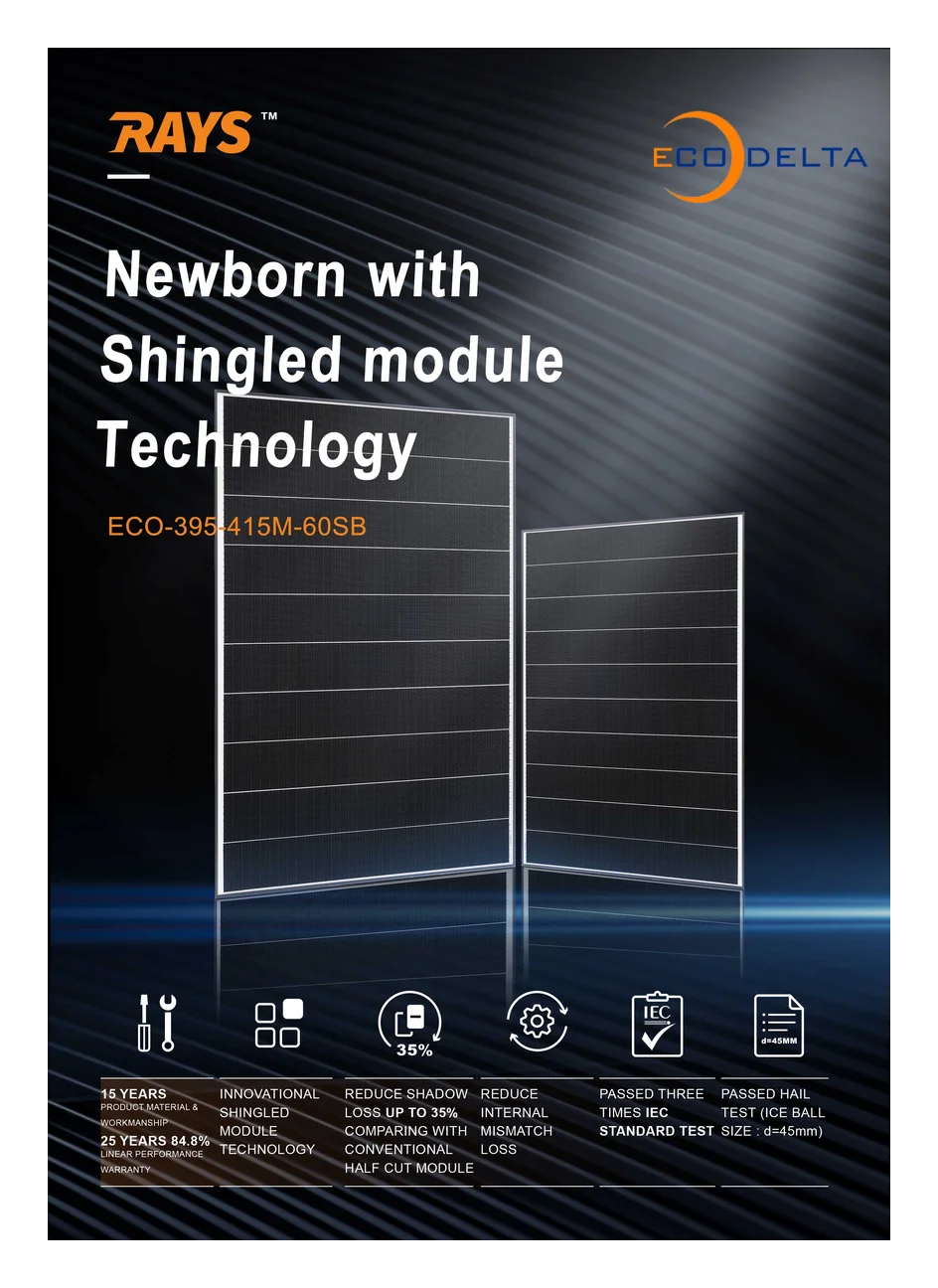
Strong in heat, no clear weak spot
The Ecodelta Rays series introduces a new quality to the Polish photovoltaic market, utilizing advanced shingled technology, which eliminates traditional busbars and minimizes gaps between cells. This design directly translates to higher power density and better module efficiency compared to classic solutions with busbar technology. These panels effectively solve the problem of performance drops caused by periodic shading, making them an ideal choice for complex roofs of single-family homes. The innovative construction reduces mechanical stress, providing increased resistance to micro-cracks and extreme weather conditions. For the investor, this means not only higher energy yields but also exceptional full-black aesthetics, where the uniform, dark surface of the modules blends perfectly with modern roofing. Ecodelta Rays stands out from the competition with a reduced risk of hot-spots, which guarantees the safety and longevity of the installation for decades. It is a product aimed at demanding users who expect a combination of technical innovation and elegance, looking for solutions with a low power degradation rate over time. Thanks to precise manufacturing, this series provides a solid foundation for any modern solar power plant, offering maximum return on investment while maintaining the highest visual standards.
Ranking
Signals from the data
Hot roofs and southern climates and weight-limited structures.
Top 15% of the PERC 350-400 W segment, against a median of -0.350.
Top 24% of the PERC 350-400 W segment, against a median of 55.8.
Two premium technologies combined in a single module: N-type TOPCon cells exhibit LID degradation below 0.25%/year and effective resistance to LeTID, while the shingled architecture using ECA adhesive instead of solder ribbon eliminates thermal stress and microcracks at interconnection points. The net result is a measurably lower annual degradation rate (~0.4%/year vs. ~0.55%/year for PERC).
Peak efficiency of 21.2% places the RAYS series directly alongside its peer comparables: AE Solar AURORA (21.28%) and Aptos Solar DNA (21.25%). The sub-0.1 percentage point difference is negligible in residential installations; however, on roof areas with limited space, RAYS delivers power density comparable to the leading 54-cell modules on the market.
Shingled cell technology eliminates visible metallic busbars, producing a uniform black surface with no premium charge for a dedicated all-black product line. For the residential segment with dark roof cladding, this represents a significant aesthetic advantage over conventional silver-framed modules.
Splitting cells into parallel-connected strips (shingled architecture) limits the weakest-link effect: localized shading from a chimney, roof window, or antenna affects only the shaded strip rather than the entire cell string. This is a tangible advantage over conventional half-cut PERC modules without power optimizers on complex roof layouts.
The 25-year linear power warranty aligns with the premium market standard and ensures predictable energy yield over the full investment horizon of a prosumer system (SPBT typically 7–12 years). The manufacturer has been active since 2002 (over 20 years), which reduces the risk of warrantor insolvency compared to newer brands.
A 15-year product warranty falls below the rising market standard – Jinko Solar Tiger Neo, Trina Vertex S+, and REC Alpha all offer 25-year product warranties. Over a 25-year investment horizon, the 10-year gap means no warranty coverage for potential module defects during the second half of the system's operational life.
The peer comparable LEDVANCE M395~415P54LM-BF-F3 (415 Wp, 21.25%) offers a bifacial construction, potentially generating an additional 5–15% yield on installations with high-albedo surfaces (white membrane, gravel, snow). The RAYS series does not offer a bifacial variant, which may be a limitation when optimizing ground-mount or flat-roof installations.
- At 20.2% efficiency, this panel is 0.8pp above typical PERC 0-400W modules (median: 19.4%)
- 201.6 W/m² power density - 7.2 W/m² more than PERC 0-400W median (194.4 W/m²), more power per roof area
- At -0.34%/°C, hot weather performance is typical for PERC 0-400W panels
- In the top 85% for efficiency among all PERC panels
Specifications
Simulations
Degradation from this panel's own datasheet figures. No inverter, soiling or shading losses.






Found 1746 panels of the same or similar size to this one, within ±10 mm. See them here Found 1902 panels of the same or similar size to this one, within ±25 mm. See them here Found 3386 panels of the same or similar size to this one, within ±50 mm. See them here Found 3817 panels of the same or similar size to this one, within ±100 mm. See them here